Table of Contents
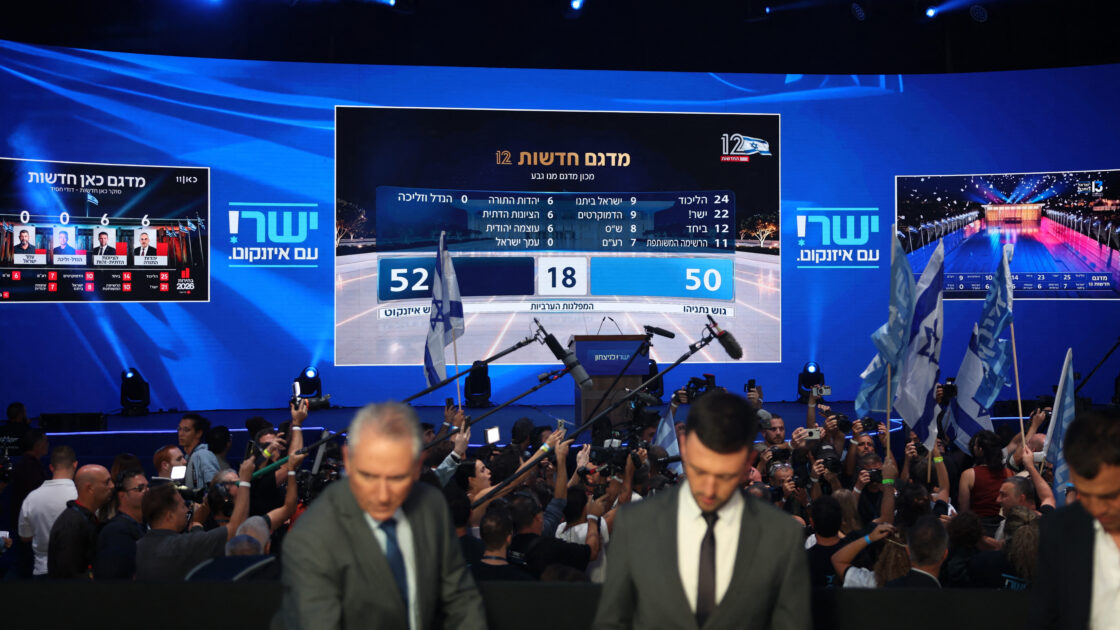
Partial results and exit polls from Israel’s parliamentary election show no clear winner, with neither the bloc led by Prime Minister Benjamin Netanyahu nor that of his main rival, Gadi Eisenkot, on a clear path to a governing majority. With just over 57 percent of votes counted early on Wednesday, Netanyahu’s right-wing coalition was on track to win 56 seats in the 120-seat parliament, while Eisenkot’s opposition bloc held 49 seats, according to tallies published by Israeli media.
Political Deadlock and Turnout
Either side would need 61 seats to form a majority government. Arab parties were projected to win 16 seats, which could give them significant leverage in forming the next government. The election is largely seen as a referendum on Netanyahu’s handling of the October 7, 2023 Hamas-led attacks and Israel’s ensuing war on Gaza, as well as the attacks on Lebanon and Iran. An inconclusive result would leave Israel in political limbo, allowing Netanyahu to remain in power in a caretaker capacity while parties try to forge a governing coalition.
According to two exit polls published by Israeli media after Tuesday’s vote, the two blocs were deadlocked on 51 seats, while a third exit poll showed Netanyahu’s bloc was three seats ahead. Netanyahu was defiant early on Wednesday, aiming to position himself to remain the country’s longest-serving prime minister. “We must establish a strong, right-wing, nationalist government,” said Netanyahu. “We must not endanger Israel and establish a government that relies on anti-Zionist Arab parties.”
Reactions from Political Leaders
Eisenkot stated that the exit polls showed a “lack of confidence” in the current prime minister. Yair Lapid, the current opposition leader, echoed the sentiment, stating that the Netanyahu bloc suffered a crushing defeat and a total collapse. Yair Golan, the leader of the opposition Democrats, said Israeli voters have fired the Netanyahu government and pledged to work with political partners to form a new administration. However, Gideon Saar, Israel’s foreign minister and a member of Netanyahu’s Likud party, said the opposition’s celebrations were premature and noted that Likud remains the largest party in Israel.
Netanyahu, the 77-year-old head of Likud, has served as prime minister for nearly 19 of the past 30 years and has repeatedly survived political crises. Meanwhile, at the headquarters of the Joint List, an alliance of Arab parties, supporters erupted in whistles and applause as the exit polls were published, capping a night of historic turnout among Palestinian citizens of Israel. Yousef Jabareen, leader of the Joint List, called the election a historic day and stated that the government of bloodshed must go. Mansour Abbas, the leader of Ra’am, or the United Arab List, also hailed the projected results, telling reporters that his party will transform the mandate into a new reality, as reported by Israel’s Channel 12.
Analyst Perspective and Voting Data
Ehab Jabareen, a Palestinian political analyst and researcher in Israel, told Al Jazeera that early exit poll projections show a clear weakening of Netanyahu’s bloc but cautioned against declaring either a Netanyahu victory or the end of his political career. He explained that while the exit polls suggest his bloc has lost its majority, they also indicate that his opponents face a difficult task in building one, and that Netanyahu could remain in office as caretaker if neither side can form a government.
Polling stations closed at 10pm local time on Tuesday. The Central Elections Committee reported that some 77.7 percent of eligible voters, representing more than 5.69 million of about 7.33 million voters, cast their ballots. This figure is about 7.1 percentage points higher than the 70.63 percent recorded in the 2022 election, marking the highest turnout in a Knesset election since 1999, when 78.7 percent of eligible voters participated. Earlier in the day, the committee rejected a request from Netanyahu’s Likud party to extend voting hours.