Table of Contents
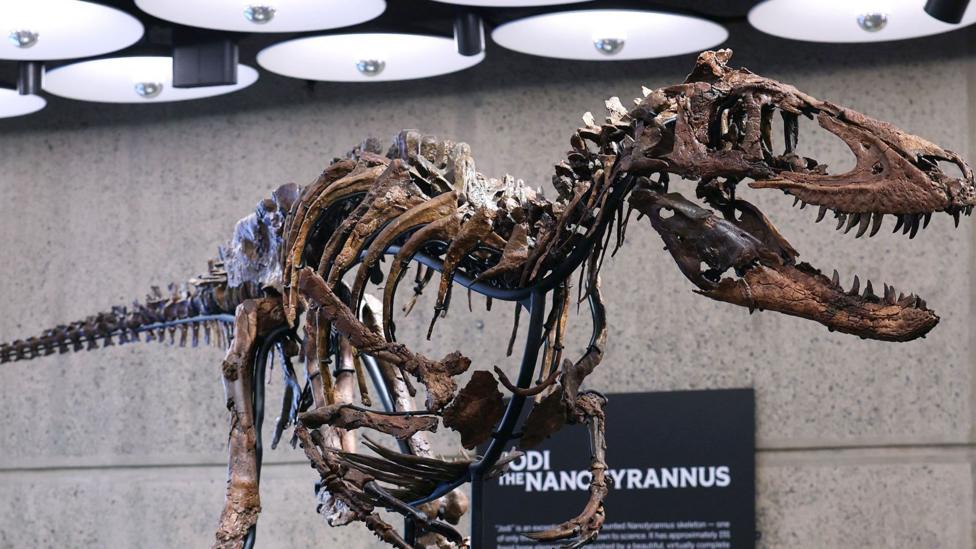
The mounted skeleton of a newly identified dinosaur once mistaken for a young Tyrannosaurus rex has sold at auction for a colossal $47.3 million. Nicknamed Jodi, the roughly 10-foot-tall skeleton was auctioned by Sotheby’s in New York following confirmation last year that it belongs to a distinct genus.
Auction Details and Rarity
The Late Cretaceous carnivore was expected to fetch at least $9 million when it went under the hammer on Tuesday. Sotheby’s described Jodi as an exhibition-ready skeleton featuring about 191 fossil-bone elements and a virtually complete skull. According to the auction house, the specimen is one of only three known to science and is the first to come to market since researchers confirmed the genus last October. The anonymous buyer won the fossil after 12 minutes of bidding among six interested parties.
The sale makes Jodi the second-most valuable dinosaur fossil ever sold, trailing only a T. rex dubbed Gus, which Sotheby’s sold for a record $50.1 million in July. The third-most valuable is a Stegosaurus named Apex, sold for $44.6 million in July 2024.
Discovery and Scientific Classification
Megan Jacobs, a palaeontologist at the University of Portsmouth, told BBC Radio 4’s Today programme that Nanotyrannus was long believed to be a T. rex teenager, though it is smaller, more slender, and features blade-like teeth for slicing meat. Both dinosaurs lived together about 67 million years ago. Jodi was initially exhibited as a juvenile T. rex at London’s Frieze Masters art fair in October 2023 before the classification changed.
Rancher Jodi Pierson discovered the skeleton on her land in the Hell Creek Formation in Montana, and commercial palaeontologist Clayton Phipps excavated it. Phipps also found the “Dueling Dinosaurs” fossil eight miles away in 2006, which proved crucial for researchers Lindsay Zanno and James Napoli to classify Nanotyrannus separately from T. rex and end decades of debate.
Scientific Debate Over Private Sales
The auction has reignited concerns among scientists that private sales to the ultra-rich could hinder research and public access. Prof Steve Brusatte, a palaeontologist at the University of Edinburgh, told the BBC that museums and universities cannot afford such price tags, comparing the situation to the Mona Lisa being hidden away from the public.
Responding to the latest sale, Brusatte called it harrowing that one of the best Nanotyrannus skeletons could vanish into a private collector’s vault instead of inspiring the public in a museum. However, Jacobs noted the other side of the debate, stating that the immense time, effort, and money required for excavation means she does not begrudge the sellers, adding that many specimens ultimately find their way into museums.