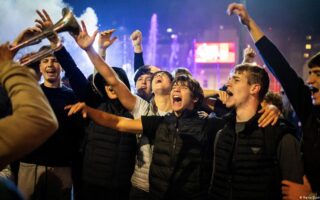
When Serbian President Aleksandar Vučić and Hungarian Prime Minister Viktor Orbán met in northern Serbia last November, neither could have imagined they would both be out of power within a year. Popular movements ousted both leaders, with Orbán falling first in April after a defeat by Péter Magyar’s Tisza party, followed last Sunday by a landslide victory for a student movement in Serbia’s parliamentary elections.
The Youth-Led Uprisings
While Hungary’s Tisza party centers on the personality of its leader, Serbia’s Student List insists it operates without leadership. However, tech-savvy young people drove massive voter turnouts of 79% in Hungary and 69% in Serbia. These youth utilized artificial intelligence tools to analyze data, spot voting threats, and deploy tens of thousands of election monitors to block intimidation and fraud by the governing parties.
Voter mobilization and election monitors proved crucial to opposition victories in both nations. Last weekend, Hungary’s DE civic action group sent 70 election monitors to Serbia to collaborate with student representatives at polling stations in the northern province of Vojvodina. These groups had previously held summer workshops to share methods and experiences from the Hungarian election with Serbian students.
A primary strategy involved identifying vulnerable polling districts beforehand where unusually high governing party votes in past elections hinted at voter intimidation or chain voting. Péter Klemm, a student activist from Subotica, told the BBC that volunteers noticed groups of masked Vučić supporters gathering near voting stations around 16:00 on election day, prompting them to dispatch mobile teams and film everything. Combined with stationary monitors, groups of 20 to 30 volunteers at each threatened site acted as a strong deterrent against fraud and intimidation, he believes.
Parallels in Power and Fall
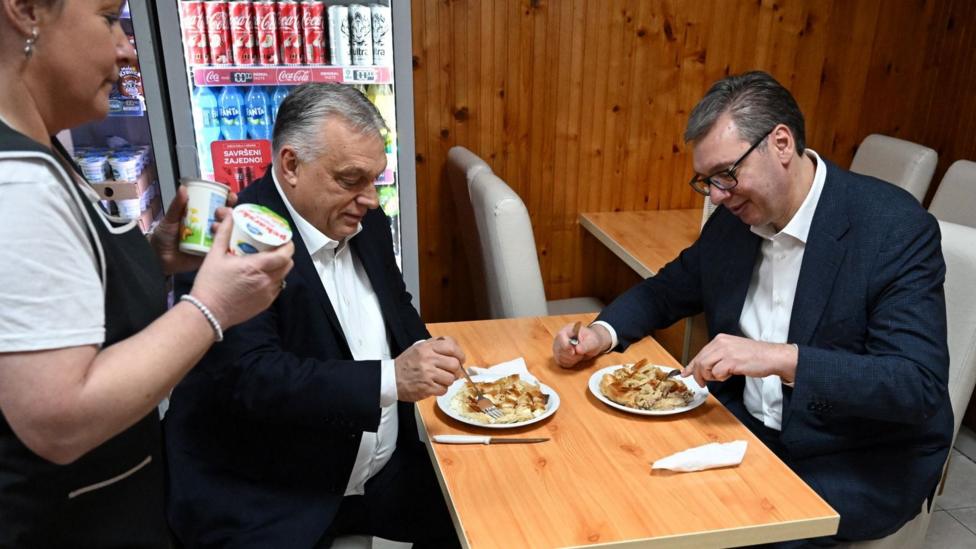
Before their downfalls, Orbán and Vučić appeared invincible. Having held office for 16 and 14 years respectively, both powerful leaders had seized control of state institutions and established overlapping business empires across the two countries. During their meeting in Subotica, the nationalist leaders shared traditional burek pastries at a bakery before visiting a winery to discuss oil deals, including a planned Hungarian purchase of Serbia’s Nis oil refinery. Both maintained close ties with Russian President Vladimir Putin, Chinese President Xi Jinping, and Bosnian Serb separatist leader Milorad Dodik, alongside a Chinese-financed high-speed railway project connecting Belgrade and Budapest.
The parallels extending into their ousters are striking, as Aleksandar Vučić conceded defeat at 21:30 on Sunday evening, mirroring Viktor Orbán’s concession on 12 April, as few observers anticipated either leader would step down peacefully. Speculation arose that Vučić spoke to Orbán twice on Sunday night for advice—once prior to his concession and again at 23:15—with Orbán allegedly convincing his Serbian ally against using force. Vučić denied speaking to Orbán before his announcement but confirmed the later conversation, while Orbán declined to comment when contacted by the BBC.
Numerical similarities also mark the two elections, as the Student List secured 140 seats in the 250-seat Serbian parliament, matching the exact number of seats Péter Magyar’s Tisza party won in the 199-seat Hungarian parliament. Magyar, who was the only European leader to call the students directly that evening to congratulate them, stated to the BBC that it is always positive to hear that the Tisza story can inspire other nations. Ilija Srdanoviċ, head of the Student List, noted on the eve of the vote that Hungary’s election result clearly demonstrated that their approach was correct, making him one of the individuals Magyar spoke with that Sunday evening.
Aftermath and Accountability
Both Orbán, 63, and Vučić, 56, now face potential prosecution for corruption and abuse of power. The judicial systems in both nations share similarities, with Serbia’s special prosecution service for organised crime, JTOK, and Hungary’s special prosecutors, NVVH, holding comparable powers that could prove mutually beneficial.
Hungarian companies aligned with Orbán were also involved in the Novi Sad railway station construction project. The collapse of the station’s canopy on 1 November 2024 killed 16 people—an incident blamed on both corruption and negligence that ultimately ignited the Serbian student movement. Áron Timar, founder of the DE civic action group in Hungary, told the BBC that a European perception existed that the Orbán and Vučić regimes strengthened the longer they stayed in office, but in reality, they weakened until society found its voice and rose up unstoppable.