For years, Serbian President Aleksandar Vucic dominated the media spotlight and evening news broadcasts. However, following his defeat in the October 25 election to the Student List, the political landscape in Serbia has begun to shift rapidly.
The Fallout From the Election Defeat
During a press conference held before fewer microphones than usual, Vucic accused the election winners of practicing “revolutionary terror.” He warned that if state authorities failed to act against beatings and destruction, his side would be forced to organize themselves. Vucic pointed to the immediate resignation of the Serbian state broadcaster RTS general director and senior editors as examples of this pressure. Additionally, a small group of protesters entered the Informer TV station, prompting journalists’ associations to demand the revocation of its broadcasting license due to its history of demonizing critics, while other pro-Vucic tabloids have softened their tone.
The Student List, comprising professors, activists, and artists born out of student protests, secured 53% of the vote on October 25, leaving Vucic’s Serbian Progressive Party (SNS) behind with 39%. Citizens across many cities have peacefully removed portraits of Vucic from municipal buildings. Meanwhile, the public prosecutor’s office for organized crime initiated investigations into electoral fraud, and a special commission is reviewing the Higher Public Prosecutor’s Office in Belgrade, which critics accuse of previously shielding Vucic and targeting his opponents.
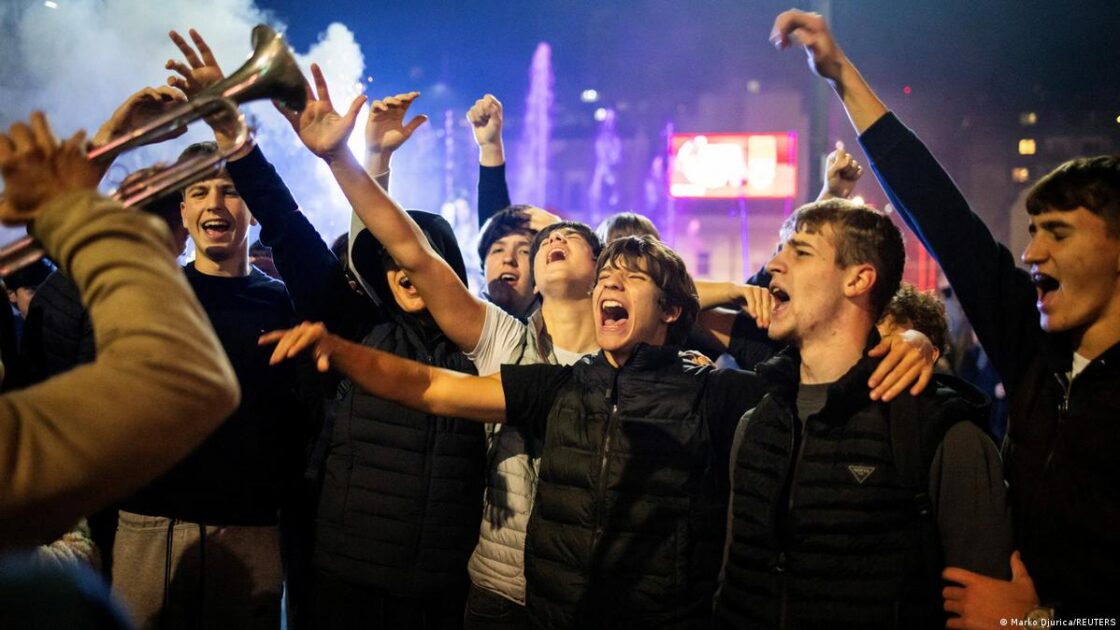
The revolt was ultimately catalyzed by the tragic collapse of a concrete canopy at the newly renovated Novi Sad railway station two years ago, which caused 16 deaths and was widely attributed to corruption and poor workmanship. Despite their recent electoral success, citizens celebrating in the streets are already growing impatient as the new parliament has yet to convene and the SNS retains multiple levers of power.
Dejan Bursac from the Institute for Philosophy and Social Theory at Belgrade University told Deutsche Welle (DW) that a society oppressed for a long period naturally expects justice, noting that people are growing restless in the current power vacuum. While Vucic and his allies plan to act as a strong opposition and await a political comeback, critics are demanding thorough investigations and criminal charges against members of the outgoing administration.
Navigating the Transition and Foreign Policy
Political shifting is common in Serbia, with politicians frequently migrating toward power. Zlatko Minic from Transparency Serbia told DW that many former loyalists are already distancing themselves, resigning, or positioning themselves as informants for the incoming administration. Minic warned that the outgoing government still retains opportunities to award financial obligations and contracts before leaving office.
Despite these lingering risks, the Student List has maintained contacts with police and administrative officials who opposed Vucic’s governance style. The group recently demanded further resignations within the police and judiciary, while urging whistleblowers to report any attempts by outgoing officials to destroy official documents.
In a symbolic gesture, Student List representatives held their first press conference in Pioneers Park in front of the parliament building. The park had been fenced off in 2025 by Vucic’s followers as an encampment that investigators say served as a base for anti-government attacks, and supporters of the Student List promptly cleaned the area following their election victory.
The victorious coalition brings together left- and right-wing groups alongside pro-European and pro-Russian factions, focusing heavily on domestic reforms and European Union accession. Oliver Toskovic, a psychology professor and future member of parliament, told DW that the new government plans to stabilize the nation rather than pursue abrupt foreign policy shifts. Toskovic noted that while reliance on Russian energy remains a challenge inherited from the previous administration, implementing immediate sanctions would destabilize the country. Furthermore, leading figures of the Student List have pledged to ease regional tensions, with lead candidate Ilija Srdanovic expressing openness to dialogue with Pristina and holding a phone conversation with Croatia’s prime minister.
The electoral process remains ongoing, with a repeat vote scheduled for Sunday, November 1, at approximately 50 polling stations due to initial irregularities. Parliament will convene once these ballots are officially counted.