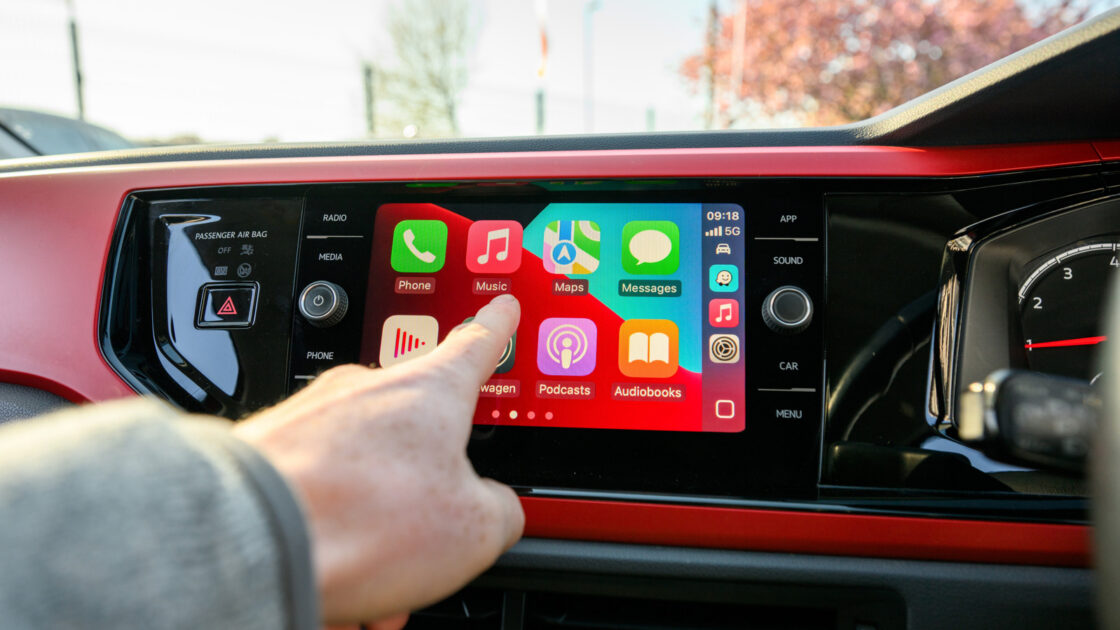
Navigating and listening to music is far better via CarPlay than mounting your phone or relying on your memory and the radio. However, you have probably noticed that most apps on your iPhone do not appear in CarPlay.
The Restrictions and Guidelines Behind CarPlay Apps
For an app to work on CarPlay, developers must specifically add support for it. Because an interface designed for a phone must be simplified for a dashboard display, there is no automatic conversion. If a developer lacks the time, money, or inclination, the app will not appear on the vehicle screen.
Beyond this, developers must follow strict CarPlay guidelines set by Apple. Only specific categories of apps are permitted, mostly focusing on driving essentials such as navigation, parking, electric vehicle charging, audio, communications, public safety, and quick food ordering. Apple permits only interface flows that it considers meaningful for use while driving.
Apple enforces a ban on several categories, including social media and games. Even permitted apps must adhere to narrow policies, such as hiding message contents, while music apps are strictly prohibited from showing lyrics despite some existing workarounds.
Future Changes and Evolving CarPlay Features
Apple has introduced new functionality to CarPlay, including access to artificial intelligence voice assistants like Perplexity and ChatGPT, complementing the dedicated Siri AI app and native integration.
Support for video apps represents a major update for drivers, though playback is restricted strictly to times when the vehicle is parked. Because many infotainment systems lack video playback capabilities entirely, compatible video apps remain hidden in those vehicles, leading to slow adoption among developers. Additionally, CarPlay now supports widgets, allowing users to glance at information from apps that otherwise lack full CarPlay integration.
The future scope of CarPlay remains uncertain, particularly as some car manufacturers decide to drop the software. Automakers such as Rivian and Tesla utilize fast processors and large screens to deliver complete in-vehicle entertainment systems, leaving drivers with standard CarPlay options feeling somewhat underwhelmed.