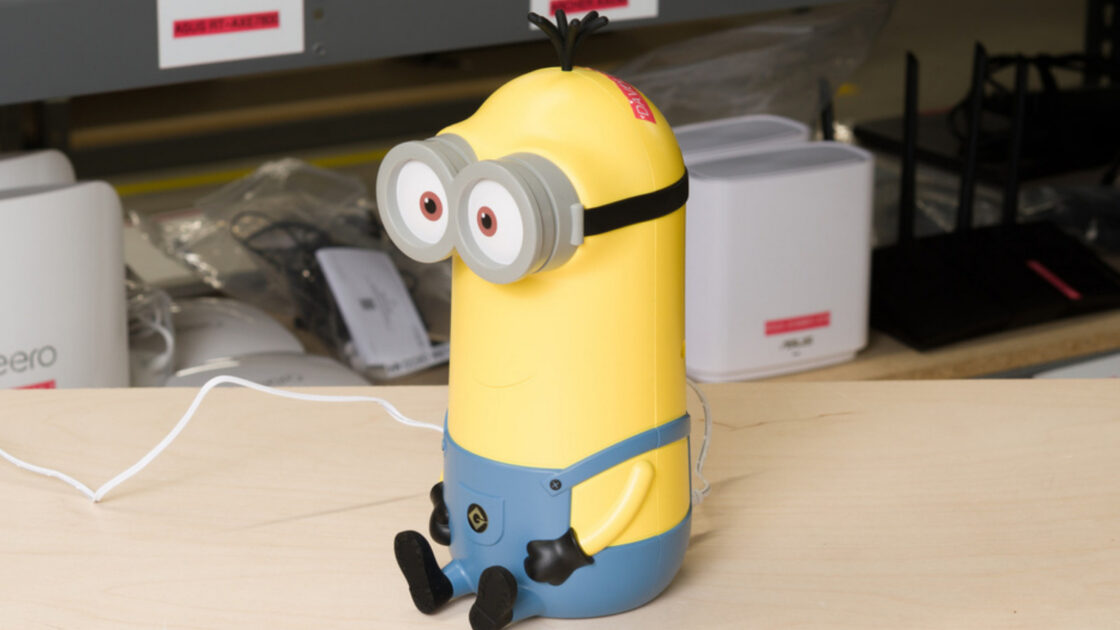
Viral Minions-shaped Wi-Fi routers produced by South Korean networking company Davolink have captured attention online, but they are now caught up in a strict US regulatory ban affecting foreign-made networking hardware. While the taller model named Kevin recently went viral on social media and quickly sold out on Amazon, future iterations and long-term support face significant hurdles under current American telecommunications policies.
Minions Routers Specifications and Features
Davolink originally showcased the devices at CES in January 2023 through an exclusive design agreement with Universal before launching them in South Korea that summer. The taller model, Kevin, is designated as the DVW-632 and stands 9.6 inches tall as a tri-band Wi-Fi 6E router equipped with a 2.5 Gbps WAN port, a single gigabit LAN port, WPA3 security, and mesh networking support. Its AXE5400 rating delivers 573 Mbps on the 2.4 GHz band alongside 2.4 Gbps on both the 5 GHz and 6 GHz bands. Meanwhile, the smaller Bob model, known as the DVW-642, functions as a dual-band Wi-Fi 6 router featuring a gigabit WAN port and a top speed rating of 1.77 Gbps.
The core business of Davolink involves supplying gateways and access points to major South Korean carriers including SK Broadband, KT, and LG Uplus. Within the US government vulnerability database, a single entry exists for a Davolink product—a 2018 severity flaw regarding a weak password on a DVW-3200N router, which was subsequently resolved via firmware.
Performance tests place Kevin’s AXE5400 capabilities in the same tier as TP-Link’s Archer AXE75. Testing comparisons indicate that the Minion router outperforms its competitor in both speed and range, though traditional models like the Archer offer four gigabit LAN ports compared to Kevin’s single port, which requires a separate network switch for multiple wired connections.
The Impact of the FCC Foreign Router Ban
The Federal Communications Commission incorporated routers produced abroad into its Covered List on March 23 following a national security determination issued by an interagency body convened by the White House. Law firm Wiley interprets the term “produced” to encompass major development stages such as design and development, regardless of a company’s home nation. Consequently, equipment placed on the Covered List cannot obtain the standard FCC authorization required for retail distribution in the United States.
Because Kevin and Bob received FCC authorization between November 2023 and February 2024, prior to the March listing, existing units remain legal to import, sell, and operate. However, future models like a potential Wi-Fi 7 Minion cannot enter the US market unless the manufacturer secures an exemption. Furthermore, the listing restricts modifications to authorized hardware, including software upgrades.
An FCC waiver currently permits security patches and compatibility fixes through at least January 1, 2029, ensuring affected devices receive critical updates until that deadline. If the agency decides not to formalize the waiver permanently, Davolink will be prohibited from patching Kevin and Bob after the end of 2028.
Exemptions, officially termed Conditional Approvals, can be issued by the Department of Defense or the Department of Homeland Security for up to 18 months. Securing these approvals requires manufacturers to reveal component and firmware origins, explain why production occurs overseas, and provide a timeline for moving manufacturing to the US alongside spending figures and progress reports. While brands like Netgear, Eero, and ASUS have successfully obtained approvals, Davolink has not disclosed whether it has applied for an exemption.