Scientists have long sought to understand the origins of the universe through various theories, including the Big Bang model, cosmic inflation, and quantum-cosmology proposals. To test these scientific ideas, researchers from the Center for Astrophysics, a collaboration between Harvard and the Smithsonian, created the Lumina Project to simulate the early universe on a scale larger than ever achieved before.
Supercomputer Scale and Detail
According to findings published in the Monthly Notices of the Royal Astronomical Society, the simulation models how regular matter, dark matter, and radiation interacted during the first 2 billion years of the universe. The modeled area spans a region equivalent to a cube roughly 1.5 billion light-years on each side, as reported by CNET. This surpasses the previous record holder, the 2022 Thesan simulation, which covered about a billion years across a 300-million-light-year cube.
The high level of detail in the simulation was driven largely by observations from NASA’s James Webb Space Telescope and other instruments that observe ancient celestial objects. The simulation itself ran on the Frontier supercomputer at Oak Ridge National Laboratory in Tennessee. Out of Frontier’s approximately 37,000 system GPUs, the Lumina Project utilized about 15,000.
The massive scale allows researchers to study complex cosmic events, such as helium reionization. After the universe cooled roughly 380,000 years after the Big Bang and atoms formed into regular hydrogen and helium, the first generation of stars emerged and emitted ultraviolet light that reionized nearby atoms.
“Lumina follows both hydrogen and helium reionization,” Justin Zier told CNET in an email, noting that the setup allows researchers to study the processes together in a self-consistent model where effects immediately influence the evolving universe. Aaron Smith, an assistant professor of physics at the University of Texas at Dallas and a paper author, stated in a release that the team can now follow how both elements changed into their modern form across an enormous volume while still resolving galaxies and luminous objects.
The simulation helps scientists test whether their physical understanding aligns with model results. The team has already used Lumina to predict that there were fewer massive galaxies in the early universe than James Webb Space Telescope observations suggest. The model also incorporates the mysterious small red dots spotted by the telescope, which some researchers believe are black hole stars.
Stunning Imagery and Visualizations
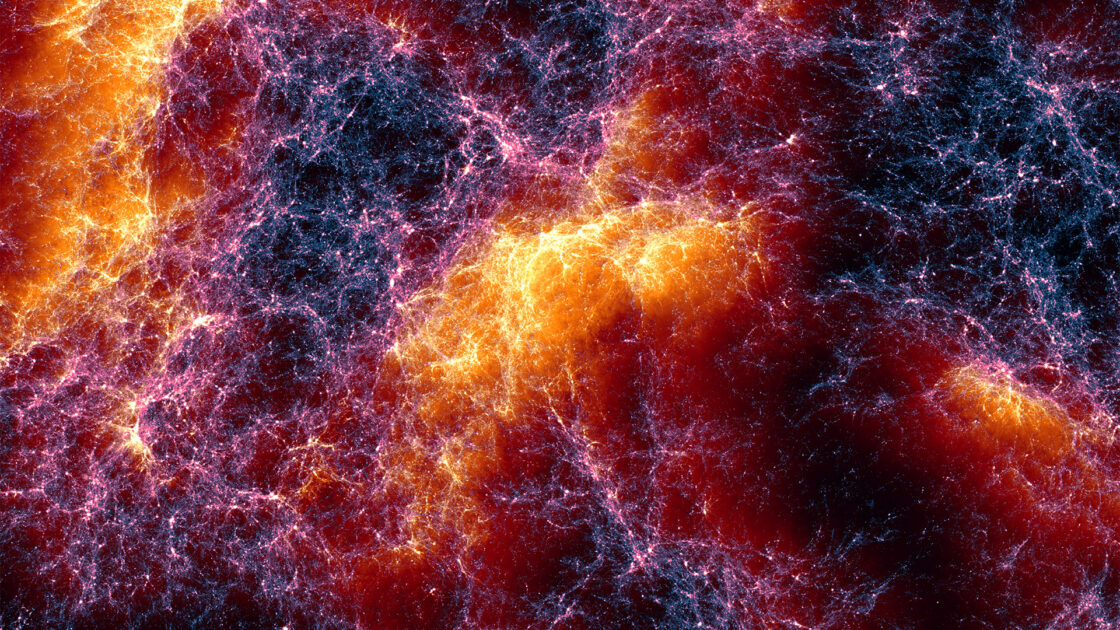
Beyond its scientific utility, the simulation produces detailed imagery showcasing early cosmic interactions, including mixing gases at various temperatures, chemical reactions, and the positions of early stars and galaxies. By mapping out dark matter and dark energy, the project generates complex visualizations featuring colorful clouds, threads, and filaments.
The project includes 15 distinct videos illustrating various elements, from gas densities to hydrogen and helium reionization. One video demonstrates the scale of the project by zooming from a wide shot of the entire simulation volume down to a single galaxy in empty space. Another video guides viewers through a massive halo, layering dark matter density, gas temperature, gas metallicity, and stellar light before stripping the layers away to reveal a cluster of galaxies.
The research team has made the full collection of visualization videos available to showcase the complex data and findings generated by the supercomputer model.