Table of Contents
Voters across South Africa are heading to the polls for municipal elections that will determine the control of the country’s largest cities. The vote serves as a major test for the African National Council (ANC), the leading party in the national government coalition, amid an ongoing electoral decline.
Deep-Rooted Frustrations and Voter Sentiments
In Tembisa, a township on the outskirts of Johannesburg, residents express vastly different views on participation. Some locals like Vatiswa Zoya have decided against voting entirely due to enduring hunger and hardship. Conversely, 22-year-old Lindokuhle Mbandazayo told Deutsche Welle (DW) that regular power outages and sewage in the streets drive her to the polls to demand local repairs.
Sanusha Naidu, an analyst at the Institute for Global Dialogue, stated to DW that this embedded frustration pushes people to vote to hold political parties accountable, though improvements will not happen overnight.
Key Issues: Water and Infrastructure
Water access remains a central voter concern as multiple regions face supply shortages and rationing. Ferrial Adam, executive director of the water rights NGO WaterCAN, told DW during a Johannesburg protest that half of South Africa’s drinking water systems are not fit for human consumption. Adam added that roughly 70% of wastewater treatment works are in critical condition, spilling sewage into rivers and streams nationwide. In Tshwane, a recent treatment failure left over 400 residents ill. Naidu noted that political candidates have offered transactional and superficial promises regarding water budgets and aging infrastructure without providing deep solutions.
Decline of the ANC and Political Shifts
Many voters blame the ANC for municipal failures after the party historically held outright majorities in most councils. The ANC secured 53.91% of the overall vote in 2016 across 161 of 213 councils, but that figure dropped to 45.59% and 122 councils in 2021. Global marketing research firm Ipsos predicts support could plunge to 30% in this election, potentially increasing coalition-run local governments.
Naidu explained that the ANC struggles to meet expectations of younger generations, including Millennials and Gen Z, who comprise most of the electorate. Mbandazayo, voting in her second election, noted she is considering alternative parties because the ruling party has failed to deliver results over long periods.
Migration and Campaign Debates
Immigration has emerged as a prominent campaign topic following months of protests regarding the asylum process. Digital analysis firm Murmur Intelligence reported that opposition groups such as Action SA, the MK Party, and the Patriotic Alliance have utilized immigration in their platforms. Aldu Cornelissen, co-founder of Murmur Intelligence, told DW that Action SA is positioned to benefit most from this sentiment by advocating for border protection and immigrant removal, estimating their potential gains between 6% and 8%.
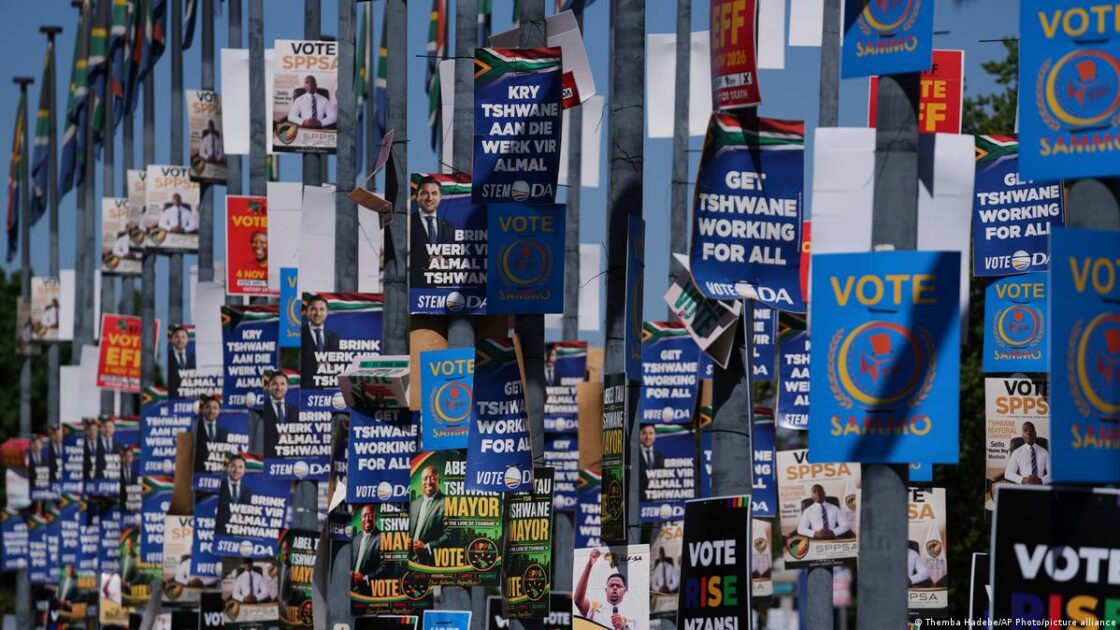
Despite narrow margins, a fragmented political landscape has intensified the competition. The Independent Electoral Commission (IEC) reported 136,760 candidates contesting nationwide, including 75 parties in Johannesburg, 70 in Tshwane, and 69 in eThekwini.
Misinformation and Turnout Impact
The IEC has investigated over 700 complaints of disinformation, including false claims that the ANC plans to mobilize asylum-seekers to vote. Legally, asylum-seekers, refugees, and permanent residents cannot vote in South African elections. William Bird, director of media monitoring agency Moxii Africa, told DW that disinformation targets hot-button issues and standard electoral tropes. Bird praised the IEC as a premier electoral-management body and noted that false narratives aim to destabilize or invoke fear, exacerbated by social media incentives.
Municipal election turnout historically trails national participation, dropping from 57.95% in 2016 to 45.87% in 2021. Voters receive two ballots: one for a direct local representative and another for a party under a proportional representation (PR) system. Naidu emphasized that voter turnout remains vital because PR seats comprise half of all council seats, directly influencing municipal control and the formation of upcoming coalition governments.