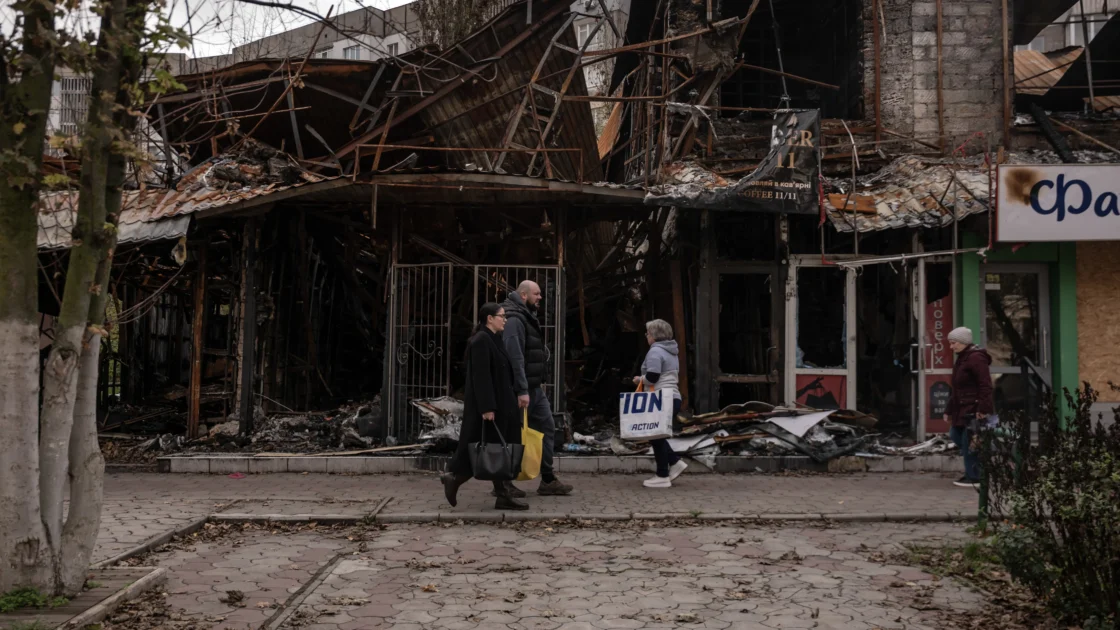
A brief ceasefire in Ukraine’s Kherson region provided residents with a rare pause from constant drone attacks, allowing people to walk the streets, visit cafes, and reunite with family. The truce, which lasted from Oct. 27 to Nov. 1, was negotiated by First Lady Melania Trump and Pope Leo XIV to help the nearby town of Oleshky.
A Temporary Return to Normal Life
In Kherson, best friends Olena Soboleva and Anna Herasimenko, both 21, took the opportunity to venture outside under autumnal skies clear of drones and guided bombs, as reported by NPR. “No drones, no explosions,” Soboleva stated. “No one wants to kill you.” The friends passed families, shoppers, and couples, and lined up at a cafe filled with cat paintings. “The city seems alive,” Herasimenko said, “just like it used to be.” Over the weekend, Herasimenko also visited a salon for a manicure, noting that the streets were full of people as they were in the past.
The truce ended Sunday night. Russia and Ukraine agreed to the pause to assist Oleshky, a town across the Dnipro River from Kherson that was occupied by Russian troops in 2022 and heavily mined. With food and medicine scarcely reaching the area, families of residents reported that their loved ones survived on pickles and boiled weeds. Hundreds of Oleshky residents were evacuated over the weekend and escorted on buses into northern Ukraine. Dmytro Lubinets, Ukraine’s human rights ombudsman, thanked Melania Trump for ensuring the ceasefire happened, expressing belief that such truces between Ukraine and Russia can be upheld and honored.
Respite Amid Ongoing Conflict
The short pause offered immense relief to Kherson, which Russian troops occupied for several months in 2022 before local partisans aided Ukrainian soldiers in forcing them out. Since 2024, Russian forces across the river have targeted Kherson residents with FPV drones carrying explosives, leading to highways and streets being shrouded in heavy mesh nets for protection. Despite the danger, cars arrived at the Greek-style monument marking the city’s gateway during the ceasefire. Svitlana Vorobiova, a retired police officer who now lives in a safer city, drove back with her children to take photos at the monument and visit her parents. “I brought my son with me,” Vorobiova explained, her voice breaking. “He hasn’t been here in four years. He said, ‘I cannot believe I’m in my hometown!'”
Volodymyr Mykolaienko, a former mayor of Kherson, strolled past a crushed administrative building during the truce as locals stopped to shake his hand. Mykolaienko, 66, spent years as a prisoner of war in Russia after being arrested during the 2022 occupation, enduring confinement, starvation, and torture before being released in a prisoner exchange last year. The temporary peace allowed him to visit his father’s grave in a part of the city typically unsafe due to drones. “I could not hold myself back,” he stated. “I was able to do exactly what I have long wanted to do — to talk to my father, pray, thank him for my life and to tell him what was happening to our city.”
At a busy bus stop, oncology nurse Olena Yehorova smiled at a man playing folk music on his accordion as people prepared for the end of the truce. “This truce has been such a relief,” she said. “The people in our city have been able to breathe. Of course, we still walk around with caution, because you cannot trust the Russians.”