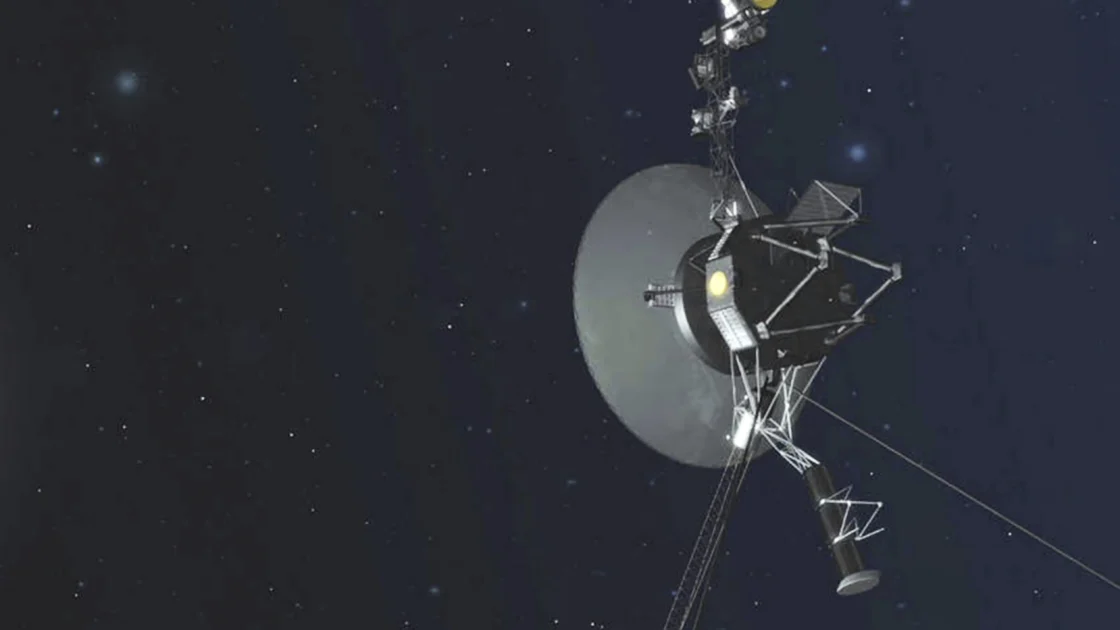
NASA’s Voyager 1 has traveled farther than any other human-made object sent into space and is set to reach a milestone of being one light-day away from Earth on Wednesday. To celebrate the occasion, NASA is hosting a symbolic event called “Shine Bright for Voyager’s Light-Day” and asking the public to flash the spacecraft’s call sign in Morse code using lights.
A Journey Spanning Decades
A light-day represents the distance that light travels in a 24-hour period, which equals more than 16 billion miles. Launched on September 5, 1977, the spacecraft has been traveling for nearly 50 years.
During its long mission, Voyager 1 performed flybys of Jupiter and Saturn. It discovered a faint ring system around Jupiter in 1979 and captured detailed photographs of the rings and moons of Saturn in 1980.
On February 17, 1998, Voyager 1 surpassed the U.S. space probe Pioneer 10 to become the most distant human-made object in existence. Alongside its twin, Voyager 2, it remains one of only two spacecraft to operate outside the heliosphere, the protective bubble surrounding the solar system.
Continuing the Interstellar Mission
Voyager 1 crossed the interstellar boundary in 2012, and its ongoing mission involves charting and measuring magnetic fields, particles, and plasma waves beyond the sun’s influence.
NASA recently turned off the Low-energy Charged Particles experiment, known as the LECP, to conserve power and extend the operational life of the probe. The spacecraft currently operates two remaining science instruments to measure magnetic fields and listen for plasma waves.
Additionally, the spacecraft carries the Golden Record, an interstellar time capsule designed to share Earth’s story with any potential extraterrestrial life. The gold-plated record features 115 images, natural sounds like wind and surf, spoken greetings in 35 languages, and symbolic instructions on how to play the media.
Voyager 1 is projected to officially hit the light-day milestone at 5:16 a.m. Eastern Time on Wednesday, following 49 years, two months, and 11 days of space travel.