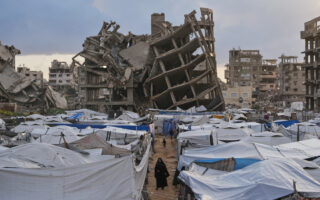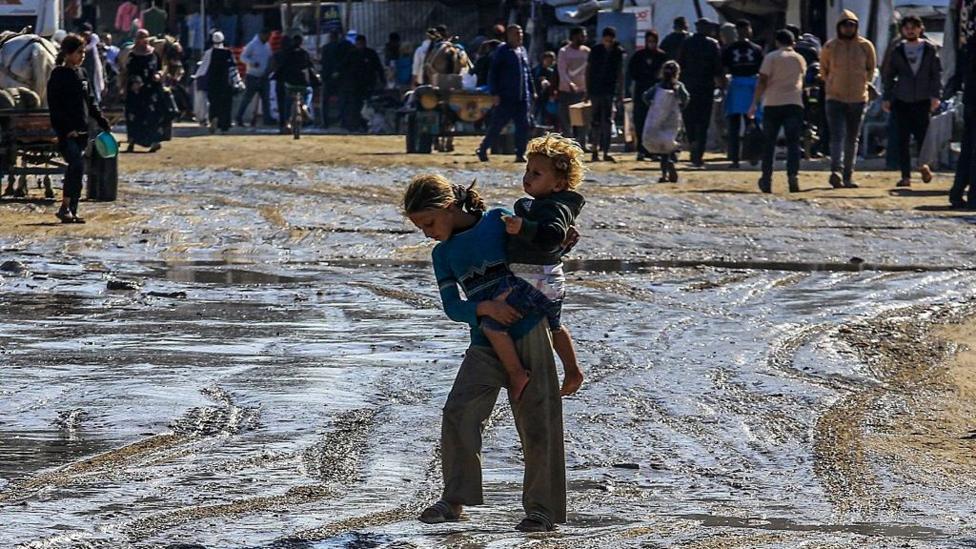
US President Donald Trump’s Board of Peace has urged Israel to immediately allow all necessary humanitarian supplies into Gaza after rain flooded tens of thousands of tents. The US-backed body, established to oversee the implementation of Trump’s Gaza peace plan, acknowledged steps being considered by Israel but stated that the current response remains insufficient.
Humanitarian Crisis and Flooding in Gaza
Heavy rains recently flooded tens of thousands of tents where displaced residents live. On Sunday, three children and a woman were killed when a sand embankment collapsed onto tents in the central Strip. The UN reports that about 65% of Gaza’s population, approximately 1.4 million people, live in tents or makeshift shelters due to displacement from Israeli military actions.
Speaking to the AFP news agency from Gaza City, Mohammed Jneid described being soaked as heavy rains struck from one side and sewage overflowed from the other. He stated they have nothing left, including bedding and food. Islam Al Mobayed told AFP from her tent housing seven children, five of them young, that life there is exhausting and not a real life.
In rare criticism of Israel, the Board of Peace stated it had been urging the Israeli government to authorise essential goods for temporary shelter, water, and sanitation infrastructure. The Board added that supply entry delays worsened a foreseeable humanitarian challenge and postponed the decommissioning of weapons and the transfer of Hamas authority to a transitional government. The Board also noted that Hamas’s failure to disarm and transfer power compounded civilian difficulties.
The UN’s humanitarian agency OCHA reported that more than 150,000 tents are outside Gaza ready for entry, but efforts face constraints from Israeli restrictions on supplies and equipment alongside funding shortfalls. UN humanitarian coordinator Ramiz Alakbarov stated on Monday that essential shelter and winter stocks inside Gaza are completely exhausted, urging Israeli authorities to immediately lift all restrictions because time has run out.
Responses from Israel and Hamas
Israeli foreign ministry spokeswoman Michal Maayan stated on Monday that Israel implemented a winter plan in recent months alongside the Board of Peace and international charities. According to Cogat, the Israeli military body responsible for aid, that plan delivered more than 91,000 tents and over 8,200 trucks containing tarpaulins, blankets, winter clothing, and other equipment. Cogat stated it will not allow equipment that could serve military purposes.
Maayan accused Hamas of hoarding aid, stating that Hamas is responsible for delays in making progress and that winter hardships result from Hamas actions and policies. Israel’s military agency in charge of co-ordinating aid added that reconstruction can only begin after Hamas fully disarms.
In response, Hamas released a statement via Palestinian media asserting that the Board’s comments present a distorted account of the disaster’s causes. Hamas denied responsibility for ceasefire delays, referencing an August statement from Egyptian, Qatari, and Turkish mediators that blamed Israel for violations. Hamas stated that Israeli restrictions prevent materials needed for shelter and recovery, adding that the Board should examine its own serious shortcomings.
The October 2025 deal to end the two-year-long war involved Hamas agreeing to surrender governance and weapons in exchange for a phased Israeli troop withdrawal from the 60% of Gaza it still occupied. However, Israel insisted that Hamas must fully disarm before any withdrawal occurs. This dispute has stalled the peace plan’s next stages, with both sides attributing blame to each other as the conflict’s background spans from the 7 October 2023 attack that killed 1,200 people and resulted in 251 hostages, followed by an Israeli military campaign that has killed 74,645 people according to the Hamas-run health ministry.