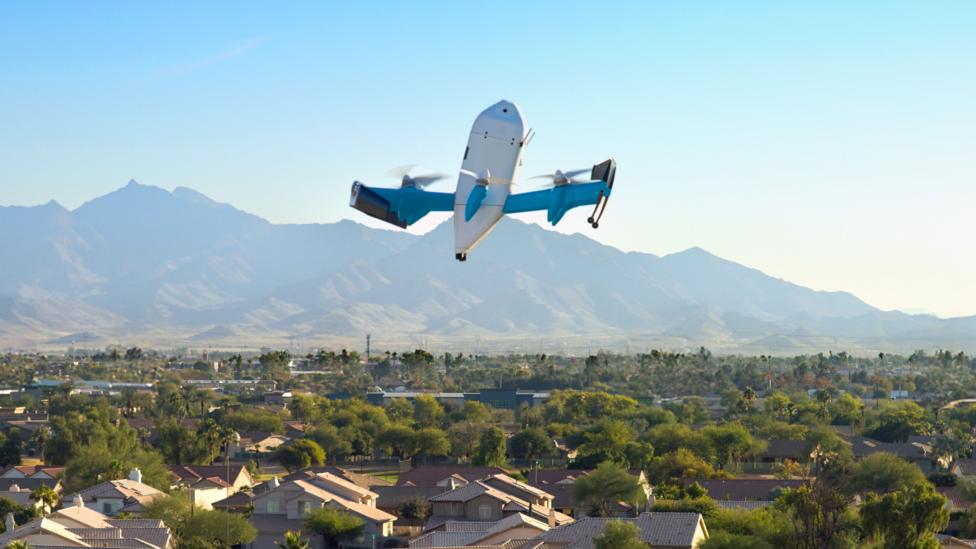
Home delivery drones are becoming an everyday reality in many communities, but the rising popularity of aerial drop-offs has sparked growing complaints from residents over a persistent and irritating buzz. Nature lover Ashley Schmidt from North Garland, Texas, stopped cycling to local parks and avoids spending time in her garden because she cannot stand the sound of online order delivery drones flying overhead. Schmidt describes the sound as an annoying buzz that triggers her fight or flight response, noting that she can hear the aircraft approaching, passing directly overhead, and departing.
The Noise Problem of Low-Altitude Flight
As reported by BBC News, delivery services operated by companies like Amazon and Walmart are expanding rapidly to speed up home deliveries. Amazon Prime Air is working to expand deliveries to nearly 500 cities and towns in the US, alongside a launch in Darlington, northern England, while smaller drone services deliver local food treats in various cities. Although traffic noise often blends into the background, the sudden whine of drone rotors cuts through the daily hum. Antonio Torija Martinez, a professor in acoustic engineering and psychoacoustics at the University of Salford, explains that the sound is particularly noticeable even when general sound levels are low. Because drones operate at low altitudes directly over residential areas, they expose communities unaccustomed to aircraft noise to a novel, intrusive, and frequent sound source. While people who benefit from these services may mind the noise less, complaints are expected to grow as the sector expands. The Federal Aviation Administration regulates commercial drones in the US, but critics argue it allows overly noisy operations, while the agency maintains that operators and local leaders hold primary responsibility for community concerns.
Engineering Quieter Propellers
Startups and major companies are working on technology to muffle the irritating drone buzz. London-based startup Greenjets has designed a propulsion system that encloses spinning blades inside a pod to muffle sound and direct noise away from the ground, utilizing slower rotor speeds and vibration-reducing materials to cut noise by at least two thirds. Darren James, future technologies lead at Greenjets, notes the company set out to tackle both noise level and frequency. Beyond civilian delivery, this low-noise technology has utility for German police and harbour security teams, African conservationists tracking poachers undetected, and experimental US Special Forces units. However, Robert Tollast, a research fellow at the Whitehall think tank RUSI, points out that speed often takes priority over stealth for larger military drones used in Ukraine.
For Detroit-based entrepreneur Greg Sharrow, the journey to quieter drone design began in 2012 when filming a violinist required a silent aerial camera angle. Realizing that propeller tips slicing through the air generated most of the noise, Sharrow developed a tipless propeller featuring twisted loop-shaped blades. After initial testing in water with boat propellers, Sharrow Engineering is now focusing on ultra-quiet drone rotors that have been validated to work and operate dramatically quieter.
Meanwhile, major delivery operators report progress in reducing acoustic footprints. An Amazon spokesperson stated that the company has achieved measurable sound improvements, using custom-designed propellers in its latest models that produce nearly half the perceived sound of previous generations with a milder tone. Wing, the drone maker supplying Walmart deliveries, designs propellers to minimize noise and varies flight paths to prevent repeated overflights over individual homes. Despite these technological improvements, residents like Schmidt desire a complete halt to drone deliveries in residential areas until the nuisance is fully resolved.