Table of Contents
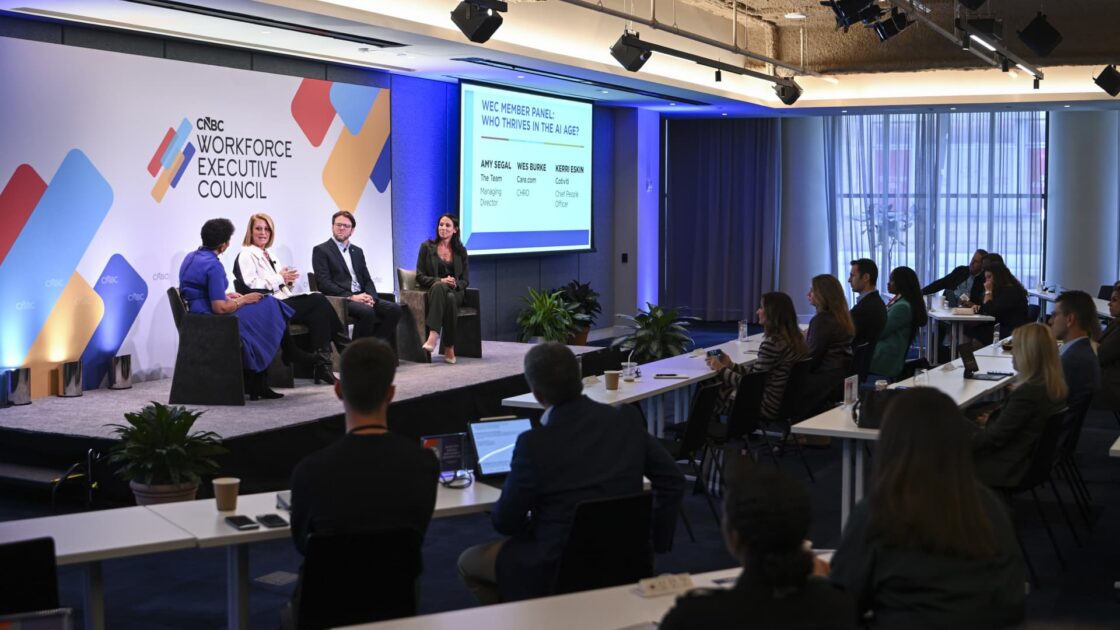
The 2026 CNBC Workforce Executive Council Summit in New York City brought together industry leaders, executives, and policymakers to discuss the sweeping impacts of artificial intelligence on employment, workplace culture, and company benefits. As companies navigate the rapid integration of advanced technologies, discussions centered on managing worker confidence, shifting hiring criteria, and addressing rising healthcare and financial strains.
Walmart’s AI Training Boosts Associate Confidence
As enterprise AI investments expand, companies are evaluating how employees experience the technology. Walmart surveyed its 2.1 million associates in June, gathering over 1.7 million responses to understand their comfort levels with artificial intelligence. Maren Waggoner, Walmart Chief People Officer for Associate Experience and Digital, told US Top News and Analysis (cnbc.com) that 77% of office-based associates and 84% of U.S. frontline associates feel confident using digital and AI tools.
Walmart has partnered with Google and OpenAI over the past 13 months to provide at-cost-free learning and certification programs. Waggoner stated that associates who completed OpenAI training reported a 27% confidence gain. This contrasts with broader national trends, where a Pew Research Center poll in August showed 52% of U.S. adults feel more concerned than excited about AI.
Waggoner explained that Walmart aims to use robotics and automation to reduce physical friction while focusing human labor on judgment and customer service. At an innovation lab in Dallas, Texas, automated tasks have generated quality assurance roles rather than massive job cuts. Furthermore, Waggoner noted that frontline customers still prefer interacting with human cashiers, allowing associates to leverage AI tools for problem-solving, such as a store manager in Mexico who built an AI agent to drive fresh produce sales.
Shifting Hiring Practices and Workplace Strategy
According to former LinkedIn chief human resources officer Steve Cadigan, companies must fundamentally alter how they evaluate new talent as AI alters job scopes. Cadigan told US Top News and Analysis (cnbc.com) that the hiring focus over the next five years will center on adaptability rather than existing knowledge.
“Do I have a high belief in your ability to adapt? I think that’s what we’re going to start to look for,” Cadigan said.
Cadigan also warned that organizations frequently make the mistake of using old tech playbooks merely to accelerate tasks and cut costs, arguing that AI’s true value lies in creative expansion. He criticized the frequent use of the term “digital transformation,” noting it often signals impending job cuts and damages employee trust. Instead, he urged organizations to promise professional growth and development.
Meanwhile, major corporations are reshaping headcounts as AI automates internal operations. Microsoft announced voluntary buyouts for 60,000 employees following previous job reductions, while American Express stated it is cutting 5% of its global workforce to streamline processes. Barclays and Qualcomm have similarly announced staff reductions driven by technology integration and shifts toward AI infrastructure.
Financial Strain and On-Demand Pay Solutions
With many Americans living paycheck-to-paycheck amid high inflation for everyday essentials, employee priorities have shifted toward immediate financial security. DailyPay CEO Nelson Chai told US Top News and Analysis (cnbc.com) that workers care most about timely compensation rather than peripheral perks like gym memberships.
DailyPay partners with over 2,000 large companies to offer earned wage access, allowing employees to withdraw money they have already earned ahead of regular paydays via debit cards, ACH transfers, or bank deposits. Chai noted that this model helps workers manage financial strain caused by the rising costs of groceries, gas, and utilities.
Evolving Healthcare Costs and Wellness Markets
Healthcare expenses continue to climb, with employer costs projected to rise between 8.2% and 9.5% in 2027, according to consulting firms Marsh and Aon. KFF data shows that deductibles and family premiums have outpaced overall inflation over the past decade, prompting roughly 59% of employers to plan cost-cutting adjustments to health benefits.
James Lucania, HealthEquity CFO, told US Top News and Analysis (cnbc.com) that the market is transitioning toward a wellness spending model. Lucania explained that consumers increasingly manage preventive health, diagnostics, and functional wellness out of pocket or via tax-advantaged accounts like HSAs and FSAs, while traditional insurance will likely evolve to cover intensive medical interventions and hospital care.
City-Level Oversight Amid Federal Inaction
As debates over federal oversight continue following a voluntary accord signed in Washington, local governments are stepping up regulatory efforts. New York City Council Speaker Julie Menin recently led a legislative investigation where senior leaders from Anthropic, OpenAI, Google, and Meta testified regarding safety risks.
Menin told US Top News and Analysis (cnbc.com) that AI labs failed to answer fundamental safety questions regarding cataclysmic event risks and mandatory third-party validation checks. She emphasized that artificial intelligence cannot safely self-regulate and urged that municipalities implement smart safeguard rails to ensure accountability without stifling technological innovation.