Table of Contents
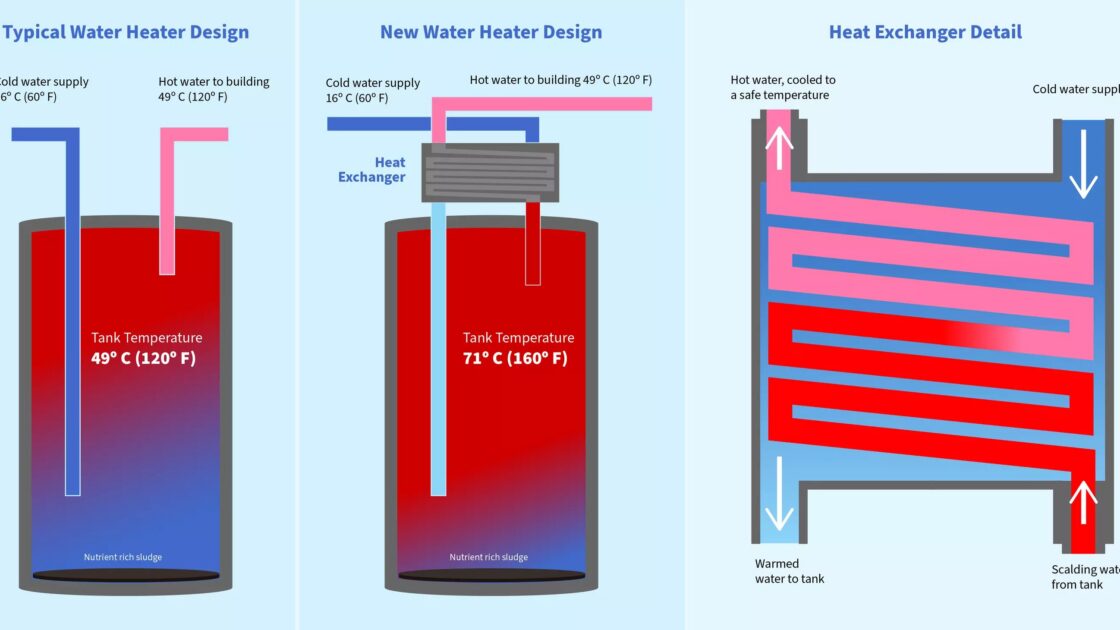
A new water heater design developed and patented by researchers at the National Institute of Standards and Technology aims to eliminate harmful bacteria inside the tank. The technology targets Legionella pneumophila, the pathogen responsible for Legionnaires’ disease, by raising tank temperatures to 160 degrees Fahrenheit.
How the New Design Works
Legionella bacteria thrive in warm water, surviving in standard tanks set to 120 degrees Fahrenheit and multiplying throughout home hot water pipes. While standard heaters can reach higher temperatures, those levels risk severe skin scalding at the faucet.
To solve this, the research team implemented an unmixed heat exchanger connecting the cold water inlet and the hot water outlet. As cold water enters the system, it receives a heating boost from the outgoing water while simultaneously cooling the exiting water to safe levels for household use. According to the Centers for Disease Control and Prevention, Legionnaires’ disease carries a fatality rate of approximately 10 percent.
Beyond eliminating pathogens, the process recaptures waste water heat and improves heating efficiency because the incoming water enters the tank at a higher temperature.
Inspiration From HVAC Technology
The unmixed heat exchanger concept shares similarities with technology found in refrigerators, air conditioners, and heat pumps. Air conditioners utilize heat exchangers during the refrigeration cycle to transfer heat between indoor and outdoor air, while heat pumps can use them for defrosting.
David Yashar, a NIST mechanical engineer behind the innovation, explained to CNET that his background in HVAC and refrigeration directly influenced the patent. Using an unmixed heat exchanger across the inlet and outlet served as a simple, effective, and inexpensive method to elevate the water temperature to the desired condition and lower it safely afterward.
Market Availability and Retrofitting
Although the research successfully proved the concept utilizing a 60-gallon tank, commercial availability depends on manufacturers licensing the technology and developing consumer-ready products, a timeline that could range from quick to several years.
When discussing retrofitting existing household models, Yashar told CNET that the modification involves hardware and control changes that might not be simple for current applications. Furthermore, retrofit tanks would require additional insulation because internal temperatures would run about 40 degrees hotter than standard systems, preventing excessive standby heat losses.