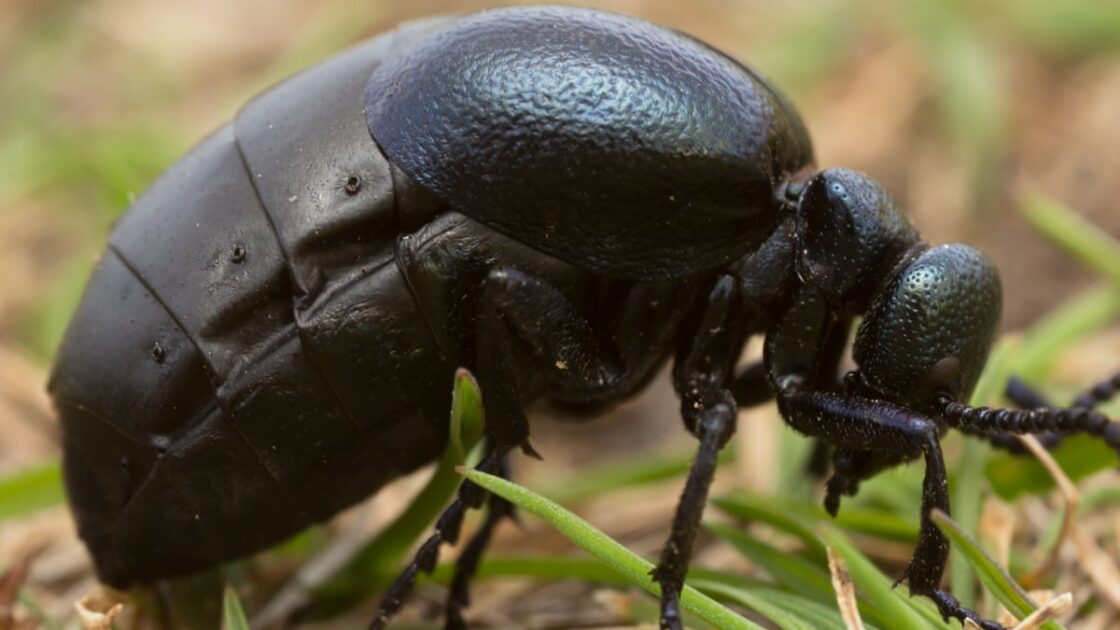
A rare beetle that secretes an oily substance from its knees when threatened has been rediscovered in Wales after nearly 60 years, conservationists have announced. Natural Resources Wales stated that the short-necked oil beetle was found at the Castlemartin range in Pembrokeshire, having nearly vanished from Britain during the 20th century due to habitat loss.
Unique Life Cycle and Rarity
The insect gets its name from its stubby physical shape and its defensive mechanism of releasing a yellow-orange fluid from its knee joints when disturbed. The specialized creature depends on solitary bees alongside dense vegetation and flower cover for survival. Its larvae feature hook-like feet designed to latch onto bees. Once inside a bee nest, the larvae feed on pollen until they emerge as adults, maintaining a lifespan of approximately one year.
Natural Resources Wales noted that only a small number of locations in the UK offer suitable conditions for the insect, with merely one in 10,000 larvae successfully reaching adulthood. The species is officially classified as nationally rare. Following its rediscovery in Devon in 2006, populations have also been identified in the Hebrides and on Salisbury Plain.
Surveys and Conservation Efforts
The conservation charity Buglife reported that the insect was first spotted at the Pembrokeshire location in 2020. However, subsequent surveys in 2022 and 2025 uncovered only dead adults, creating fears over the long-term viability of the population in that region. The 2026 survey ultimately found larvae distributed in a manner indicating that hatchlings from a substantial batch of immature beetles had successfully survived.
Anna Hobbs, project delivery officer for the Bumblebee Conservation Trust, described finding proof of active breeding as very exciting. She explained that the insect relies on precise habitats and the presence of solitary bees, requiring conservation work to account for multiple species. She expressed gratitude to partners and volunteers for their persistence following two years without any larval sightings.
The beetle project operates as part of Wales’s flagship species recovery initiative, Natur am Byth, which focuses on protecting various endangered plants and animals sharing similar habitats with the short-necked oil beetle, including the pale dog violet, goldilocks aster, and shrill carder bee. Project partners look forward to ongoing site management to ensure the survival of the species.