Table of Contents
NASA has released comprehensive technical specifications for its upcoming Artemis III spaceflight, which is scheduled to blast off during the summer of 2027. Rather than landing on the Moon, the four-person crew will ascend into low Earth orbit to perform docking operations with two experimental lunar landers developed by Jeff Bezos’ Blue Origin and Elon Musk’s SpaceX.
Complex Orbital Rehearsal Strategy
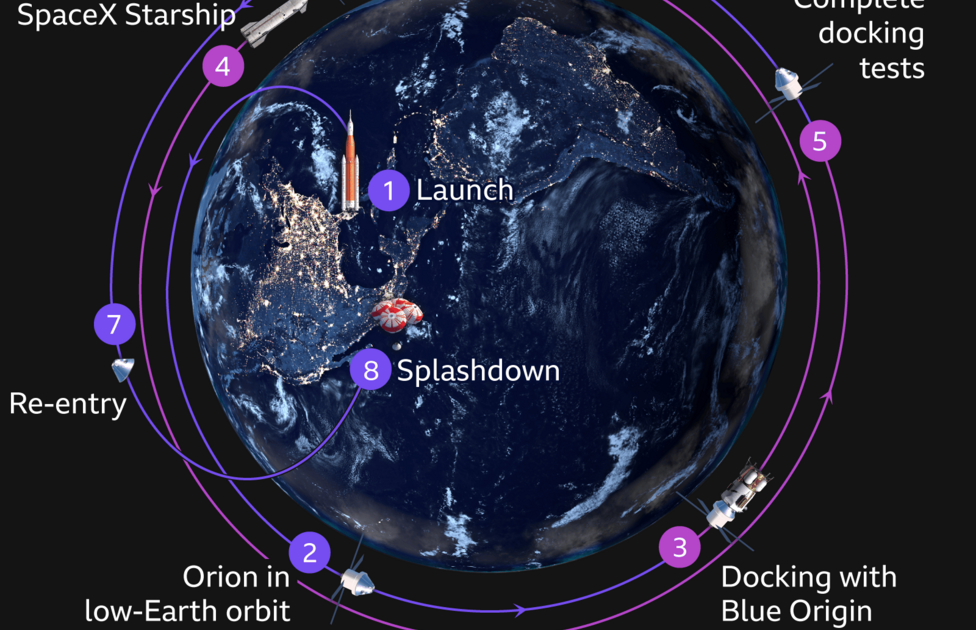
Described by the American space agency as its most intricate operation to date, Artemis III involves three separate rocket launches, three individual spacecraft, and two distinct docking maneuvers. The expedition will run for 14 days, with the flexibility to extend to 17 days if necessary. Blue Origin will initiate sequence operations by launching its New Glenn rocket from Florida, placing an uncrewed prototype lander named Blue Moon into orbit.
NASA will then launch its Space Launch System (SLS) rocket from the Kennedy Space Center, sending four astronauts into orbit aboard the Orion capsule. After taking two days to evaluate systems aboard Orion, the crew will dock with the Blue Moon craft on day three. The astronauts plan to enter the Blue Moon lander to inspect its interior hardware across a two-day period.
By day six of the flight, SpaceX will launch its massive Starship vehicle from Florida. The upper section, known as “the Ship,” will act as a secondary lander prototype, though it currently lacks life-support capabilities. Orion will detach from Blue Moon to execute a brief, two-hour docking test with Starship, though crew members will not board the SpaceX craft. The astronauts will spend the remainder of the fortnight performing flight experiments and evaluating Orion’s upgraded heat shield during re-entry.
Shift in Strategy and Crew Appointments
NASA altered its original goal of making Artemis III a crewed lunar landing in February 2026. The decision stemmed from delays in the development of SpaceX’s Starship lander and its untested in-orbit refueling process. A report released by the US Government Accountability Office in March 2026 cited limited progress regarding SpaceX’s refueling technology, with a initial trial tentatively set for late 2026. NASA repurposed Artemis III as a crewed docking rehearsal to prevent overall program delays.
NASA astronaut Randy Bresnik will command the Artemis III mission, joined by Italian Space Agency pilot Luca Parmitano, who brings over 300 days of spaceflight experience. Americans Andre Douglas and Frank Rubio will participate as mission specialists, while test pilot Bob Heintz has been assigned as the designated backup crew member.
Future Lunar Surface Base Plans
Following Artemis III, NASA aims to conduct Artemis IV in 2028 as the first crewed lunar landing since 1972. The astronauts plan to spend roughly a week exploring the Moon’s south polar region, where locked surface ice could provide drinking water, oxygen, and rocket propellant for future deep-space journeys.
However, technical setbacks continue to pose challenges. On May 28, 2026, an engine test explosion severely damaged Blue Origin’s primary launch pad at Cape Canaveral. NASA remains optimistic that repairs will finish between December 2026 and January 2027, keeping the timeline intact for Artemis III.
The overarching objective remains building a permanent presence on the Moon. Under a framework presented in May 2026 by NASA Administrator Jared Isaacman, the agency plans to deploy survey drones and robotic landers before 2029, expand crewed surface expeditions starting in 2029, and construct semi-permanent habitats by the mid-2030s.
Global Race for the Moon
Independent observers have raised doubts about NASA’s ability to maintain its timetable, citing slow hardware development schedules. The Open University’s Dr Simeon Barber told BBC News, “It would not surprise me at all if China gets [to the moon] first.” He highlighted that the complex lander technology remains the main architectural bottleneck outside NASA’s direct manufacturing control.
The previous test flight, Artemis II, launched on April 1, 2026, carrying Reid Wiseman, Victor Glover, Christina Koch, and Canadian astronaut Jeremy Hansen. The ten-day voyage took Orion 252,756 miles from Earth, flying around the far side of the Moon before safely splashing down off the San Diego coast on April 10, 2026.
Global space agencies are actively pursuing parallel lunar schedules. China plans to land crew members on the Moon by 2030 using its Mengzhou capsule and Long March 10 rocket. India aims for a human lunar landing by 2040, while Russia continues plans for a joint base with China targeted for the mid-2030s. Astronauts from Europe and Japan are expected to participate in future Artemis launches.