Table of Contents
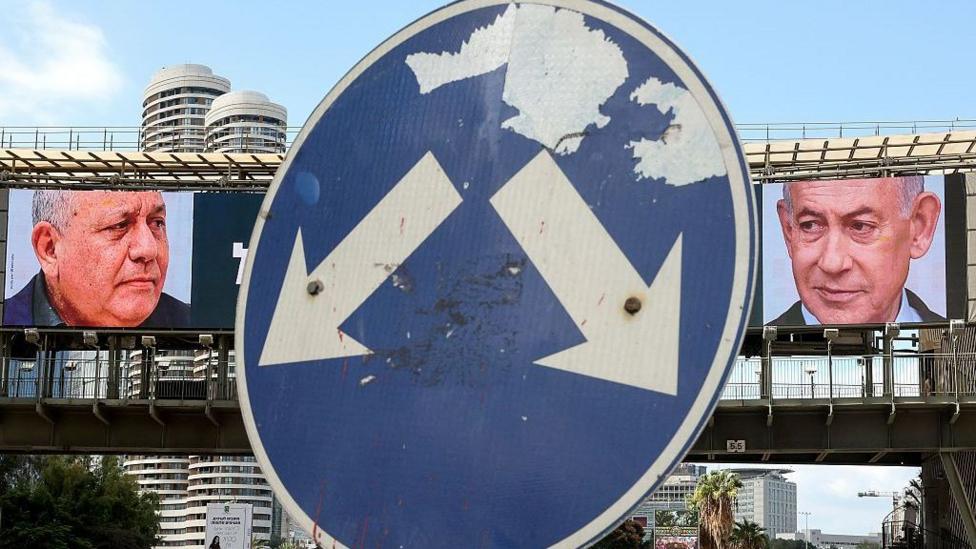
Israel faces a political deadlock following an election where neither incumbent Prime Minister Benjamin Netanyahu’s coalition nor the bloc led by his main challenger, Gadi Eisenkot, secured a majority after 85% of votes were counted. Forming a government will likely require leading parties to break campaign promises, making new elections a strong possibility.
National unity government led by Netanyahu
Netanyahu could attempt to persuade Eisenkot to join a national unity government. Doing so would require Eisenkot to abandon his central platform, which was built on ousting Netanyahu and positioning himself as the sole alternative. At his campaign headquarters, Eisenkot called on Netanyahu to retire, accusing him of a culture of lies, division, and incitement.
That speech occurred before exit polls were revised, overtaking Eisenkot’s bloc and placing Netanyahu in the lead. Netanyahu could try to bring Eisenkot’s Yashar Party into a unity government with Likud by dropping his current far-right and ultra-Orthodox coalition partners. However, at Likud headquarters, he thanked his loyal partners and called for a strong right-wing government, which some interpreted as an intention to maintain his current alliance.
A renewed conflict with Iran could also increase pressure on political leaders to set aside their differences and cooperate. Before the election, Israeli and US media reported that Netanyahu sought fresh strikes against Iran and urged Donald Trump to approve US involvement—actions critics would likely view as an attempt by Netanyahu to save his political career through regional conflict.
Eisenkot-led coalition with Arab parties
Forming a coalition with Arab parties would represent a seismic shift in Israeli politics, as only one independent Arab party has ever briefly joined a coalition in 2021. Eisenkot and every other Jewish party in his bloc except one have previously ruled out joining government with them, yet this alliance remains the opposition’s only path to a majority.
Arab parties emerged as a major story on election night by defying expectations to potentially capture a record 19 seats, driven by an unprecedented turnout among Israel’s Arab population, who make up about one-fifth of the country. Historically, many boycotted elections to protest a system they believe treats them as second-class citizens, but high turnout was fueled by a desire to remove Israel’s most right-wing governing coalition.
The United Arab list, projected to win around seven seats, stated they would join an opposition government, while The Joint List, projected to win 12 seats, offered support from the outside. Currently, The Democrats’ Yair Golan is the only Jewish leader advocating this scenario, and such a coalition would remain fragile, particularly regarding issues involving Gaza and the occupied West Bank.
Netanyahu-led majority, with right-wingers from opposition
Another option involves Netanyahu persuading right-wing parties within Eisenkot’s bloc to break away and join his coalition. The leading candidates for this move are Naftali Bennett, joint-leader of the Beyachad political alliance, and Avigdor Lieberman, leader of Yisrael Beiteinu, both of whom share security-focused hardline views with Netanyahu.
However, both campaigned explicitly to remove Netanyahu and to extend military conscription to the ultra-Orthodox, putting them at direct odds with the ultra-Orthodox parties already in Netanyahu’s government. While some analysts suggested Bennett and Lieberman could replace the ultra-Orthodox parties, current electoral math indicates that grouping might lack the seats needed for a majority.
New elections
If none of the negotiating scenarios succeed, the default outcome will be new elections. Many would view this as a tacit win for Netanyahu, who would continue serving as caretaker prime minister and might believe his chances of winning a new vote are higher.
Certain analysts suggest that high Arab turnout might not repeat if their record parliamentary representation yields no changes, and a second vote could mobilize additional right-wing voters. Netanyahu may also calculate that roughly 70,000 Israelis who flew home from abroad to vote, who are believed to oppose him, would not return again, while right-wing parties that failed to clear the 3.25% electoral threshold might secure fewer votes or decline to run, directing more ballots to Likud and its allies.
Between 2019 and 2022, Israel held five separate elections as Netanyahu and his rivals repeatedly struggled to cooperate.