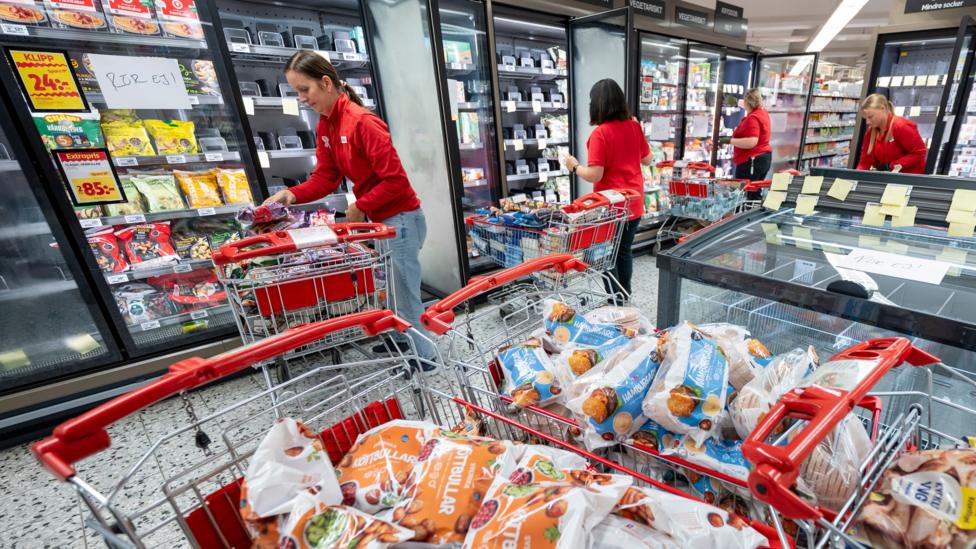
A wave of cyber-attacks targeting supermarket chains across at least 10 European countries has prompted European Union officials to warn of a deliberate effort to disrupt the food supply chain. Retailers in Belgium, Estonia, Finland, Ireland, Italy, Luxembourg, the Netherlands, Portugal, Germany, and Sweden reported freezer temperatures soaring as high as 50C (122F), forcing businesses to discard large amounts of food.
Impact Across European Nations
Belgian supermarkets suffered heavily, with dozens of stores reporting refrigeration failures, prompting federal prosecutors to launch an investigation. Mathieu Tilman, a manager at a Delhaize supermarket in Belgium, told BBC News that the scale of food waste was shocking and distressing. In Italy, Giorgia Meloni’s government convened a meeting with intelligence chiefs, though officials noted the impact was limited because most distribution networks use modern security systems. The national cybersecurity agency reported that at least four Co-op stores in Sicily and one business in Tuscany were affected due to obsolete security equipment exposed directly to the internet.
In Ireland, the Musgrave Group confirmed that 13 SuperValu stores were impacted by a cyber-incident, though restocking of chilled and frozen goods was already underway. A small number of Dutch corner shops also faced disruptions, following a separate incident last month that forced supermarket chain Albert Heijn to take services offline. In Germany, Rewe Büsken experienced refrigeration disruptions after hackers targeted system provider Danfoss, though operations resumed on Monday afternoon. Portugal’s Mosqueteiros group stated that seven Intermarché stores were linked to a cyber-attack directed at an external service provider managing refrigeration systems.
Swedish chain ICA confirmed a limited number of stores faced refrigeration problems without explicitly confirming a cyber-attack, while national cybersecurity agencies monitored the situation. Finland’s Kesko group reported irregular temperatures in a small number of smaller grocery stores and launched an investigation. In Estonia, public broadcaster ERR reported that at least one supermarket was targeted by hackers who deliberately raised refrigeration unit temperatures to 50C. No group has yet claimed responsibility for the coordinated attacks, which follow a similar incident three weeks prior that disrupted around 700 French grocery stores.
Official Reactions and UK Warnings
EU officials expressed deep concern over the vulnerability of remote-monitoring systems and refrigeration units, highlighting the rising threat of government-backed hybrid attacks. EU food and agriculture commissioner Christophe Hansen stated that the bloc was treating the incidents with extreme gravity and warned of potential future disruptions. Commission spokesman Thomas Regnier emphasized that the events demonstrate how cyber-attacks can compromise essential services and daily life, noting that collective resilience is essential against such non-isolated incidents.
Meanwhile, the UK’s National Cyber Security Centre (NCSC) advised British retailers to update software on fridge temperature controls. NCSC head Richard Horne told BBC Radio 4’s Today programme that vulnerable technology had been exploited in a few British instances across the broader food supply chain, and agency staff worked overnight to alert organizations with exposed systems. Horne added that the UK faces a likelihood of suffering an AI-powered cyber-attack targeting critical national infrastructure within two years.