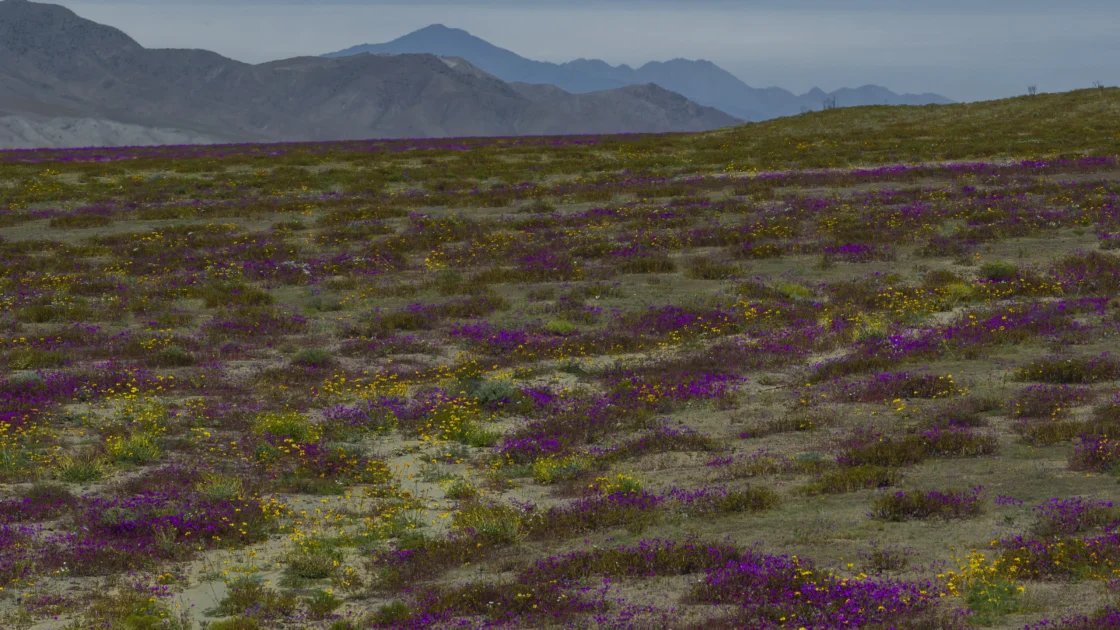
Heavy rainfall in northern Chile has transformed the world’s driest non-polar desert into a vast patchwork of pink, yellow, lilac, and purple wildflowers. The rare phenomenon, locally known as the Desierto Florido or Desert Bloom, has produced the largest and most colorful floral display in 30 years and perhaps on record.
A Dormant Archive Awakened by Winter Rains
During the winter, heavy rains brought by the El Niño super cycle triggered flash floods across the Atacama Desert, with some locations recording their heaviest rainfall since the 1950s. While the floods in July and August damaged dozens of homes and forced hundreds of people to evacuate, the moisture penetrated deeper into the parched ground than it had in decades. This allowed millions of seeds, bulbs, and tubers that had remained dormant beneath the sand for years to finally sprout.
More than 200 plant species are currently in flower across the region. Scientists studying the event note that certain patches of the desert are blooming where flowers have never been recorded previously, indicating that some bulbs stayed dormant since detailed studies of the phenomenon began in 1997. Moisés Grimberg, administrator of Llanos de Challe National Park, described the landscape as a natural seed bank turning into a living archive, emphasizing that the brief biological window gives these species only two to three months to complete their life cycle.
The sudden explosion of flora has also sparked a temporary ecosystem, with hatching insects drawing in lizards, bats, and larger mammals such as guanacos. Biologists from INIA, Chile’s national seed bank, are actively collecting specimens and recording flower density per square meter to analyze how native plants adapt to extreme arid conditions. Ana Sandoval, a researcher at the institute, explained that the desert is not an empty place, but rather waiting for the right precipitation to awaken.
Tourism Surge and UNESCO Ambitions
The extraordinary bloom has drawn large numbers of visitors to the region. Llanos de Challe National Park, which typically receives about 10,000 visitors annually, has welcomed 15,000 tourists in just the past few weeks alone. Chile’s national tourism board projects that the region will see approximately 300,000 overnight trips during the two-month duration of the bloom. Among the main attractions is the endemic garra de león, a rare flower featuring crimson petals and flame-like green leaves that grows exclusively along a small stretch of the Atacama coastline.
Local authorities are now taking steps to secure long-term protection and international recognition for the area. Miguel Vargas, governor of the Atacama region, has initiated the process to seek UNESCO World Heritage recognition for the desert bloom phenomenon. Vargas stated that the designation would boost special-interest tourism and help diversify the regional economy away from its heavy reliance on mining, potentially making it Chile’s eighth World Heritage site within a couple of years.
As the current bloom is projected to last until mid-November, scientists continue to investigate whether this event is the largest in the Atacama’s recorded history and whether closer examination will uncover previously unknown plant species among the millions now in bloom.