Table of Contents
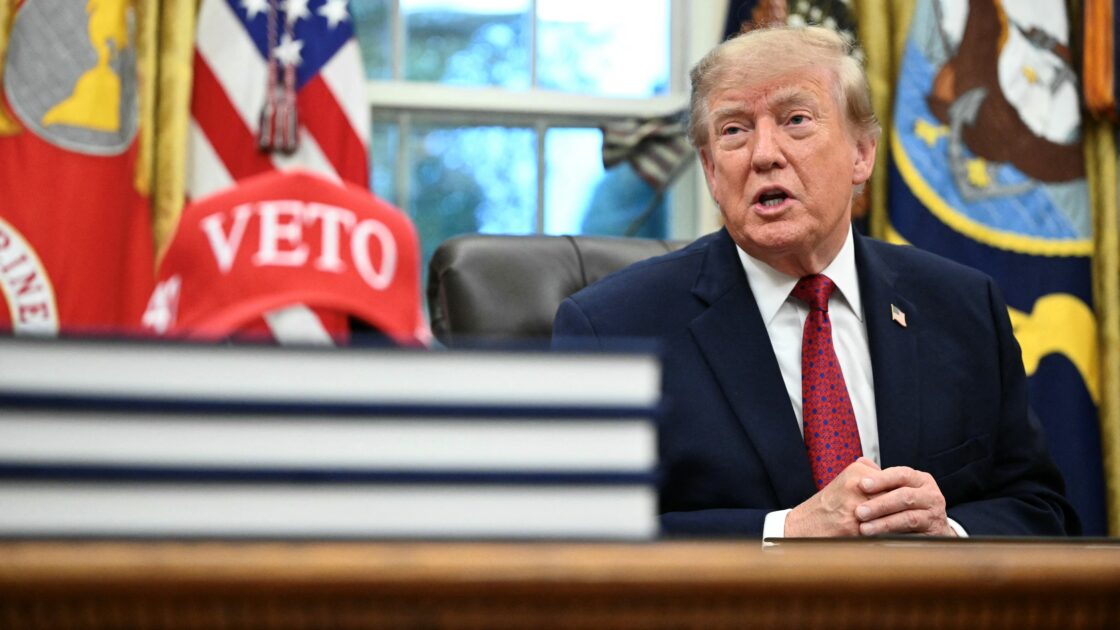
Following the US midterm election results, US President Donald Trump’s Republican Party lost control of both chambers of Congress. In a phone interview with Politico late Tuesday night, Trump struck a conciliatory tone, stating he would be open to working with Democrats rather than simply issuing vetoes for the next two years.
Congressional Power Shift and Veto Authority
While a few seats remain uncounted, Democrats have secured comfortable majorities in both the House of Representatives, with at least 253 of 435 seats, and the Senate, winning at least 54 of 100 seats. Following the defeat, Trump shared an image on Truth Social depicting a Make America Great Again red baseball hat reading “VETO”. Under Article 1, Section 7 of the US Constitution, the president holds broad executive authority to reject legislation passed by Congress. Although Congress can override a presidential veto, doing so requires a two-thirds majority, which Democrats lack in both chambers.
Since taking office in January 2025, Trump has issued 292 executive orders, including 67 this year and 225 last year, according to the Federal Register. Andrew Proctor, a lecturer in US politics at University College London, told Al Jazeera that Trump now holds significantly less leverage with Congress, making a certain amount of gridlock likely. Proctor noted that recent history suggests the president working with Democrats on legislation is unlikely, though Trump’s comments point to an alternative possibility of picking and choosing when to veto or negotiate.
Potential for Bipartisan Healthcare Talks
Despite past rhetoric, some Democrats have expressed a willingness to collaborate with the president on key campaign promises. Michigan Senator Abdul El-Sayed told MSNOW on Thursday that he is prepared to work with Trump if the administration focuses on reducing the influence of money in politics, increasing pocketbook funds, and passing Medicare for All. El-Sayed emphasized that he wants to deliver for the public by expanding healthcare access, ending Medicare cuts, stopping the war, and halting tariffs with Canada. Similarly, progressive Senator Bernie Sanders indicated in recent interviews that he would not rule out Trump signing a Medicare for All bill if passed by both chambers of Congress, describing Trump as a politician who is not overly ideological.
Proctor argued that while passing Medicare for All in the next two years is unlikely, common ground could emerge on healthcare if the administration focuses on rolling back specific subsidies cut under earlier legislation to make healthcare more affordable for millions of Americans. Proctor recalled that some Republicans expressed willingness to negotiate on healthcare reforms in 2025, suggesting that healthcare-specific policies could offer an area for potential agreement.
Legislative Roadblocks and Congressional Investigations
Historically, Trump has not been among the most avid users of the presidential veto, utilizing it twice in his current term and 10 times during his first term. By comparison, Joe Biden issued 12 vetoes in his single term, Barack Obama used the veto a dozen times across two terms, Bill Clinton issued 37 vetoes, George H.W. Bush used it 44 times, and Ronald Reagan used it 78 times. Proctor noted that Republicans also possess another tactic to block legislation: the filibuster. By using extended debate to delay votes, Senate Republicans could prevent legislation from reaching Trump’s desk entirely.
Following the Democratic sweep in the midterms, calls for investigations into the administration have already surfaced, echoing Trump’s two impeachments during his first term for abuse of power, obstruction of Congress, and inciting the US Capitol riots. On Tuesday night, US Representative Robert Garcia, poised to become chairman of the House Oversight Committee, posted “LAWYER UP” on X, while Senator Ron Wyden, expected to lead the Senate Finance Committee, posted “Subpoenas.” The White House has denied any wrongdoing, with spokesperson Lauren Bis stating on Wednesday that if Democrats pursue sham investigations and radical policies, they are choosing to work against the American people. Reports also indicate that impeachment proceedings against Defence Secretary Pete Hegseth may be imminent regarding the Iran war, which Trump and other Republicans have blamed for their party’s electoral losses.