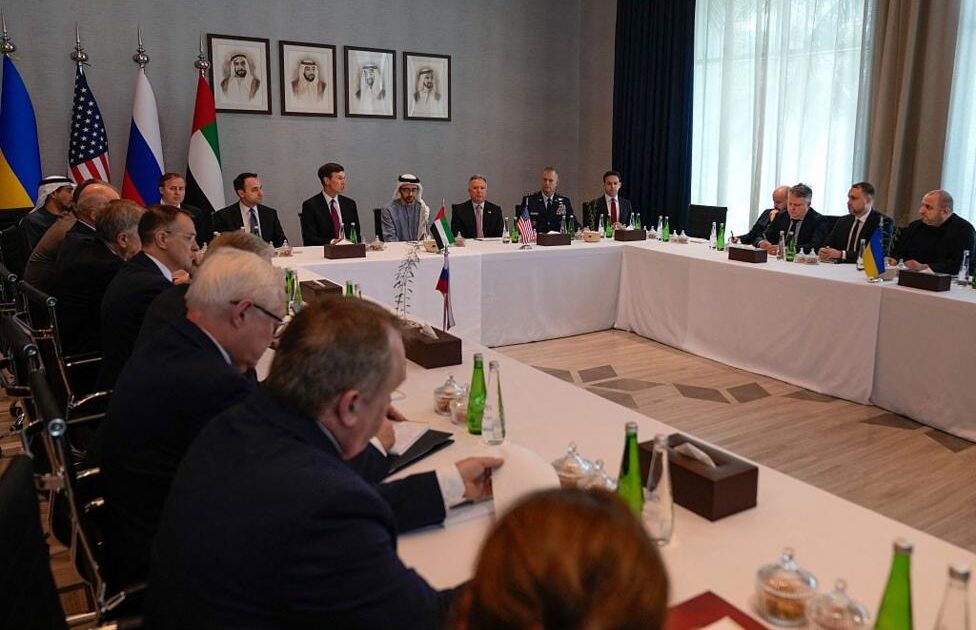
The first day of trilateral negotiations between Ukraine, Russia, and the United States aimed at ending the war in Ukraine has concluded in Abu Dhabi. While senior officials from Kyiv and Moscow remained silent following the four-hour discussions, US Secretary of State Marco Rubio stated that the talks had been very productive.
Peace Talks and Security Concerns
US officials noted before the meetings that Moscow and Kyiv were privately demonstrating some flexibility regarding control over eastern regions in a postwar scenario. Opening the Tuesday sessions, Jared Kushner told delegates that the US had narrowed the gaps between the two sides without sharing specifics, expressing hope for a solution to end the conflict. Kushner previously stated that the discussions would focus on addressing the postwar security concerns of both nations.
Kushner and US peace envoy Steve Witkoff also met with Ukrainian, European, and Nato officials on the sidelines. European leaders, previously excluded from peace negotiations, have pushed for inclusion amid worries that continent security decisions might occur without them. Rubio acknowledged during a visit to Paris that European nations are part of solving the problem for the long term, though a US official noted that Russia holds negative feelings toward Europe.
Moscow and Kyiv remain far apart on ending the conflict, particularly regarding the mostly occupied eastern region of Donetsk. Russia demands that Ukraine surrender remaining parts of Donetsk, while Kyiv aims to freeze the contact line to keep control over these areas for future security. The US official indicated that while public stances remain rigid, both capitals have shown slight private flexibility, though territorial issues require a new security architecture.
International Reactions and Delegations
For Ukraine, a postwar security architecture involves reassurances of allied aid during future attacks, whereas Russia desires a Nato rollback from Eastern Europe. The proposed framework includes security consultations, crisis communication hotlines, reciprocal de-escalation measures, and the potential reactivation of the Nato-Russia Council. The previous trilateral round in Geneva in February ended without a breakthrough before Washington shifted attention to the US-Israel war on Iran.
Ukrainian MP Oleksandr Merezhko, heading the foreign affairs parliamentary committee, told BBC News that he believes Donald Trump desires a quick deal at Ukraine’s expense that Kyiv will reject. Merezhko stated that true negotiations require greater pressure on Russia through sanctions and deep strikes, adding that Trump’s recent deal to buy diesel from Russia only encourages Moscow to continue the war.
The Russian delegation in Abu Dhabi features Kremlin aide Vladimir Medinsky, deputy foreign ministers Sergei Ryabkov and Mikhail Galuzin, spy chief Igor Kostyukov, and army general Yury Zhigarlovsky. Kyiv’s delegation includes Foreign Intelligence Service head Rustem Umerov, Volodymyr Zelensky’s chief of staff Kyrylo Budanov, and MP Davyd Arakhamiya. Meanwhile, Russia continues striking Ukrainian energy infrastructure, which Kyiv views as an attempt to force acceptance of a Russian-dictated deal.
Discussions are scheduled to resume on Wednesday.