Table of Contents
The term “resilient” frequently appears in third-quarter earnings reports as companies release their latest financial results. According to various businesses, Americans continue spending despite inflationary pressures, although success varies across different sectors.
Economic Pressures and Retail Sales
These corporate commentaries arrive amid concerns that diesel fuel prices, which reached a record $6.52 per gallon in September, would drive up consumer product prices. Economists also expressed worry that more expensive regular gasoline, high borrowing costs, and ongoing tensions between the U.S. and Iran might cause a pullback in consumer spending.
Retail sales climbed 0.8% in September following a 1.3% increase in August, largely boosted by rising spending at gas stations. Despite these economic challenges, certain corporate executives noted that market headwinds have not yet impacted sales.
“There’s been a lot of noise in the market this year. There’s a lot of geopolitical stuff,” Royal Caribbean Chairman and CEO Jason Liberty stated on the company’s earnings call. “But I look at our business [and our results], and I think that really talks to the resilience of the business, the resilience of the consumer.”
Corporate Performance and Consumer Trends
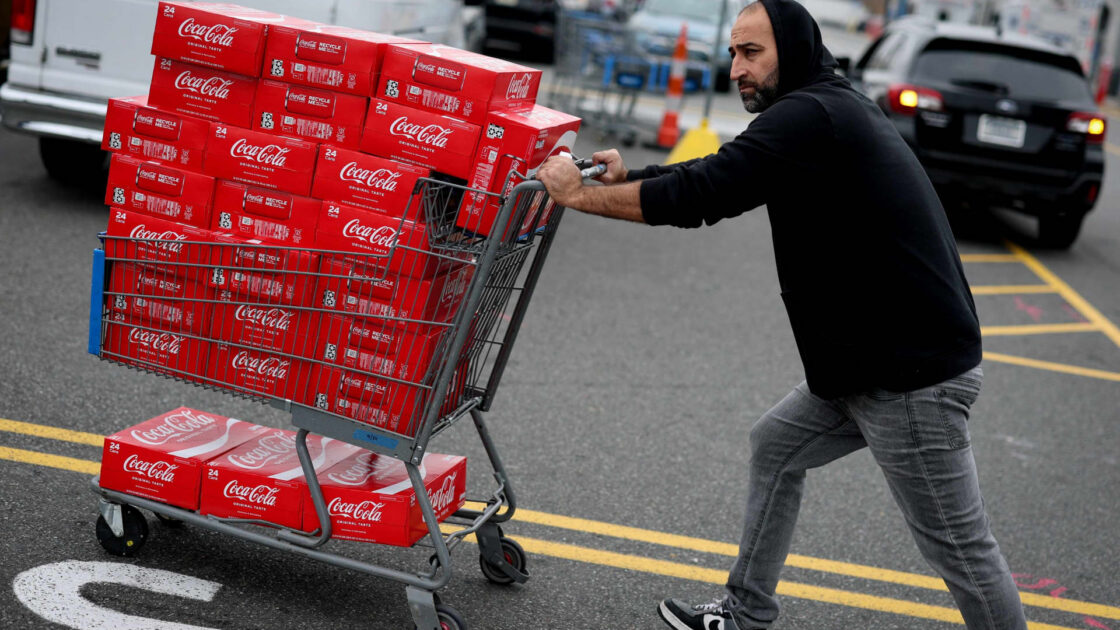
Coca-Cola surpassed analysts’ expectations for third-quarter earnings and revenue despite what CEO Henrique Braun described as an “uneven environment.” The company noted that North America unit case volume remained flat, signaling steady demand despite higher prices, while overall volume benefited from increased demand outside North America.
“The underlying momentum remains quite strong,” Chief Financial Officer John Murphy told US Top News and Analysis (cnbc.com). “Consumer sentiment is largely unchanged in the sense that, wherever you are on the income scale, you’re looking for value, and I think our system here has done a good job interpreting that.” Consequently, Coca-Cola raised its full-year forecast, expecting comparable earnings per share to grow by at least 11%.
Royal Caribbean beat Wall Street expectations for earnings per share while narrowly missing revenue projections. CEO Liberty reported that the number of guests served in the third quarter rose 9% year over year to 2.7 million vacationers, with 2027 booking volumes already pacing ahead of historical levels. Following the report, Royal Caribbean shares closed up more than 5% on Tuesday.
Sherwin-Williams exceeded analysts’ revenue expectations but fell short on earnings per share. CEO Heidi Petz stated that the paint retailer’s performance demonstrated company resilience and strategic strength in a challenging demand environment. Net sales grew 7.9% compared to the same period last year, driven by higher selling prices, though profit benefits were partially offset by rising raw material and supply-chain costs.
UPS beat Wall Street expectations for both earnings per share and revenue, with U.S. revenue rising 4.5% to $14.86 billion. CEO Carol Tomé informed investors that consumers remain resilient heading into the busy holiday season, prompting the company to raise its full-year consolidated revenue projection to approximately $92.6 billion. UPS shares also closed up more than 5% on Tuesday.
Mixed Results in the Appliance Sector
Not all companies observed identical spending trends, as appliance manufacturer Whirlpool missed both top and bottom lines for the third quarter and reduced its full-year revenue guidance. North American net sales dropped over 8% year over year for the period ending September 30.
Despite the downturn, Whirlpool highlighted its own version of resilience through disciplined working capital management. CFO Roxanne Warner explained in the earnings release that these measures protect year-end free cash flow and balance sheet resilience to navigate difficult market conditions, and company shares closed up more than 3% on Tuesday.