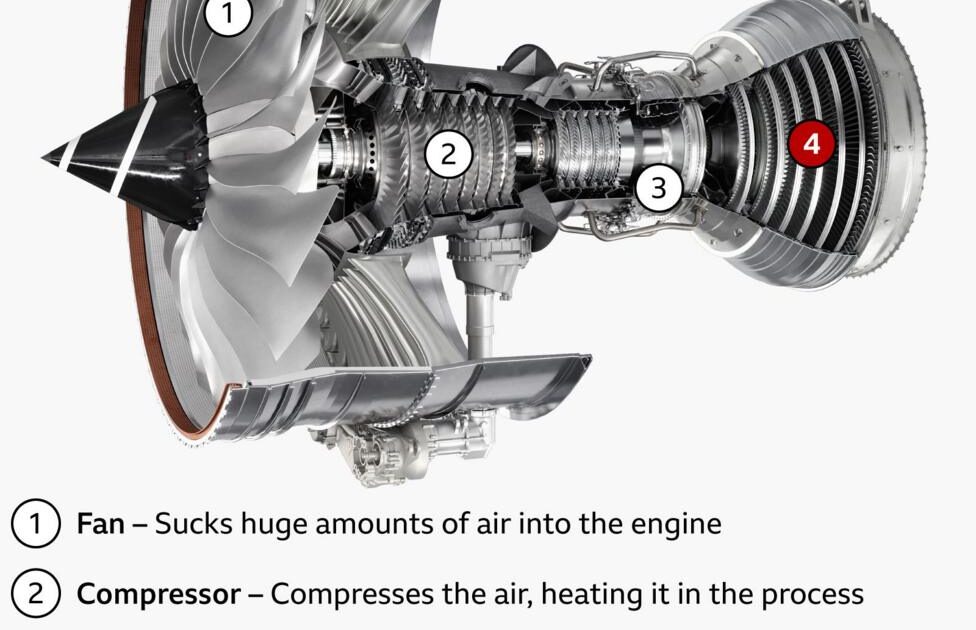
Inside modern aircraft engines, hundreds of tiny turbine blades endure immense mechanical stresses and temperatures exceeding 1,500 degrees Celsius. These critical components are not cut or sculpted from material, but rather grown as a single crystal of metal alloy over several hours.
An Engineering Marvel
Only a handful of companies globally can produce single-crystal turbine blades, with the entire end-to-end process perfected in just five countries, including the United States and the United Kingdom. Major engine-makers such as Rolls-Royce, GE, and France’s Safran constantly compete for access to this specialized manufacturing method. In September, GE Aerospace announced plans to acquire its turbine blade supplier for $11.75 billion to secure its supply chain, while Rolls-Royce stated in March that it would invest more than £19 million in its Rotherham blade casting facility.
Ben Fifoot, a manufacturing engineer at Rolls-Royce, describes the intricate production as fighting the laws of the universe. Molten metal naturally cools into a solid object with many jumbled alloy grains, comparable to a crumbly sugar cube rather than a solid diamond. To achieve a single crystal, engineers use a small spiral at one end of the blade known as a pigtail. Fifoot explains that this spiral chokes the flow of solidifying crystals at the start of the cooling process so that only one takes over, after which the sacrificial spiral is removed.
Rolls-Royce blades power commercial airliners such as the Airbus A350-900 via the Trent XWB-84 engine and the Boeing 787 using the Trent 1000 XE. To ensure performance, the components are protected by special ceramic coatings and feature internal channels that allow cool air to flow over them. Bill Sweetman, an aviation industry writer and consultant, notes that high demand gives these components a magical aura, while manufacturers continuously work to make cooling passages more intricate and reduce component weight to improve fuel efficiency.
Global Competition and Future Demand
China is currently attempting to become the sixth country to master the complete technology chain for single-crystal blade casting. A report in May cited an engineer at the AECC Beijing Institute of Aeronautical Materials claiming that China possesses a single-crystal alloy that is cheaper to make and comparable or superior to second-generation superalloys used in Europe and the US. However, Sweetman points out that Western manufacturers maintain a massive advantage due to established supply chains, clustered innovations, and lengthy safety records.
High global demand for aircraft is currently straining supply chains across the industry. Paul Withey, a specialist at the University of Birmingham who previously worked for Rolls-Royce, suggests that demand could increase further if either Airbus or Boeing launches a new short-haul plane in the coming years, forcing the other to follow. Such a move would spark fierce competition among suppliers vying to provide engines and their vital single-crystal turbine blades.