Table of Contents
Russian air attacks across Ukraine have killed at least five people, authorities said, coming a day after a Ukrainian strike on Russia’s Kerch Bridge killed two and partially collapsed the structure.
Strikes on Odesa and Zaporizhia
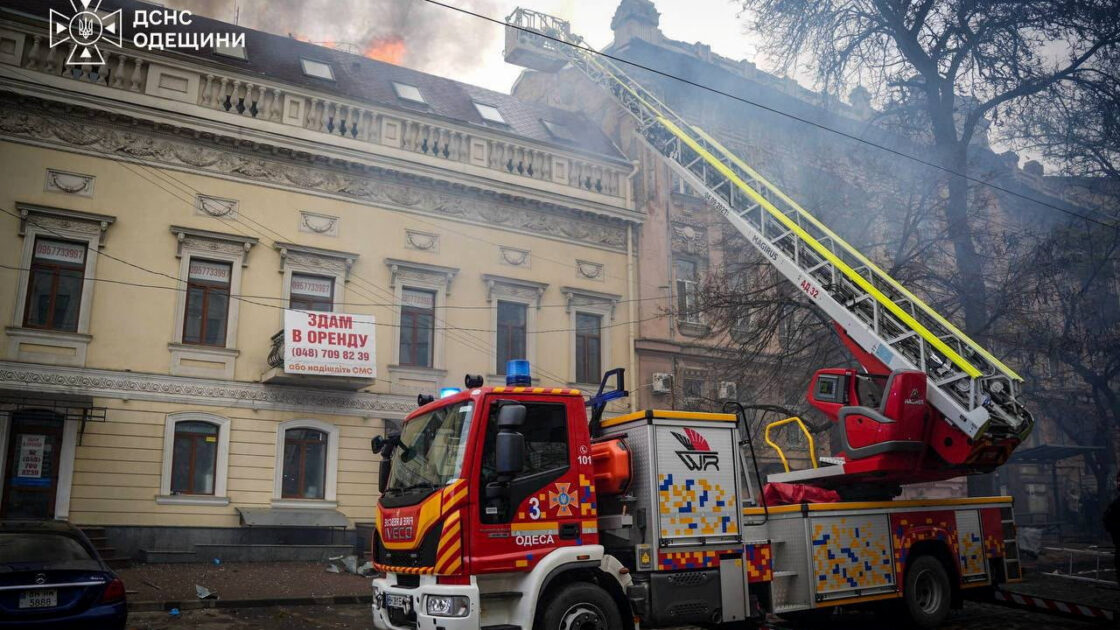
In the southern city of Odesa, at least four people were killed and 13 others wounded in Russian air strikes. President Volodymyr Zelenskyy described the assault as brutal and deliberate, stating it also targeted first responders.
Oleg Kiper, the head of the Odesa region’s military administration, reported that three Russian strikes hit the city’s historic centre. The Odesa city council stated that one strike impacted a UNESCO-protected area, igniting a car and shattering hundreds of windows across at least seven buildings.
Zelenskyy wrote on X that double-tap strikes occurred after emergency workers and police had already arrived at the location. He added that the attack served as further proof of Russian intentions and disregard for diplomatic efforts.
In the southeastern Zaporizhia region, a Russian drone strike killed a woman and injured a man in the town of Kushuhum, according to local military administration official Mykhailo Semykin. The strikes also prompted local authorities to order families with children to evacuate the village of Balabyne, affecting 184 people, including 85 children from 80 families.
Energy Infrastructure Under Fire
In northern Ukraine’s Rivne region, a Russian attack left 80 settlements without electricity, though no casualties were reported. Ukraine’s Energy Ministry stated that Russia has launched more than 1,000 attacks on energy infrastructure since September, with new power outages recorded in Dnipropetrovsk, Donetsk, Zhytomyr, Zaporizhia, Kharkiv, Sumy, Rivne, and Cherkasy regions over a 24-hour period, as reported by Interfax. The United Nations has previously characterized Russia’s stepped-up winter targeting of energy facilities as war crimes.
The energy ministry noted that conditions in the Dnipropetrovsk and Kharkiv regions remained extremely difficult. Energy personnel are working to restore power supply as quickly as possible, though repeated strikes continue to severely hinder repair efforts.
The renewed aerial bombardments followed a Ukrainian attack on the Kerch Bridge, a symbolic road-and-rail link connecting Russia to the annexed Crimean peninsula, which resulted in two deaths.
Weapons Development and Refineries
Zelenskyy praised the effectiveness of domestically produced weaponry used to damage the bridge, stating on social media that the country’s technologies and companies are progressing well. He noted that cutting-edge long-range drones and missiles were deployed in the large-scale operation following weeks of preparation, placing Ukraine in the global top three for technology development and at the forefront in Europe.
In additional strikes targeting the Russian mainland, Ukraine hit two oil refineries in southern Russia. Ukraine’s General Staff confirmed that storage tanks at the Ilsky refinery and a processing unit at the Afipsky refinery in the Krasnodar region were struck. The facilities, which can process approximately 95 million barrels of oil annually and supply front-line Russian forces, were also targeted previously on Sunday night. Russian officials acknowledged attacks on two industrial facilities in the area without providing further details.
European Funding and Diplomatic Talks
Amid the ongoing long-range exchanges, the European Commission proposed a new 45 billion euro ($49.5bn) loan to Ukraine to address a 70 billion euro ($76.8bn) funding shortfall for the upcoming year. European Commission President Ursula von der Leyen stated that repayment would only be required after Russia pays reparations for damages incurred since the full-scale invasion began in February 2022. Zelenskyy expressed hope for swift adoption by the European Parliament, the Council, and EU member states.
Diplomatic developments included close monitoring in Kyiv of a tripartite meeting between US President Donald Trump, Chinese President Xi Jinping, and Russian President Vladimir Putin at the APEC summit in Beijing. Al Jazeera’s Audrey MacAlpine reported from Kyiv that Ukrainians expressed concern over the meeting potentially elevating the Russian president to the same status as world leaders from the United States and China.
Parallel negotiations aimed at ending the conflict are scheduled to commence in Berlin. US delegates are reportedly traveling to meet with Ukrainian representatives and potentially European leaders to discuss security guarantees and a recently agreed prisoner swap.