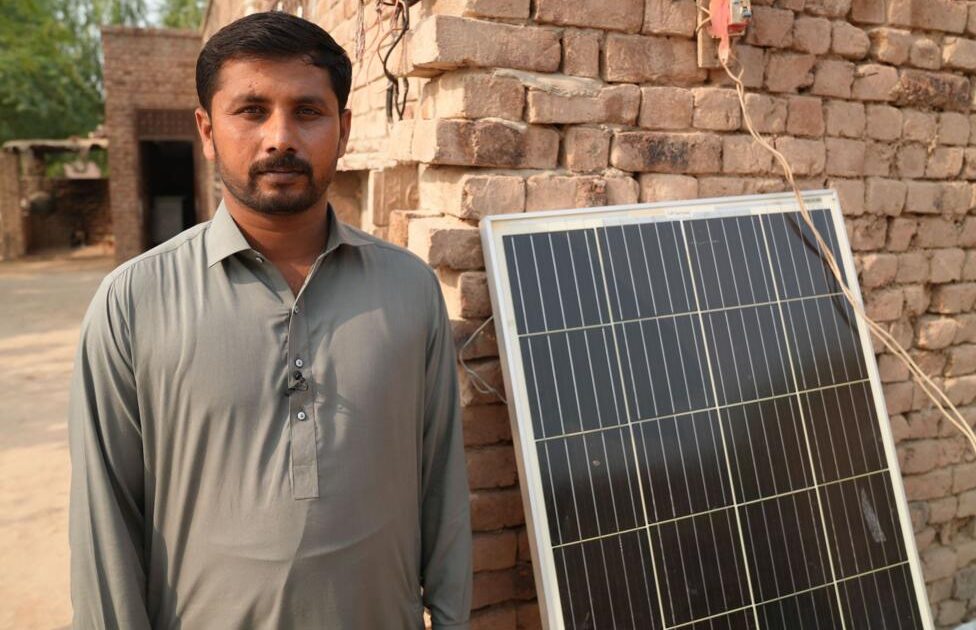
Faisal Shahzad’s newlywed home in rural Punjab features typical wedding gifts like silverware and sofas, alongside his bride’s family dowry of a 340W solar panel. Across Pakistan, homes, hospitals, and industrial facilities are increasingly installing imported solar panels to cope with rising energy demands and costs.
The Rise of Solar and the Grid Death Spiral
Data from the Pakistan-based think tank Renewables First shows that solar power’s share of electricity generation surged from 1% to 28% between 2018 and 2025, with about seven million households now utilizing panels. Shahzad noted that solar panels have become an essential wedding gift instead of motorbikes. While he still relies partly on the national grid for his extended family’s heavy appliance use, monthly grid bills have climbed to between 15,000 and 18,000 Pakistani rupees in a country where the average monthly wage is just under 40,000 rupees (£110; $145).
The transition was propelled by individual households escaping unreliable grid service and surging tariffs that more than doubled in a few years, contrasted with a 93% drop in the cost of Chinese solar panels, according to Muhammad Hassan Dajana of Renewables First. Energy Minister Awais Ahmad Leghari described the public’s economically viable adaptation as a healthy response, reported BBC News.
However, the mass migration from the grid risks triggering a utility death spiral. As fewer customers purchase grid energy, remaining consumers face higher fixed costs of maintenance, potentially creating a two-tier system where vulnerable citizens bear escalating bills while state-owned infrastructure requires heavy public funding. Leghari stated that the exodus has cost remaining consumers over $500 million annually over the past two years.
Industrial Shift and Policy Adjustments
Industrial sectors are also embracing solar energy. Sabawoon Khan, utilities manager at Kohinoor Textiles Mills in Islamabad, explained that the facility’s hundreds of machines run entirely on solar power when the sun shines, replacing heavy-furnace-oil engines. CEO Taufique Sayeed Saigol noted that the mills plan to introduce industrial batteries for storing excess solar energy while maintaining a connection to the grid.
Critics, including Faisalabad chamber of commerce president Arif Ehsan Malik, have accused the government of altering policies regarding net metering, noting that officials reduced the rates for purchasing excess solar electricity from users while selling power back at higher rates. Leghari defended the regulatory change, explaining that the initial model placed an unsustainable financial burden on grid consumers, potentially costing them 150 to 200 billion rupees annually within two years.
Leghari outlined goals to modernize the grid through improved storage and efficiency, targeting up to 90% clean power by the end of 2036. Although the initial solar boom caught the government off guard, Leghari stated that the shift has been integrated into 10-year forecasts as the rate of disconnections slows.
Dajana warned that Pakistan stands at a crossroads between a successful parallel energy transition and a costly, declining grid system. Meanwhile, Shahzad intends to expand his home setup further. He stated that the plan is to acquire another 10 to 15 panels, connect a complete battery backup system, and achieve full self-sufficiency.