Table of Contents
Jurf al-Sakhar, a stronghold of Iran-linked fighters in Iraq, has become the center of a major anticorruption campaign initiated by Prime Minister Ali al-Zaidi’s administration following discoveries of illicit oil smuggling. Situated about 60km southwest of Baghdad, the 345-square-kilometre territory holds immense strategic value along the Shia pilgrimage route connecting the capital to Karbala.
History and Militia Control
The geography previously served as Saddam Hussein’s military-industrial complex for testing and concealing weapons. Following the 2003 US-led invasion, it transformed into a conflict zone before ISIL seized it in 2014, and the Iran-backed Popular Mobilisation Forces later recaptured it.
Kataib Hezbollah, a prominent faction within the PMF, assumed full control, renamed the area Jurf al-Nasr, and blocked state institutions under security pretexts. This lockdown prevented approximately 140,000 displaced residents from returning to their homes.
Oil Scandal and Dismissals
A recent leaked intelligence report from the Iraqi Ministry of Interior revealed that millions of dollars in crude oil had been siphoned from two state pipelines running through the closed sector since 2021. The document stated that perpetrators built makeshift underground refineries to process the stolen resources.
Following this information, al-Zaidi established a high-level investigative committee backed by the military that entered the restricted area on November 13. The committee confirmed the existence of illicit facilities, and nine senior security and administrative officials in Babil province, including the provincial police chief and the director of the Oil Pipelines Company, were subsequently dismissed.
As reported by the state Iraqi News Agency, the government ordered armed forces to enter Jurf al-Sakhar and issued a deadline for the armed faction to vacate the territory by Friday.
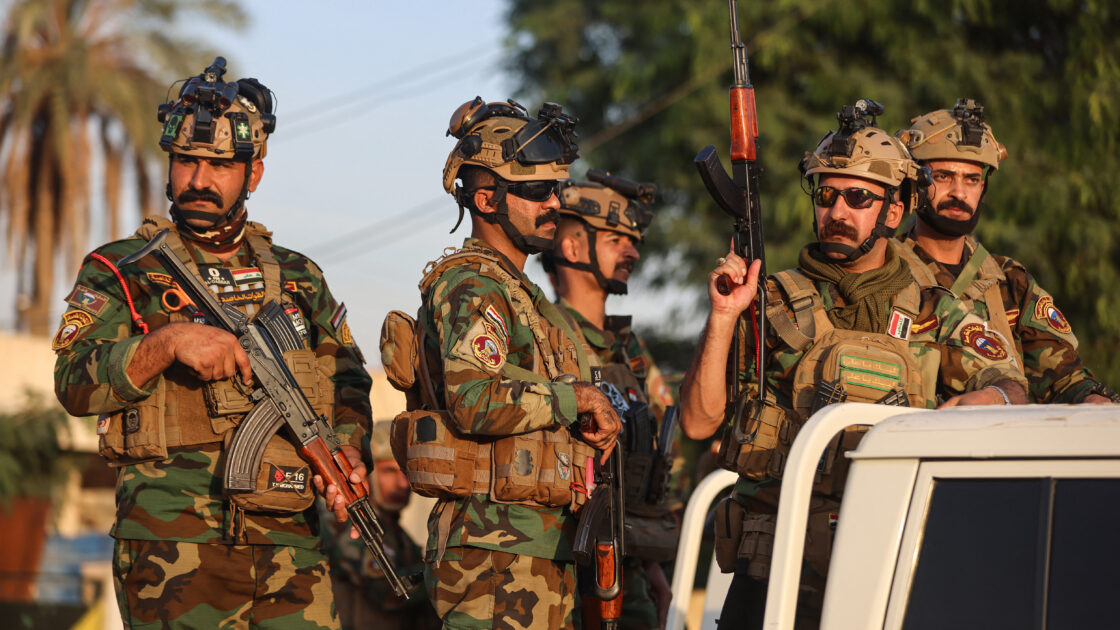
Kataib Hezbollah rejected the oil-smuggling accusations, accused al-Zaidi of corruption, and characterized the crackdown as political extortion. The militia mobilized around 8,000 fighters toward the area ahead of the government committee’s inspection.
Iraqi journalist Hamza Mustafa told Al Jazeera that the military posturing masks underlying vulnerabilities. Mustafa noted that the previous justification of fighting terrorism no longer applies, describing the field mobilization as potentially the group’s final defense line.
Security expert Saif Raad told Al Jazeera that economic motives fuel the fierce resistance, noting allegations that the zone hosts thousands of illegal fish farms. Raad stated that desperation over the area stems from financial rather than security reasons.
Political Standoff and Mediation
Since taking office in May, al-Zaidi has prioritized disarming all armed factions under pressure from the United States, pushing a deadline from September 30, 2026, to June 2027. Mustafa explained that the operation removes pretexts from armed factions now exposed for oil smuggling.
Iraqi political analyst Fadel Abu Ragheef told Al Jazeera that al-Zaidi’s lack of partisan background allows him to take unprecedented steps with boldness. The standoff has divided the ruling Coordination Framework, prompting leaders like Nouri al-Maliki, Hadi al-Amiri, Qais al-Khazali, and Ammar al-Hakim to mediate behind the scenes.
Abu Ragheef noted that these factions resist disarmament terminology, leading to a shift in concepts toward organization and management that provides a negotiating window until June 2027.
With Friday’s deadline approaching, Esmail Qaani, commander of the Quds Force of the Islamic Revolutionary Guard Corps, traveled to Baghdad to avert a military clash. Qaani and al-Zaidi held talks that resulted in a tentative agreement for Kataib Hezbollah to withdraw soon.
Mustafa cautioned that the crisis remains unresolved, noting that Qaani has less ability to dismantle the situation than in the past due to al-Zaidi’s firm stance. Raad reinforced this view, asserting that the prime minister remains determined to centralize state arms and restore sovereign authority over all Iraqi territories.