Table of Contents
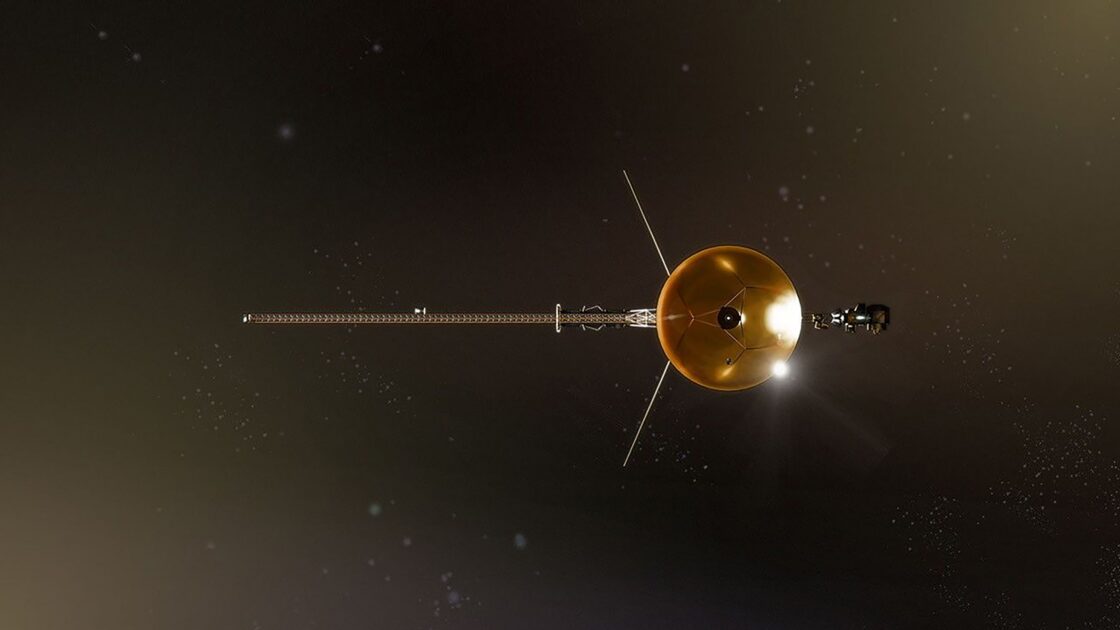
Voyager 1 is so far away that it takes light one whole day to travel from the spacecraft to Earth and vice versa, placing its current distance at one light-day. This immense expanse raises numerous physics questions about the spacecraft’s historic journey.
Measuring Distance in Space
Meters are familiar units of distance, but they quickly become impractical for measuring the vast distances in space. While kilometers can help measure the distance between Earth and the International Space Station or the moon, larger scales require different units.
The Astronomical Unit, or AU, represents the average distance from the sun to the Earth, measuring about 1.5 x 10¹¹ meters. Humans calculated this distance by observing the transit of Venus, where Venus passes in front of the sun like a solar eclipse. By tracking Venus’ movement from different locations on Earth, observers can use the Earth’s radius to determine the distance to the sun.
For stars outside the solar system, AUs become unwieldy, leading scientists to use the parsec. Equal to about 200,000 AUs, the parsec measures distance using parallax. Parallax can be observed by holding a thumb out, closing one eye to align it with an object across the room, and switching eyes to notice the apparent shift in position. The size of this angular shift depends on the distance between observation points and the distance to the object.
Understanding a Light-Day
As Earth orbits the sun, observation locations shift by 1 AU from December to June, creating a 2 AU shift. A star with a parallax shift of 1 arc-second is defined as being 1 parsec away. Astronomer Friedrich Bessel used parallax to measure a star’s distance, determining that light would take 10.3 years to reach Earth, which established the light-year as a unit of distance. A light-year is the distance light travels in one year, amounting to 9.9 x 10¹⁵ meters or over 6 million AUs.
Any unit of time can measure distance using light, and one light-day is the distance light travels in 24 hours, or 2.6 x 10¹³ meters. No human-made object has traveled farther. Assuming Voyager traveled at a constant speed in a straight line, it would average 164 kilometers per second, or about 36,000 mph.
Forces Affecting Voyager 1
Voyager has encountered various forces throughout its space journey, starting with the rockets that launched it. Gravitational force exists between any two objects with mass, depending on their masses and the distance between them. For instance, a phone positioned 50 centimeters away exerts an exceedingly tiny gravitational force of about 4 x 10⁻⁹ newtons on a human body.
Voyager also experienced gravitational interactions with the outer planets and Earth, though the sun exerts the most significant gravitational influence due to its massive 2 x 1030 kilogram mass. With Voyager 1 weighing 722 kilograms, the attractive force from the sun is 1.4 x 10⁻⁴ newtons, which equals the weight of 78 grains of salt on Earth’s surface. Jupiter, with a mass of 1.9 x 1027 kilograms, only exerted a comparable gravitational force when Voyager passed close to the planet in 1979.
Other exotic interactions affect the spacecraft as well. Solar winds, consisting of charged particles emitted from the sun, have blown past Voyager, though their mass is extremely small and their intensity decreases with distance from the sun. The spacecraft also encounters magnetic fields and other phenomena as it moves from the heliosphere, where primary interactions involve the sun, into the interstellar medium.
Will Voyager Go On Forever?
Newton’s second law of motion states that forces change an object’s motion, expressed as net force equaling mass times acceleration. Using the estimated average speed of 164 kilometers per second and assuming the sun’s gravitational force of 1.4 x 10⁻⁴ newtons is the sole force acting on Voyager, the spacecraft experiences an acceleration of around 2 x 10⁻⁷ newtons. Because gravity acts mostly in the opposite direction of the spacecraft’s motion, this results in a very slight deceleration, slowing Voyager 1 down by 0.012 meters per second in a single day.
Despite this daily slowdown, Voyager will not eventually stop. As the craft moves away from the sun, it gets farther from the sun’s gravitational pull, which is the force slowing it down. Objects can continuously slow down without ever stopping, allowing them to escape the sun’s gravitational pull entirely at an escape velocity. At Voyager’s location, it requires a speed of at least 3.2 kilometers per second; otherwise, it would fall back toward the sun like an apple tossed in the air.
Unexpected factors could still impact Voyager 1, such as interstellar dust that might slow it down further or potentially stop it entirely. Only time will reveal the ultimate fate of the spacecraft.