Table of Contents
Spanish voters face a snap election on 29 November, with conservative opposition figures leading most polls following eight years of Socialist-led governance under Prime Minister Pedro Sánchez. A combination of the conservative People’s Party and the far-right Vox could secure a parliamentary majority.
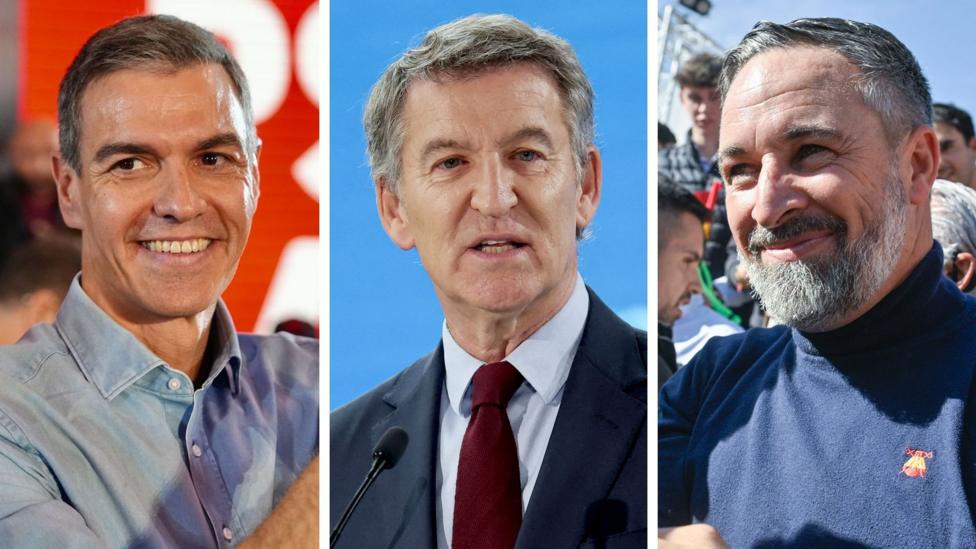
Alberto Núñez Feijóo (People’s Party)
Feijóo’s People’s Party (PP) holds a slight advantage in public opinion polls, positioning the conservative leader as the favourite to assume the role of Spain’s next prime minister. As reported by BBC News, his political campaign centers on his administrative track record, specifically his 13 years serving as president of the north-west Galicia region starting in 2009. Feijóo stated to voters that his background in management is precisely what Spain needs.
Having held public office continuously since 1991, Feijóo led the PP to secure the highest number of seats in parliament during the 2003 election, though short of an outright majority. While he prefers a majority government supported by Vox, he has not ruled out a formal national coalition under strict conditions. Although less internationally known and admitting he makes little effort to speak English, Feijóo dismissed the limitation, telling BBC News, “I don’t know English, but I know how to govern.”
Pedro Sánchez (Socialist PSOE)
Sánchez has directed the Socialist Party for 12 years and governed Spain since 2018, marking this contest as his sixth election in 11 years. He initiated the snap vote eight months early to concentrate on resolving the national housing crisis and promised a progressive comeback, as reported by BBC News. Despite projections of 2.6% annual economic growth in 2026 driven by tourism, his administration has faced corruption scandals, a migrant crisis in Ceuta, and two deadly rail disasters, including a tragedy at Urda that claimed 69 lives.
Legal challenges have touched those close to the prime minister, including former transport minister José Luis Ábalos, who is serving a 24-year prison sentence for kickbacks, and leading figure Santos Cerdán, who awaits trial for alleged bribery and denies wrongdoing. Additionally, Sánchez’s wife, Begoña Gómez, and his brother, David Sánchez, face legal allegations involving influence peddling and misconduct, which both deny. At the Socialist campaign launch, Begoña Gómez urged support from Spanish women, stating that when women step forward, the country follows.
Santiago Abascal (Vox)
Opinion polls place the anti-immigration, populist party Vox in a strong third position, potentially deciding the election outcome. Abascal, 50, rejects the far-right label and has successfully integrated Vox into mainstream politics, recently attracting high ratings on state television. His platform emphasizes repatriating migrants in an illegal situation and utilizing the Spanish navy to defend borders, telling BBC News that there is no room in Spain for “all of Africa and all of the Americas.”
Abascal began his political career with the PP at age 18 before founding Vox in 2014, shaped heavily by his family’s experiences facing threats from the Basque militant group Eta. Vox utilizes the slogan “Make Spain Great Again” and advocates for a centralized nation that opposes Catalan independence movements, contrasting with critics who draw parallels to the era of dictator Francisco Franco.
Ada Colau and Míriam Nogueras
Former Barcelona mayor Ada Colau leads the left-wing coalition Frente Amplio, previously called Sumar, which focuses heavily on fair rents and housing policies after losing supporters to the Socialists. Other left-wing factions are contesting the election independently, such as the pro-Catalan independence Esquerra Republicana de Catalunya led by Gabriel Rufián in a deal with Podemos. Meanwhile, Míriam Nogueras heads the Catalan centre-right party Junts per Catalunya, which previously triggered the snap election by rejecting government housing proposals and remains central to potential post-election negotiations.
Other Key Figures to Watch
Isabel Díaz Ayuso, president of the Madrid region since 2019, represents a strong conservative stronghold for the PP, though her tenure has faced scrutiny regarding her partner’s legal investigations and the regional government’s acquisition of a luxury penthouse. Interim transport minister Carlos Cuerpo, appointed following the Urda rail disaster, has gained high public approval and is viewed by Sánchez as a key team player.
Additional figures include Catalonia’s Socialist president Salvador Illa, Vox housing spokesperson Carlos Hernández Quero, and European Parliament member Alvise Pérez, who leads the anti-establishment party Se Acabó la Fiesta.