Democratic candidates secured major legislative victories across the United States in the midterm elections, reversing more than a decade of Republican dominance in statehouses. The election results shifted the political balance in several states, delivering new Democratic majorities and breaking longstanding Republican holds on state government power.
The outcomes reversed a period of GOP legislative control that had solidified following the 2010 midterms. Prior to the vote, Republicans held majorities in 28 state legislatures compared to 18 held by Democrats, with the remainder divided. Based on vote tallies, Democrats are projected to hold a 24-to-22 lead, according to data compiled by NPR, with seat gains reported across nearly every state holding legislative races, including traditional Republican strongholds such as Texas, Florida, and Utah.
Key Shifts and New Democratic Trifectas
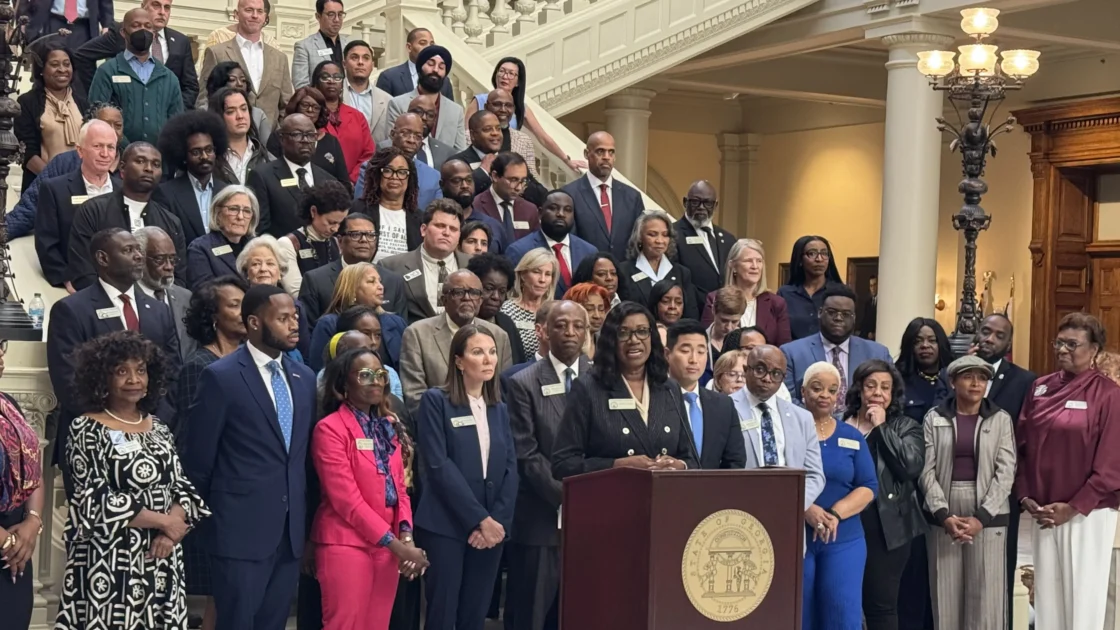
The elections delivered historic shifts in several key state capitals. Pennsylvania voters elected a Democratic majority in the state Senate for the first time since the presidency of Jimmy Carter. Democrats also took control of the Texas House for the first time in 24 years, while the Georgia House saw its first Democratic majority in over two decades.
The Republican State Legislative Committee attributed the losses to a broader national anti-incumbent mood alongside heavy Democratic campaign spending. Edith Jorge-Tuñón, the president of the committee, stated, “Ultimately, the results of this cycle underscore both the challenges Republicans face and the importance of maintaining a strong, sustained presence in the states,”
In contrast, Heather Williams, president of the Democratic Legislative Campaign Committee, stated that their victories “proved what is possible when you put statehouses at the center of a national strategy.”
The gains enabled Democrats to establish six new “trifectas,” where a single party controls the governor’s office and both legislative chambers. In Arizona, Democrats achieved their first full state government trifecta since 1966. Democratic Governor Katie Hobbs, who previously faced opposition from a Republican-led legislature, is expected to pursue reforms to Arizona’s billion-dollar private school voucher program, while Democrats aim to offer financial relief for utility, rent, and childcare expenses. In Pennsylvania, Democratic Governor Josh Shapiro promised to work with the new legislature to raise the minimum wage to $15 an hour, expand affordable housing, and protect abortion access.
Democrats secured additional trifectas in Michigan, Minnesota, Wisconsin, and Nevada. Figures compiled by the National Conference of State Legislatures show Democrats leading with 22 trifectas compared to 17 for Republicans, while 10 states remain under divided control. These figures do not include Nebraska’s nonpartisan, single-chamber legislature led by Republicans alongside a GOP governor.
Disrupting Republican Momentum and Supermajorities
Beyond gaining outright majorities, Democrats disrupted single-party Republican control in states like Georgia, Texas, Iowa, New Hampshire, and Ohio. In Georgia, Democrats won the House and came close to taking the Senate. Democratic lawmakers in Georgia may seek to expand Medicaid and repeal the state’s six-week abortion restriction, though passing abortion legislation through the Senate remains uncertain.
In North Carolina, Democrats took control of the state House, while a Senate race separated by just over 200 votes appears headed for a recount. A tied state Senate would allow the Democratic lieutenant governor to break legislative deadlocks. North Carolina Democrats intend to address abortion restrictions, while Democratic Governor Josh Stein urged bipartisan efforts on cost-of-living measures once the legislature convenes.
Additionally, figures from government relations firm Multistate indicate that Democrats succeeded in breaking veto-proof Republican supermajorities in six states. The loss of supermajorities grants Democratic governors in states like Kansas, North Carolina, and Ohio enhanced leverage to veto Republican-backed initiatives.