Table of Contents
The Cop31 UN climate talks in Turkey ended in a dramatic collapse on Sunday afternoon after the European Union, the United Kingdom, and allied developing nations rejected a proposed final agreement. The overrunning summit, which became the longest climate conference in history, failed to reach the necessary consensus after the main text omitted any mention of fossil fuels.
Rejection of the Antalya Pact
Speaking on behalf of the EU, Ireland’s environment minister, Darragh O’Brien, stated that the proposed “Antalya pact” failed to meet the moment and risked widening the gap between global commitments and required action. The draft text, prepared by the joint Turkish and Australian presidencies, invited countries to electrify economies, urged rich nations to provide adaptation finance, and called for minimizing the overshoot of the Paris agreement’s 1.5C global heating threshold. However, it omitted a call to transition away from fossil fuels—a measure demanded by over 130 countries—and included controversial provisions on carbon capture and storage (CCS) technology.
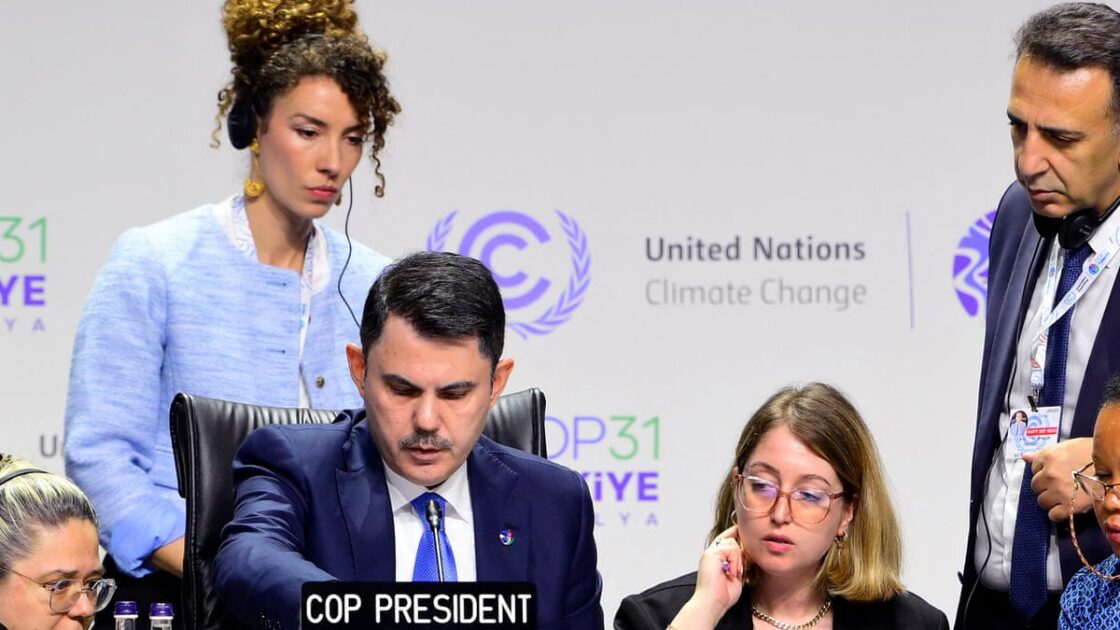
Following O’Brien’s intervention, which drew applause from the hall, nations including Panama, the Marshall Islands, and Norway voiced similar objections. Bill Hare, chief executive of Climate Analytics, described the pushback as a real line in the sand moment where countries stood up against fossil fuel interests. Meanwhile, Turkey’s Cop president, Murat Kurum, acknowledged the lack of consensus and confirmed that the draft cover decision was not adopted, noting that the presidencies did not impose an ultimatum or force the text onto anyone.
Mixed Reactions and Divisions
While the main cover text failed, the conference avoided a total collapse by passing decisions on related matters, such as a just transition to help workers move to low-carbon industries. However, critic Mohamed Adow, director of Power Shift Africa, labeled it the worst Cop ever, arguing that the EU could not absolve itself of blame and pointing out hypocrisy in European fossil fuel expansion. Conversely, Saudi Arabia defended the inclusion of CCS, while countries like China, Pakistan, the Africa group, and Ghana did not reject the final text, with Pakistan emphasizing that climate action cannot be treated as a selective menu.
Australia’s climate change minister and joint Cop co-president, Chris Bowen, defended his leadership by stating that Australia left nothing on the field, though the negotiating red lines proved unbridgeable. Simon Stiell, executive secretary of the UN framework convention on climate change, remarked that the consensus-based system fell short, while highlighting that several agenda items still achieved concrete results.
Frustration Over Lack of Urgency
The lengthy deadlock and ultimate failure to secure an overarching outcome appalled participants against a backdrop of worsening extreme weather worldwide, including deadly heatwaves, droughts, floods, and a glacier collapse in Nepal. Mary Robinson, former president of Ireland and former UN climate envoy, expressed deep frustration over the lack of urgency and leadership from the co-presidents as the conference neared its close.
UN secretary general António Guterres shared a profound sense of disappointment over the lack of consensus on an overarching outcome. He stated that while governments failed to rise to the moment, setbacks in the negotiating room do not change the facts or ambiguity of the science.