Table of Contents
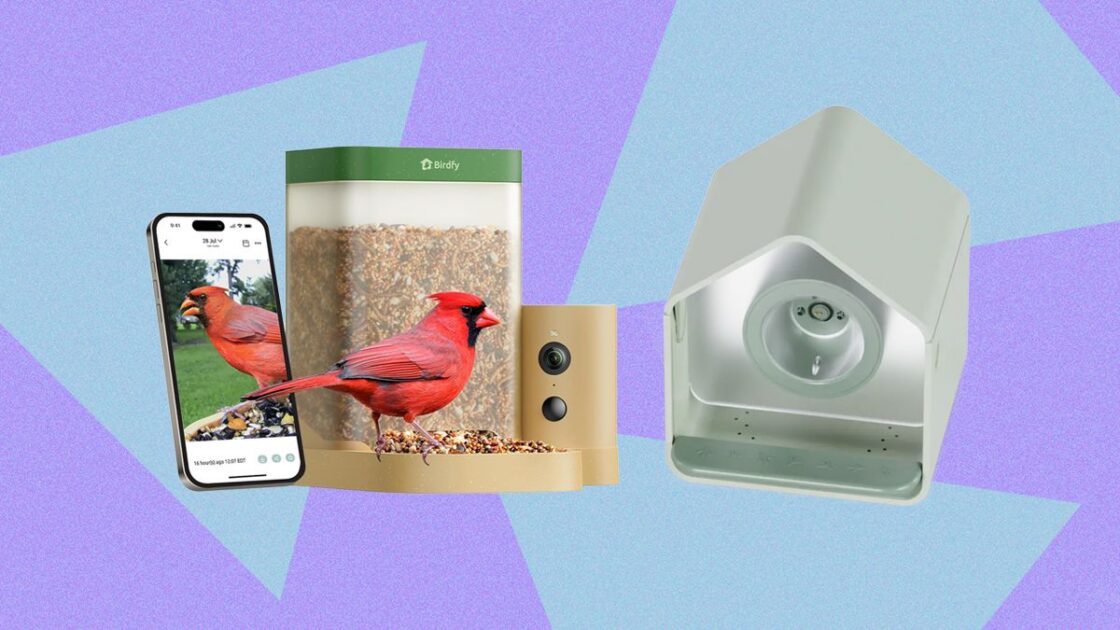
Recent releases from Birdfy and Birdbuddy allow consumers to purchase a premium smart bird feeder experience for under $100, a price point that previously required spending $200 or more. Following a four-week backyard test of both the Birdfy Rookie and the Birdbuddy Nook, the Nook came out slightly ahead due to a more premium hardware experience, despite costing $20 more and occasionally missing visits.
Birdfy Rookie: Simple Setup and Free AI Identification
Released in October of last year, the Birdfy Rookie serves as an entry-level smart feeder featuring USB-C charging, no solar power on the base model, and a straightforward assembly process. Functioning similarly to a lightweight gravity pet feeder, it holds 1.3 liters of seed and includes a side-mounted camera. The device can be mounted on a wall or pole, though it cannot be hung.
During the testing period, the 1080p camera delivered noticeably lower picture quality than the Nook, and the setup generated frequent false-alarm motion detections alongside accurate captures. The design presented several drawbacks, including an IP66 water resistance rating paired with a roof lacking an overhang, which allowed rain to enter the seed. Additionally, a loose-fitting lid blew off during strong gusts of wind, and the side-mounted camera struggled to frame larger birds effectively.
The Birdfy app features a simple design that displays daily visitor logs and supports television viewing for users with Roku devices running Roku OS 15.1 or higher. A notable advantage is the inclusion of unlimited automatic AI-based identification without requiring a subscription. Users wanting extended storage or video recording beyond the free 5 GB and 20-second limits can subscribe to Birdfy Plus for $80 per year or Birdfy Pro for $150 per year.
Birdbuddy Nook: Premium Hardware and Versatile Design
Launched in late October, the Birdbuddy Nook targets beginners and budget-conscious buyers with a smaller, squatter design resembling the flagship Home model. It utilizes thick plastic construction with a protective roof and a hinged lid for refilling, though the $99 base version excludes the extended perch and solar roof. The half-sphere camera attaches magnetically and can be positioned vertically or horizontally.
The Nook records in 2K HDR, producing sharper imagery and sound compared to its competitor. Positioned centrally rather than on the side, the camera captures superior full-bird shots, though it accumulated smudges more rapidly. The 0.9-liter seed hopper emptied quickly during testing. While the unit supports hanging alongside pole and wall mounting, the pole-mount option lacks a fastener, causing the IP67-rated feeder to swing when heavy birds land or depart.
Birdbuddy provides free AI bird identification, though users must manually activate it for each photo. A new background sound identification feature operates as a free preview before moving behind a paywall. Additional subscription tiers—Birdbuddy Premium at $70 per year and Birdbuddy Family at $99 per year—unlock Ultra resolution, livestream guest access, and individual bird naming.
Comparing Specifications and Value
The Birdbuddy Nook is priced at $99 with a 2K HDR camera, horizontal or vertical orientation, a 3,900 mAh rechargeable battery, front camera placement, a 0.9-liter seed capacity, manual free AI ID, and options to hang, wall-mount, or pole-mount on 2.4 GHz Wi-Fi networks in blue.
The Birdfy Rookie costs $80 with a 1080p camera, vertical orientation, a 5,200 mAh rechargeable battery, side camera placement, a 1.3-liter seed capacity, automatic free AI ID, wall or pole mounting options, and availability in tan or blue.
Shoppers looking to spend under $100 will find the Rookie to be a respectable choice featuring excellent free AI identification. However, buyers seeking the complete package receive better overall value from the Nook’s sturdy housing and versatile camera system for withstanding harsh weather conditions.