Table of Contents
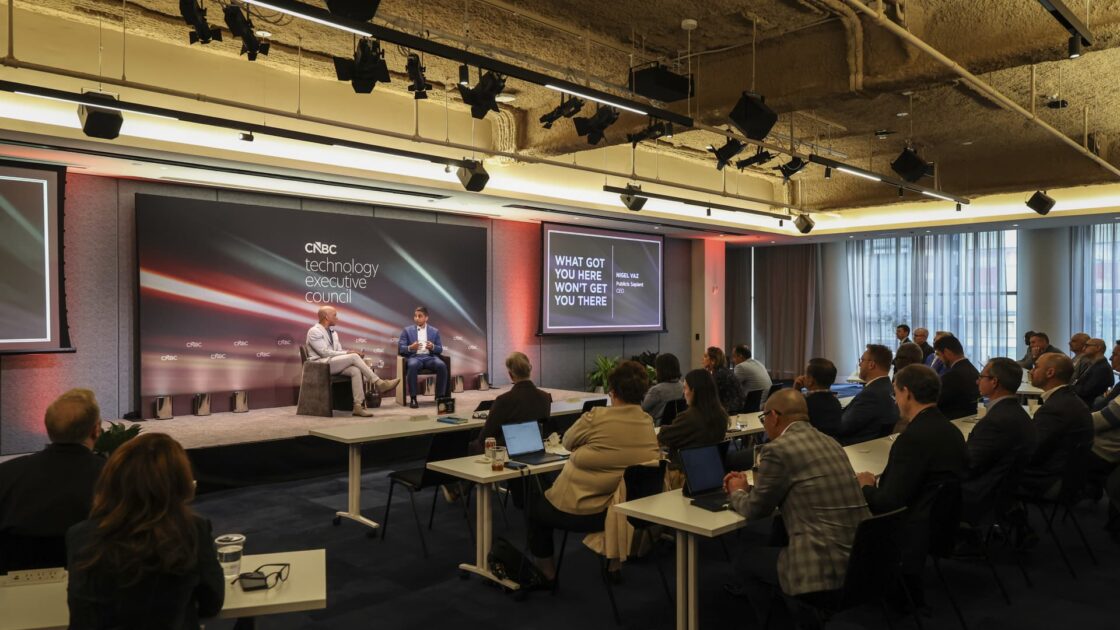
Technology executives and human resources leaders gathered for the CNBC Technology Executive Council (TEC) Summit to discuss how businesses are navigating the rapid adoption of enterprise artificial intelligence. Discussions centered on infrastructure strategies, workforce adaptation, security risks, and the shift toward specialized rather than generalized systems.
Open-Weight Models and Enterprise Specialization
Calix CEO Michael Weening stated during the summit that his company is betting on open-weight models because he anticipates a mass commoditization of AI. Weening explained that by maintaining core assets like knowledge, workflows, trust, and security, organizations can easily swap out open-weight models as better ones emerge. Calix Chief Product Officer Shane Eleniak added that solving complex organizational problems requires specialized approaches rather than centralized, generalist models, comparing the necessary division of labor to the distinct skill sets of brain surgeons and car mechanics.
Publicis Sapient CEO Nigel Vaz addressed the ongoing debate around pausing AI development for safety reasons, telling CNBC’s Jon Fortt that the discussion is almost irrelevant to most enterprises because they have not yet fully utilized existing models. Vaz also emphasized that companies must focus on the financial costs and specific business outcomes rather than viewing AI token usage merely as a dimmer switch to make every employee slightly more efficient.
Workforce Integration and Human Resources Challenges
Human resources leaders participating in the CNBC Workforce Executive Council sessions reported varying employee reactions to AI in the workplace. Paychex CHRO Mason Argiropoulos told CNBC’s Susan Caminiti that workers are eager to use the technology, though enterprise-level strategy remains a significant challenge. Crum & Forster CHRO Barbara Katz noted that while employees embrace AI, some harbor fears about job replacement, making it crucial for leadership to understand changing skill requirements.
To help employees adapt, Crum & Forster created an internal chatbot using statements from CEO Marc Adee to help staff understand his perspectives. Meanwhile, workplace surveys at Walmart revealed high enthusiasm, with 77% of office-based associates and 84% of U.S. frontline associates expressing confidence and excitement regarding digital tools, according to Maren Waggoner, Walmart’s Chief People Officer for Associate Experience and Digital. Amentum CTO Jill Bruning emphasized that companies must maintain a human-in-the-lead approach as delegation skills evolve.
Security Risks and Consumer AI Accuracy
Forum AI Founder and CEO Campbell Brown highlighted growing concerns over AI-driven cybersecurity threats and factual inaccuracies in consumer outputs. Citing recent research, Brown stated that 40% of outputs contained major errors, which poses risks when voters consult AI search engines for election information. Furthermore, Brown noted that labs prioritize lucrative enterprise coding applications over consumer accuracy and political evaluations, leaving consumer tools less scrutinized.
Calix executives warned that the risk of AI-driven cyberattacks is higher than currently forecasted. Eleniak explained that while large-scale attacks have historically been limited to nation-states due to high costs, accessible open-weight models and economical GPUs could enable bad actors to train malignant models by 2027. He suggested that container-trained models reacting dynamically to attacks will be necessary for defense.
Recent Developments Across the Tech Sector
In broader industry news discussed during the summit coverage, Google announced it is altering its cloud strategy by partnering with Oracle to sell its tensor processing units (TPUs) to outside customers, stepping up competition with Nvidia in the AI chip market. Anthropic reported holding $112.4 billion in cash and cash equivalents alongside $19.3 billion in short-term investments as of June 30, outpacing nearly every non-bank U.S. company except Berkshire Hathaway and Alphabet. Additionally, Amazon issued an internal memo discouraging software engineers from relying solely on token usage and code generation as primary metrics for AI adoption.