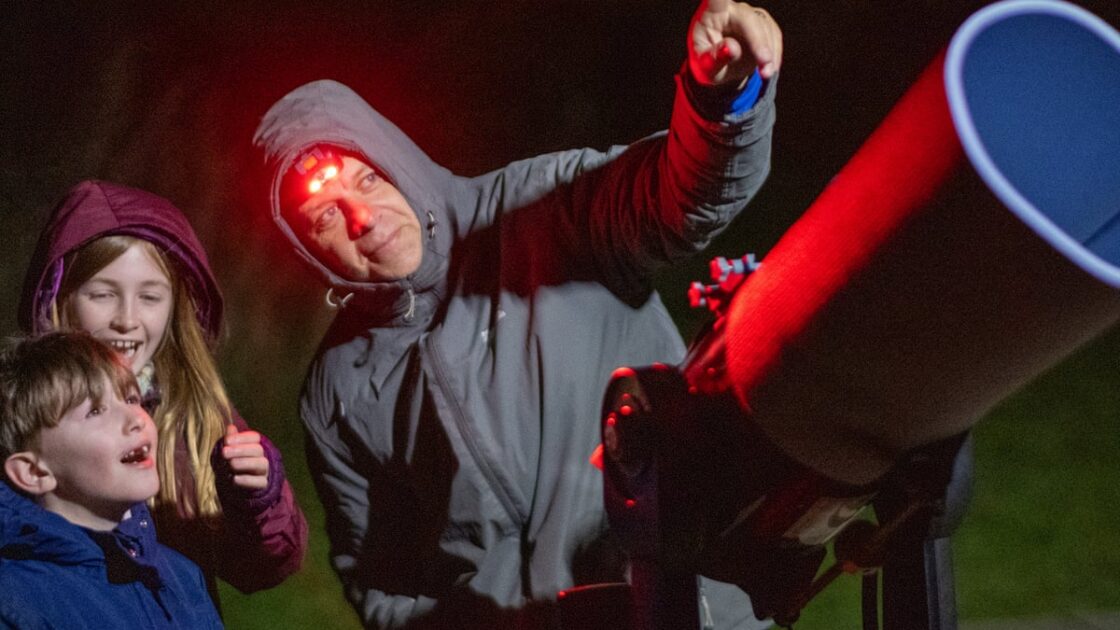
Astronomy enthusiasts and families traveled to south-west England for the 10th dark skies festival at Exmoor national park, Europe’s first designated international dark skies reserve. The event offered visitors a chance to view celestial bodies like Saturn and learn about the growing issue of light pollution.
Celebrating the Night Sky on Exmoor
Teacher and astronomer Jo Richardson described the view through a telescope at Exmoor as mind-blowing, noting that seeing a planet located 800 million miles away is incredible. Throughout October, visitors gathered at the park to observe the night sky and learn about space from national park astronomers and ecologists.
Bringing people to the dark location encourages them to think about how light pollution blocks the view of the cosmos at home, according to Jo Richardson. She explained that the goal is not to turn off all lights constantly, but to use them wisely through better education and environmental protection.
During the evening events, families participated in fireside question-and-answer sessions, peered through telescopes, and took bioluminescence walks through the woods. Jo Richardson’s husband, Peter, an astronomer who runs Space Detectives with her, stated that these activities often spark interest, noting that some youngsters who attended their clubs are now working as professional astronomers.
The Impact of Light Pollution on Wildlife
Research indicates that growing light pollution causes the night sky to become 10% brighter every year. Data from the Light Pollution Map ranks the UK as the 14th most light-polluted country in Europe.
Brightness is measured using the nine-level Bortle scale, where nine represents central London and one signifies the most remote locations on Earth. The darkest zone of Exmoor measures at a level two. Peter Richardson described a level one sky as jaw-dropping, where the Milky Way and dust lanes are visible to the naked eye.
Kate Lacey, an ecologist at the Exmoor National Park Authority, explained that darkness is vital for local wildlife, including rare Bechstein’s and barbastelle bats that depend on the dark for hunting, navigation, and migration. Protecting salmon populations is also a priority, as artificial light disrupts migrating salmon and reduces their chances of survival.
Although clouds eventually covered the sky and ended the evening stargazing, organizers hope visitors will continue to look upward and consider how light pollution threatens the night sky. Lacey noted that the night sky has inspired science, art, and religion, making it deeply important for people to experience.