Table of Contents
When stars similar in mass to the sun reach the end of their lives, they expand into red giants and shed their gaseous envelopes to form planetary nebulae. What remains in their place is a white dwarf, a highly condensed object roughly the volume of Earth but possessing the mass of the sun.
Unusual Colors in Dense Atmospheres
While early-discovered white dwarfs were named for their white to light blue glow due to extreme initial temperatures, a new study published in the journal RAS Techniques and Instruments shows they can also appear pink, green, and purple. Researchers state that density dictates this phenomenon, as the atmospheres of the coolest white dwarfs reach densities of about 1 gram per cubic centimeter. Although this matches the density of water, it is extremely compact for a star and roughly a million times denser than the sun’s atmosphere. Under these conditions, trace elements such as carbon, calcium, and sodium interact with surrounding dense helium plasma to absorb light across a wider color range.
Material originating from ancient planetary systems also contributes to the coloration. While nearby planets can be destroyed during the red giant phase, other planets and asteroids collide and migrate toward the dead star, integrating fragments into the white dwarf’s atmosphere.
Through a hobbyist telescope, a white dwarf resembles a standard faint star, but a close-up view reveals varied hues. Carbon-rich white dwarfs appear pink or purple, while those enriched with shattered asteroid material exhibit yellow and green shades. Additionally, the coolest white dwarfs display a baby blue color driven by hydrogen and helium atoms colliding within their dense atmospheres.
Examples Across the Galaxy
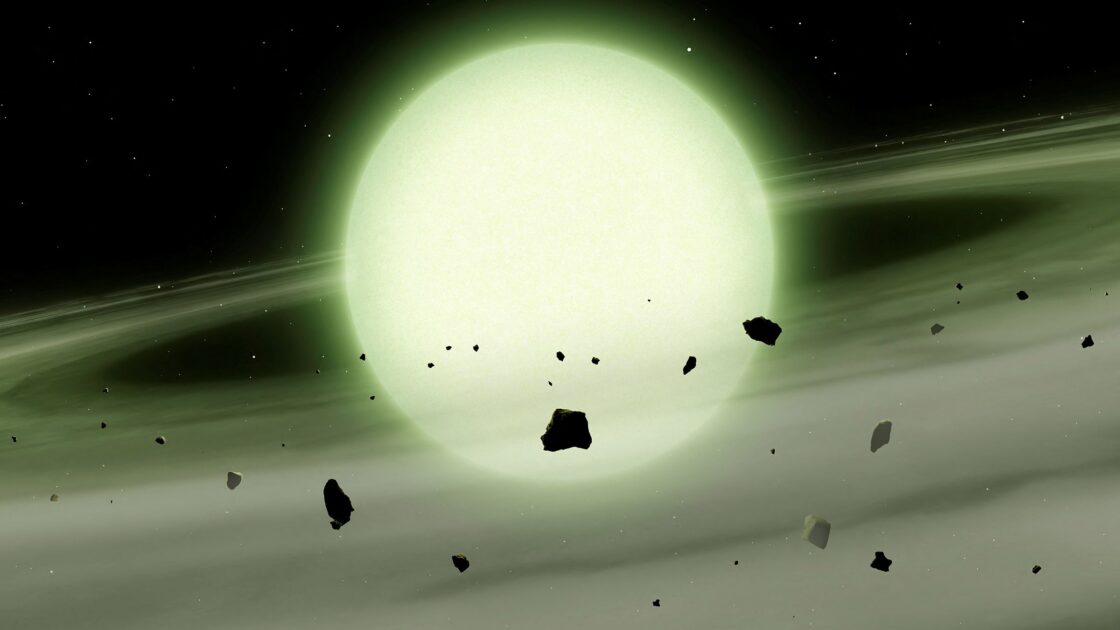
One notable example is the star WD J1330+6435. Operating at a temperature of approximately 4,000 degrees Celsius, it has gathered rocky material that enriches its atmosphere with calcium, lithium, and sodium, resulting in a light chartreuse hue that makes it the first known green star in our galaxy.
Another white dwarf, WD J1011+2845, features a massive amount of carbon in its atmosphere. With almost all radiation concentrated at wavelengths exceeding 600 nanometers, it displays a salmon-pink color, while the white dwarf WD J902-2010 leans toward a bubblegum shade.
Rarity and Observation Bias
Despite these findings, white dwarfs will not be renamed because the vast majority remain white. The study examined 152 white dwarfs located within 65 light-years of Earth and found that only five displayed unusual coloration, indicating that roughly one in thirty white dwarfs shines with non-standard light.
This challenges the previous scientific assumption that white dwarfs were predominantly blue, a view stemming from sampling bias in the night sky. Because the hottest white dwarfs are typically the brightest and visible from greater distances, past studies heavily over-represented blue stars due to ease of observation.
While the nearest white dwarf cannot be seen with the naked eye, observers can look toward Sirius B, the companion to the brightest star in Earth’s night sky. Sirius B features a temperature hovering around 25,000 Kelvin, giving it a light blue color as part of the more standard group of white dwarfs.