Table of Contents
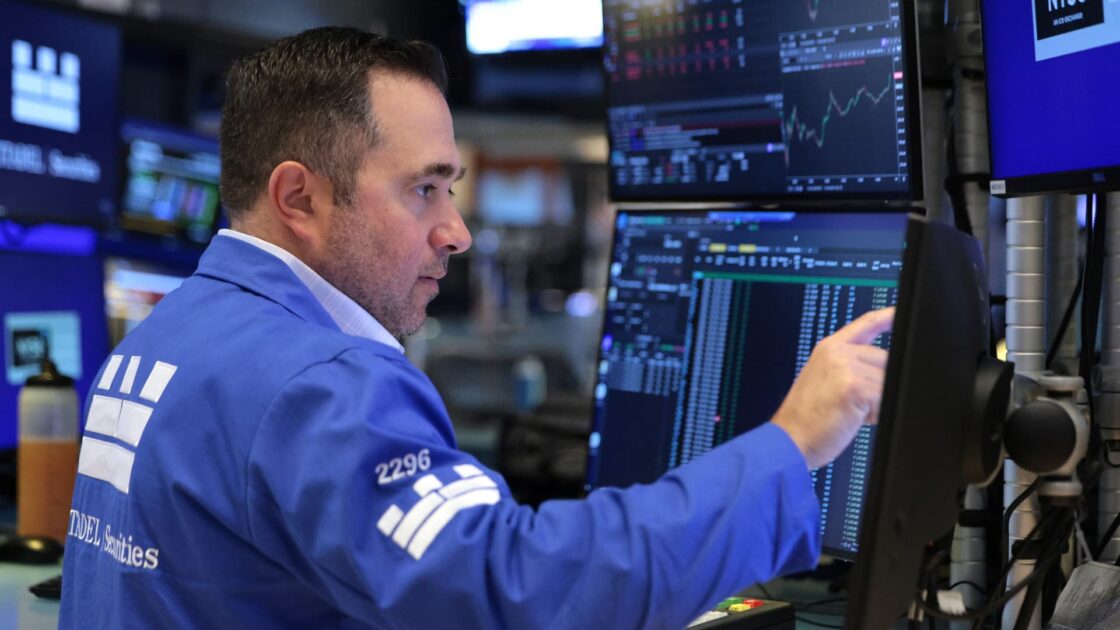
Global financial markets experienced significant volatility on Friday as investors reacted to lower-than-expected earnings from major U.S. technology companies, a massive security incident at cryptocurrency exchange Binance, and key international economic data. Major equity indexes across Asia and Europe traded mixed or lower, while cryptocurrencies tumbled significantly amid emergency asset freezes.
Technology Stocks and Earnings Fallout
U.S. technology shares faced heavy selling pressure in extended trading after Amazon and Intel released disappointing financial results. Amazon shares slid more than 6% after missing analyst expectations on both top and bottom lines, posting $1.89 per share on $201.94 billion in revenue, while reaffirming its full-year capital expenditure guidance of $220 billion. Meanwhile, Intel tanked about 21% following weaker-than-expected guidance for the current quarter, projecting adjusted earnings of 25 cents per share on revenue between $15 billion and $16 billion.
Alphabet shares plummeted nearly 13% on Thursday, forming a “death cross” pattern as its 50-day moving average fell below its 200-day moving average for the first time since July 2025. The slump followed third-quarter adjusted earnings per share and revenue that missed expectations. Sandisk bucked the trend slightly by beating fiscal first-quarter estimates with adjusted earnings of $49.51 per share, though its stock still fell 3% and the company announced an eight-for-one forward stock split. In response to the tech sell-off, Nasdaq-100 futures dropped 1.5%, S&P 500 futures slid 0.6%, and Dow futures added 17 points, as reported by US Top News and Analysis (cnbc.com).
Cryptocurrency Markets and Binance Security Incident
Cryptocurrency markets suffered steep losses following a security incident at Binance with an estimated impact of $6.3 billion. The exchange stated that an initial investigation indicated a compromised DevOps engineer’s laptop allowed an attacker to access a service container and submit unauthorized withdrawal transactions. Binance temporarily suspended deposits and withdrawals, revoked the affected address authorization, and enlisted law enforcement and blockchain intelligence firms. The platform pledged to cover all losses using company funds and its Secure Asset Fund for Users, noting that around $3 billion in assets had been frozen so far.
Following the security scare, Bitcoin dropped over 4% to $77,994.96, breaking below the $80,000 threshold. Ether fell 4.84% to $2,247.45, and Binance’s native token, BNB, tumbled 7.68% to $694.45. Defying the broader downturn, Hyperliquid’s HYPE token surged 9.7% to $89.08. Major crypto entities stepped in to contain the fallout, as stablecoin issuers Circle and Tether froze a combined $2.54 billion in funds linked to the incident on Thursday, including more than $800 million in USD Coin frozen by Circle, whose shares subsequently declined 4%.
Asian and European Markets
Asian stock markets tracked Wall Street’s losses, with technology shares particularly hard hit. In Japan, the Nikkei 225 closed 2.12% lower at 63,290.11, while SoftBank Group dropped 4.66%, Tokyo Electron fell 3.93%, and Advantest lost 5.43%. South Korea’s Kospi dropped 3.48% to close at 5,730.74, driven down by semiconductor losses that included a 6.36% fall for SK Hynix and a 3.45% decline for Samsung Electronics. Australia’s S&P/ASX 200 rose 0.18% to 8,908.10, while Hong Kong’s Hang Seng index gained 1.53% late in the trading day, boosted by academic services and energy sectors.
European markets pointed to a mixed open on Friday. Pan-European Stoxx 50 futures dropped 0.5%, Germany’s DAX index futures fell 0.2%, while futures for London’s FTSE 100 and France’s CAC 40 rose around 0.2%, and Spain’s IBEX 35 and Italy’s FTSE MIB remained flat.
Global Economic Updates and Central Banks
In macroeconomic developments, the Bank of Japan held its interest rate steady at 1.25%, maintaining its highest level since 1995 in a split 8-1 decision where board member Hajime Takata dissented in favor of a 1.5% rate. The central bank declared that inflation was generally consistent with its 2% target for the first time since adopting it in 2013, with surveyed economists anticipating a potential rate hike in December or January. Meanwhile, France’s economy unexpectedly contracted by 0.1% in the third quarter according to Insee data, dampened by a 1.7% drop in exports led by transport and aerospace equipment declines amidst ongoing nationwide unrest and budget negotiations.
Elsewhere, AstraZeneca reported strong third-quarter results with revenue growing 7% at constant exchange rates to $16.2 billion, beating FactSet estimates of $16 billion. Core earnings per share rose 19% year-on-year to $2.79, driven by oncology, respiratory, and rare diseases, prompting CEO Pascal Soriot to highlight a rich drug pipeline expected to generate over $20 billion in 2027. BP also posted strong third-quarter figures, reporting $8.5 billion in underlying replacement cost profit due to volatile energy markets and high refining margins, beating the $6.191 billion LSEG consensus forecast.