Table of Contents
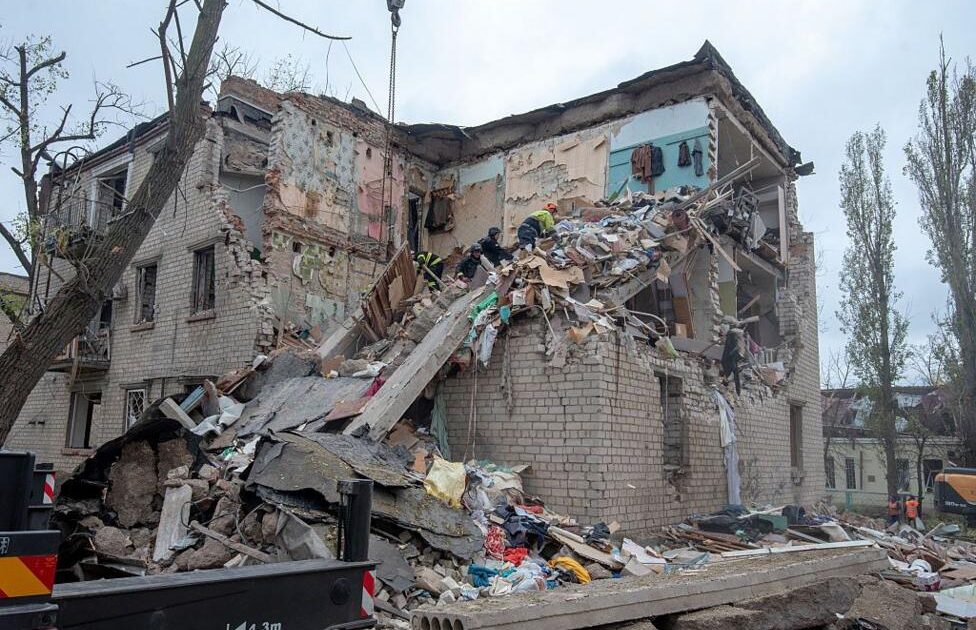
Russian strikes on Ukraine, targeting an aid centre, a hospice, and a hospital, have left at least 38 civilians dead and scores injured over a 24-hour period. President Volodymyr Zelensky stated that the victim count from a glide bomb attack in the Zaporizhzhia region alone was expected to rise, with more than 50 people potentially trapped under rubble.
Zaporizhzhia Bombing and Military Assessment
At least 31 people died in the glide bomb strike on the village of Komyshuvakha on Monday night. President Zelensky described the assault as one of the largest mass killings perpetrated by Russia during the conflict, coming as Moscow’s response to Ukraine’s proposal to extend a recent ceasefire in the Kherson region.
Authorities reported that nine heavy aerial bombs hit Komyshuvakha as residents gathered at a distribution centre for humanitarian aid. A local shelter’s roof collapsed after people took refuge inside when the attack began. Regional head Mykhailo Semikin stated that the scale of the tragedy was hard to comprehend.
The Russian defense ministry claimed the target was Ukrainian military units, resulting in 25 killed servicemen. However, as BBC News Russian defence correspondent Ilya Abishev reported, no credible evidence indicated military use of the site, nor were there major military or industrial facilities in the settlement. The UN human rights monitoring mission noted that the aid distribution was publicised and that the strike appeared to violate the foundational principles of international humanitarian law.
Attacks on Dnipro and Energy Infrastructure
Further north in Dnipro, nearly 50 terminally ill patients, the oldest aged 90, required transfer after a Russian missile destroyed their hospice on Monday night. Dnipro Mayor Boris Filatov shared photos of elderly patients on their beds amidst blown-out windows and debris, expressing a desire for diplomats and politicians abroad to witness the aftermath. A separate strike in Dnipro killed two individuals and wounded 18 others, while five more died in aerial and drone bombardments across the Donetsk region.
Energy infrastructure across nine regions suffered strikes, causing widespread disruptions to water and heating. Kyivvodokanal, the capital’s main water supplier, reported a complete cutoff of the water supply due to enemy attacks on energy facilities. Mayor Vitali Klitschko announced the suspension of the entire metro network on Tuesday, describing the city’s power situation as very difficult.
Peace Talks and Diplomatic Developments
Amid the casualties, the Kremlin announced participation in three-way peace talks with Ukraine, brokered by the US, scheduled for Abu Dhabi on November 10-11. Speaking in Berlin, President Zelensky remarked that he had not seen any indication that Russia was willing to engage seriously in ceasefire negotiations. Meanwhile, US First Lady Melania Trump is scheduled to host Russian and Ukrainian representatives at the White House on Thursday, following her reported role in brokering a recent truce in Oleshky.
The UN recently reported that civilian casualties in Ukraine hit record levels as Russian forces renewed systematic attacks on energy infrastructure. President Zelensky acknowledged during his visit to Berlin that while the front line remained stable, air defense capabilities and civilian protection faced severe shortages due to delayed Western weapon deliveries.