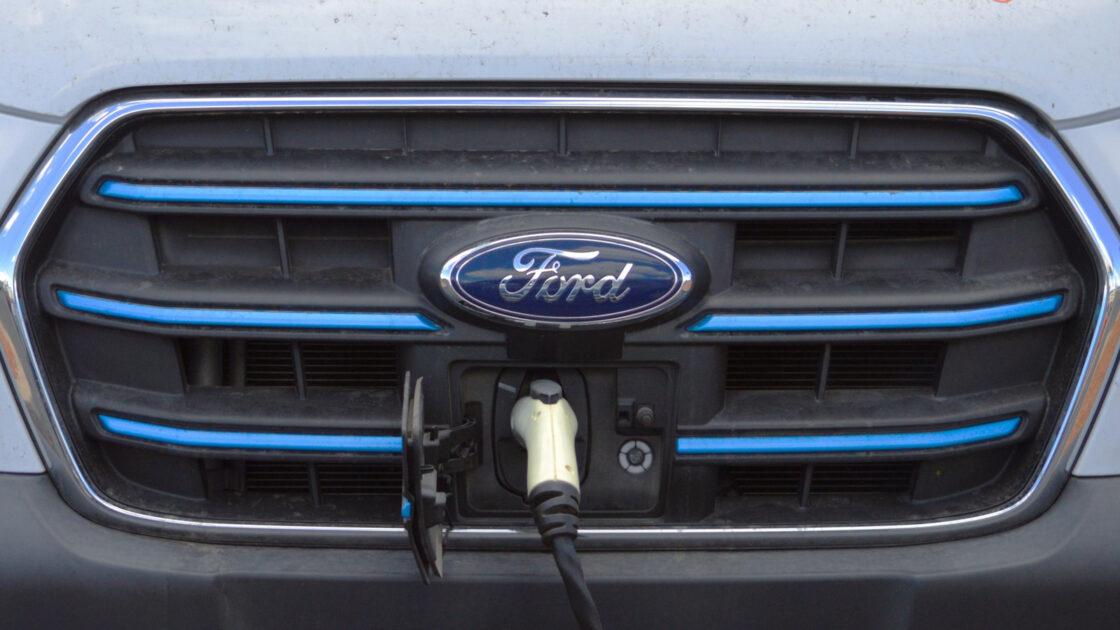
Both Ford and Slate are pursuing the same enticing goal of an electric pickup starting below $30,000. The Blank Slate Truck starts at $24,950 plus a $1,450 destination charge, while the Ford Fathom starts at $28,350 plus a $1,595 destination charge.
Slate makes your phone the infotainment system
Things get more interesting once you look more closely at the technology inside. Ford states that the Fathom will feature a large touchscreen with Apple CarPlay and Android Auto. Slate forgoes a traditional infotainment system entirely, instead giving drivers a place to mount and charge a phone.
Slate has not merely left CarPlay off the options sheet, as its approach is to have a phone or tablet do the work. Phone mounting and charging come standard, and buyers can opt for accessory speakers and a bracket that fits a larger tablet. Navigation, music, and other compatible apps normally accessed through CarPlay or Android Auto remain on the device.
Slate told InsideEVs that vehicle software updates can be downloaded onto a phone and transferred to the truck, avoiding the need for an embedded cellular connection. There is a certain logic to this method because if the infotainment hardware stays in a pocket, it cannot get hopelessly dated as the truck ages. However, compromises exist since a phone screen is smaller than a dedicated dashboard display, and prospective owners online are already discussing aftermarket stereos, Raspberry Pi projects, and other ways to get CarPlay or Android Auto into the vehicle.
Ford takes the familiar route with advanced features
Ford takes the more familiar route, as the Fathom’s built-in display will support CarPlay and Android Auto. The truck will also receive a digital key, bidirectional power, and hardware for Ford’s next-generation BlueCruise hands-free system, which requires activation. Ford has not yet announced the Fathom’s projected range, towing capacity, or payload, and preorders begin in early 2027.
The infotainment gap makes more sense when examining how these companies are building a cheap electric vehicle. Slate is starting from scratch and ruthlessly questioning what needs to be included. Ford has been making vehicles for more than a century, and its answer is to simplify engineering and assembly while keeping more familiar equipment in the cabin.
Ford is investing $2 billion to retool the Louisville Assembly Plant around its Universal EV Production System. The automaker states that the platform uses 20 percent fewer parts than a typical vehicle, 50 percent fewer cooling hoses and connections, and a wiring harness more than 4,000 feet shorter than the one in its first-generation electric SUV, the Mustang Mach-E. Assembly is expected to net out at 15 percent faster than the plant’s previous products.
Smartphone integration is not an afterthought for buyers. Deloitte’s 2025 Global Automotive Consumer Study surveyed over 31,000 consumers in 30 countries and found that 63 percent of US respondents considered smartphone connectivity via CarPlay or Android Auto in their next vehicle somewhat or very important.
Slate’s approach is not necessarily wrong, as a less expensive, two-door electric pickup with fewer electronics may be precisely what some buyers want. CarPlay or Android Auto could be one of those little features that feel much bigger after living without them, while the five-seat Fathom is shaping up as a more conventional daily driver.