Table of Contents
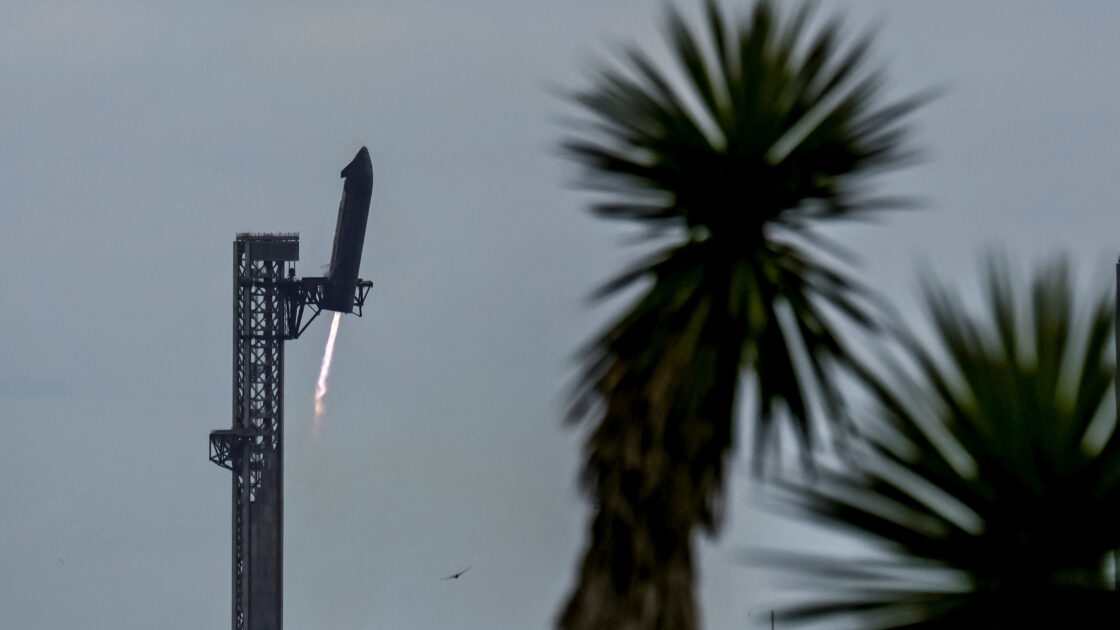
SpaceX successfully caught the upper stage of its Starship rocket using mechanical arms in mid-air on a cloudy Saturday afternoon in Texas. The 124-metre-tall spacecraft returned from space after a 22-hour flight, slipping smoothly between metal “chopstick arms” above Launch Pad 2 at Starbase.
How the Mid-Air Catch Worked
After orbiting Earth 14 times for 22.5 hours, the spacecraft emerged from thick clouds, flipped into a vertical position, and slowly descended toward the launch tower. Like giant tweezers, the mechanical arms grabbed the upper stage while its engines were still roaring. The engines were then shut off as the vehicle hooked onto the tower.
The achievement drew loud cheers from nearby spectators and praise from industry experts. SpaceX mission commentator Dan Huot described the moment as the missing link and the holy grail of spaceflight, noting that everything changes now. SpaceX founder and CEO Elon Musk shared his congratulations to the team, while NASA Administrator Jared Isaacman called the feat almost magic in a post on X, adding that it brings them one step closer to the Moon.
The Challenges of Re-entering Earth
Spacecraft returning to Earth must battle gravity and unpredictable atmospheric factors. Historical accidents, such as the fatal re-entry failures of the Soviet Soyuz 1 spacecraft in April 1967 and NASA’s space shuttle Columbia, highlight the extreme dangers involved. While space agencies and private companies have improved safety over recent decades, most spacecraft cannot be reused after splashing down in the ocean or landing on the ground.
SpaceX previously caught lower rocket boosters on three occasions, but the main upper stage had never been successfully caught in mid-air until now. Following the landing, Musk and his engineers inspected the spaceship and confirmed that components, including the vital heat shield, performed well. Niharika Patel, technical programme manager at Loft Orbital, told Al Jazeera that the autonomous operation required incredible precision to handle extreme re-entry heat and tight manoeuvring windows for a vehicle of such massive size and weight.
Impact on Future Space Travel
SpaceX aims to slash space travel costs through reusable rocket technology and rapid engineering. While its Falcon 9 rocket uses reusable first stages and discards its second stage into the sea, Starship is designed for full reusability of both the booster and the upper stage. Patel explained that a fully reusable vehicle can be rapidly refurbished and flown again, drastically increasing flight frequency and reducing expenses.
Achieving full reusability makes space access more affordable and scalable, comparable to how commercial aviation transformed global travel. Patel noted that this capability is essential for the next era of space exploration, which includes deploying large satellite constellations, building space infrastructure, and enabling sustained human missions to the Moon and Mars.