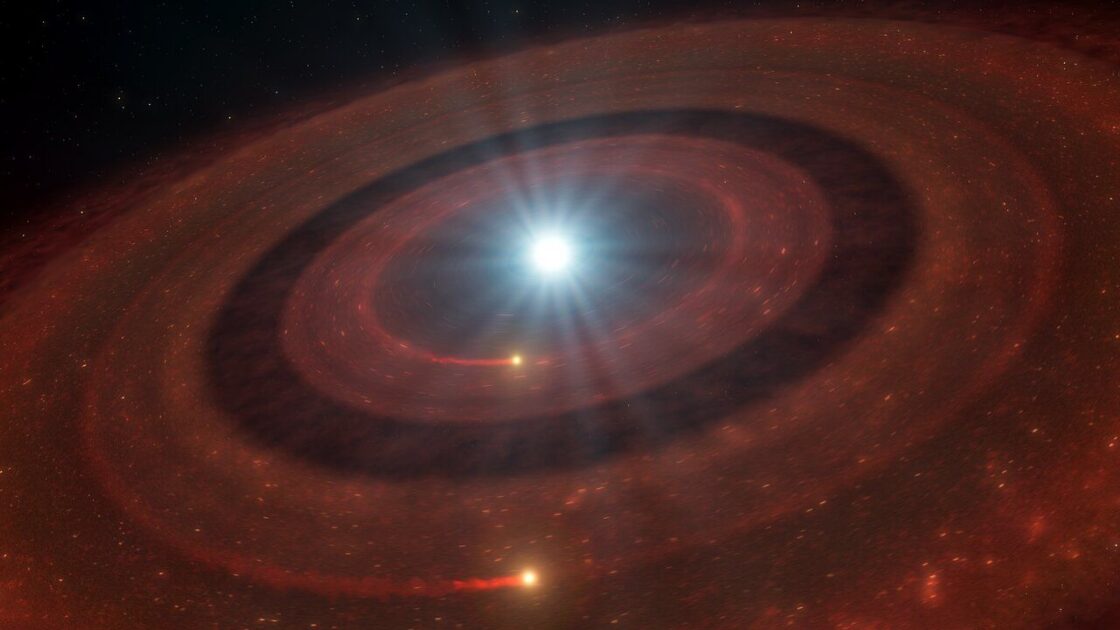
Astronomers studying the white dwarf star J1328−1450, located approximately 1,600 light-years from Earth, have discovered an unusual debris disk surrounding it. While star-mapping catalogs previously identified the white dwarf, new observations using the European Southern Observatory’s Very Large Telescope revealed that the surrounding material forms two distinct rings of gas separated by a gap.
Remnants of a Distant Planetary System
The observatory explained that this surrounding disk of material likely represents the remnants of a planetary system that once orbited J1328−1450. As the star transitioned through a red giant phase before becoming a white dwarf, it may have destroyed certain planets while exposing other rocky bodies to severe conditions. Some of the liberated material eventually accumulated into a disk of dust and gas encircling the dead star.
This exact transformation could eventually occur in our own solar system. In approximately 5 billion years, the sun will deplete its nuclear fuel and swell into a red giant, potentially consuming nearby innermost planets. Afterward, it will shed its outer layers to become a white dwarf, while any surviving rocky bodies could shatter and create a debris disk resembling the one currently observed around J1328−1450.
Hidden Survivors Shaping the Rings
The presence of two separate debris rings around the white dwarf suggests another intriguing possibility. The specific structure appears to be influenced by celestial bodies that astronomers have not yet directly detected. Data analysis indicates that at least two planetary objects may have endured the star’s violent evolution among the system’s remaining debris.
Researchers propose that these two surviving bodies could vary significantly in size. The object positioned closer to the white dwarf would span only a few kilometers in diameter, whereas the outer object could rival the size of Pluto or Earth’s moon. Their gravitational influence on the surrounding material would account for the creation of the dual rings, though scientists have not yet confirmed whether they exist as independent entities. Alternatively, the ring structure might stem from distinct components of a single planetary body, such as its core and crust.