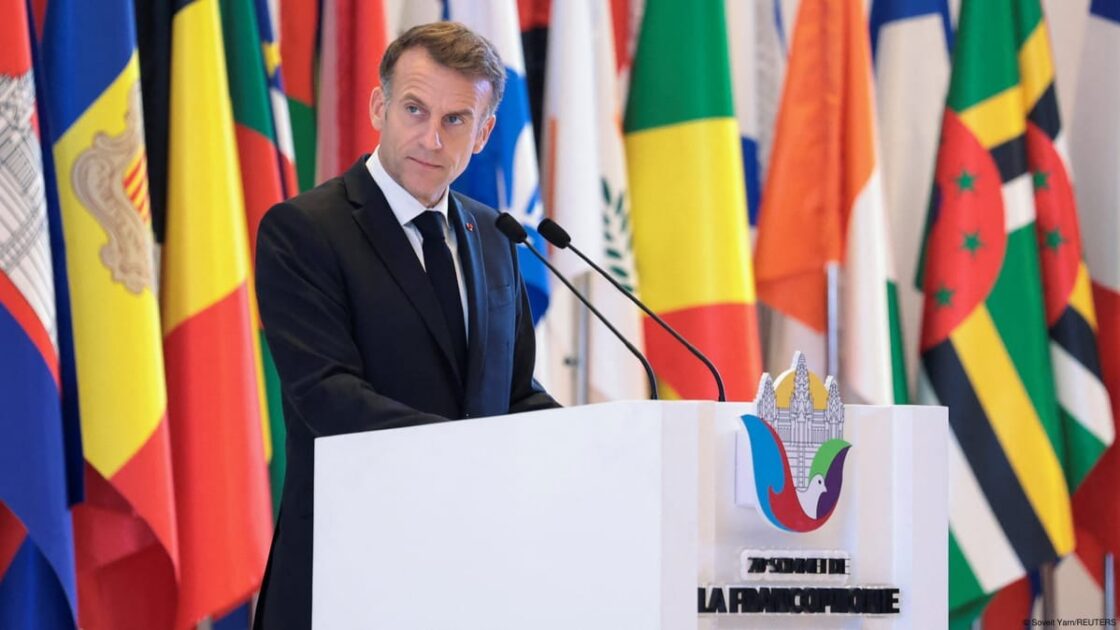
A summit of French-speaking nations commenced on Sunday in Phnom Penh, with French President Emmanuel Macron attempting to prevent a potential walkout by the organization’s largest African member concerning the upcoming leadership election.
Organization Overview and Disagreement
The Organisation internationale de la Francophonie (OIF) encompasses approximately 90 states and governments, including 53 full members, ranging from the Democratic Republic of Congo to Canada. The association comprises nations utilizing French as an official language, former French colonies, and other countries maintaining significant historic connections to France.
The OIF is scheduled to select its next secretary-general on Monday. Louise Mushikiwabo of Rwanda, who has occupied the position since 2018, is pursuing a third term. DR Congo has warned it will depart if she secures re-election, alleging that Rwanda supports the M23 armed group in eastern Congo—a claim that Rwanda rejects.
According to OIF data, DR Congo houses 57.3 million French speakers, representing the second-largest population behind France, making its departure a significant setback. Previously, Mali, Niger, and Burkina Faso exited the association last year following the suspension of their memberships over military coups.
On Saturday, DR Congo announced the withdrawal of its candidate, Juliana Lumumba, the 71-year-old daughter of the nation’s independence hero, Patrice Lumumba. Kinshasa stated it would instead support former Romanian prime minister Dacian Ciolos to foster a consensus around a unifying candidate.
Agence France-Presse characterized the proposal as conditional upon Rwanda simultaneously removing its candidate. Nevertheless, the Rwandan foreign minister affirmed that Mushikiwabo would remain in the contest.
Macron’s Intervention and Domestic Context
Macron cautioned against internal divisions within the organization, emphasizing the need to safeguard unity as its primary strength. Rwanda stated that Macron had requested President Paul Kagame to withdraw his candidate, a request that was declined, while Macron’s office noted that Paris proposed the withdrawal of both candidates.
An anonymous member of a non-African delegation told AFP that such intervention resembles a regression to historical patterns where France dictates outcomes. France serves as the principal donor, while Canada contributes 25 percent of the budget.
Macron’s arrival coincides with civil unrest in France, where over 600,000 individuals demonstrated earlier this month regarding wages and in backing student protests, resulting in thousands of arrests.
Meanwhile, UN Special Rapporteur Tom Andrews called upon delegates to urge Cambodia, characterized as a de facto one-party state, to release imprisoned activists. Andrews stated that no individual ought to be detained for advocating human rights, covering matters of public interest, or expressing critical viewpoints.