Table of Contents
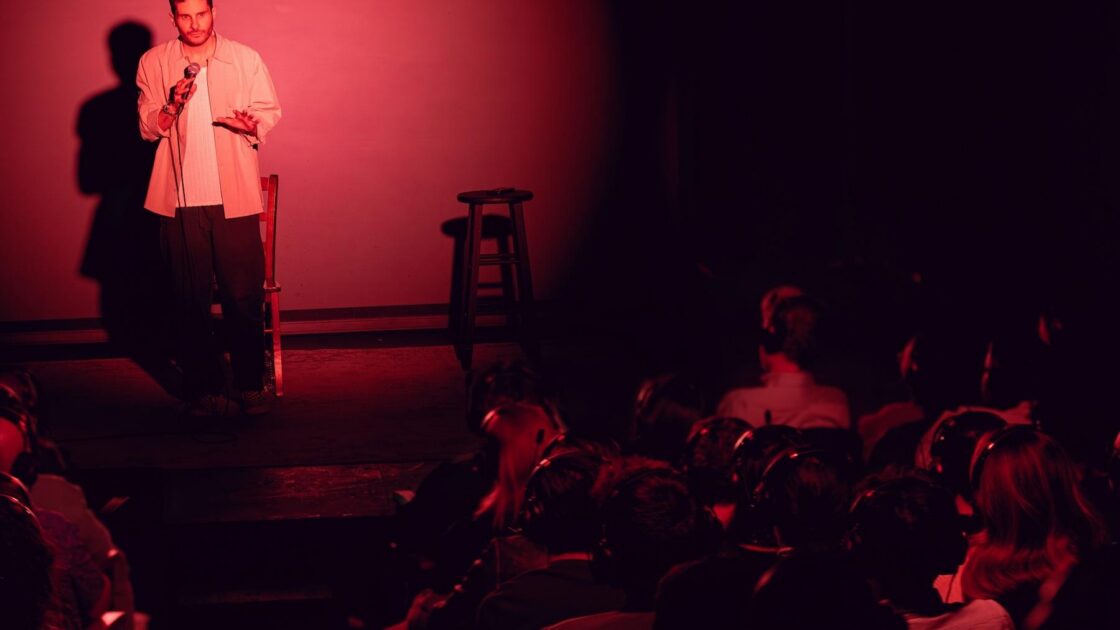
Audiences attending the off-Broadway production Love Me at the SoHo Playhouse in New York City are handed wired headphones connected to Auracast receivers upon arrival. Written and performed by comedian and former Saturday Night Live writer Drew Michael, and directed by Prashanth Venkataramanujam, the one-man show explores relationships, self-discovery, and hearing loss.
Innovative Sound Design With Auracast
The experimental sound design of Love Me relies on Auracast, a Bluetooth-based technology capable of broadcasting high-quality audio streams to numerous nearby devices simultaneously. Sound designer Daniel Kluger blends the headphones with traditional theater speakers to craft effects impossible in standard theatrical setups. Between sections, the music incorporates tinnitus ringing and hearing test tones as subtle foreshadowing of Michael’s realization regarding his hearing loss.
Kluger alters sonic clarity throughout the performance to mirror Michael’s perspective. While theater speakers occasionally output intentionally muffled audio that is further dulled by the headphones, Michael’s inner monologue remains pristine. The inner monologue features a mix of prerecorded tracks and a live feed from Michael’s stage microphone. Michael explained after the performance that the inner world represents the highest fidelity and most comfortable space for the character.
This layered audio approach creates intentionally overwhelming scenes, such as a comedy club sequence where the audience hears competing sounds. Theater speakers project crowd reactions alongside a fluctuating heckler, the headphones play prerecorded inner thoughts, and the stage microphone is muffled to keep focus on the internal monologue. This structure forces the audience to experience the intense concentration required to parse unclear sounds.
Emotional Climax and Deaf Identity
The narrative builds toward a climactic scene featuring a visual presentation of Michael’s historical audiograms. Michael described experiencing a massive breakthrough regarding the invisible cognitive labor that impacted his daily life. At this point, the audience removes the headphones worn for nearly the entire show, lifting the literal weight from their heads to match Michael’s newfound clarity of mind.
The final act explores Michael’s developing understanding of his Deaf identity. Michael noted that deafness is not the culprit, but rather the denial of it, adding that despite his hearing having never been worse, he feels more self-affirmed and happier than ever. He criticized the misconception of deafness as a tragedy, deficit, or burden.
Accessibility and Cultural Integration
While the production utilizes Auracast for storytelling, it also serves practical accessibility functions. Presented in partnership with Deaf West Theatre, the production offers dedicated audio feeds for hearing aid and cochlear implant users, alongside captioned iPads. Michael himself performs while connected to his own broadcast channel using Auracast-enabled Phonak Eon Sphere hearing aids, which double as amplification devices and in-ear monitors to maintain contact with the crowd.
Michael emphasized that the technology supports a narrative about connection rather than functioning solely as a story about hearing gadgets. He noted a historical divide between audiological technology and the cultural identity of deafness, pointing out that technological improvements have sometimes displaced Deaf history and culture when children are mainstreamed into regular schools. Michael stated that technology and Deaf identity should form a marriage rather than a divide, a collaboration that allows Auracast to function simultaneously as an accessibility tool and an artistic vehicle for self-acceptance.