Table of Contents
New regulations announced in March will require all new homes in England to be equipped with heat pumps and solar panels. While these changes are expected to increase the price of new properties by approximately £10,000, officials anticipate that homeowners will benefit from reduced energy bills over time.
How Heat Pumps Function
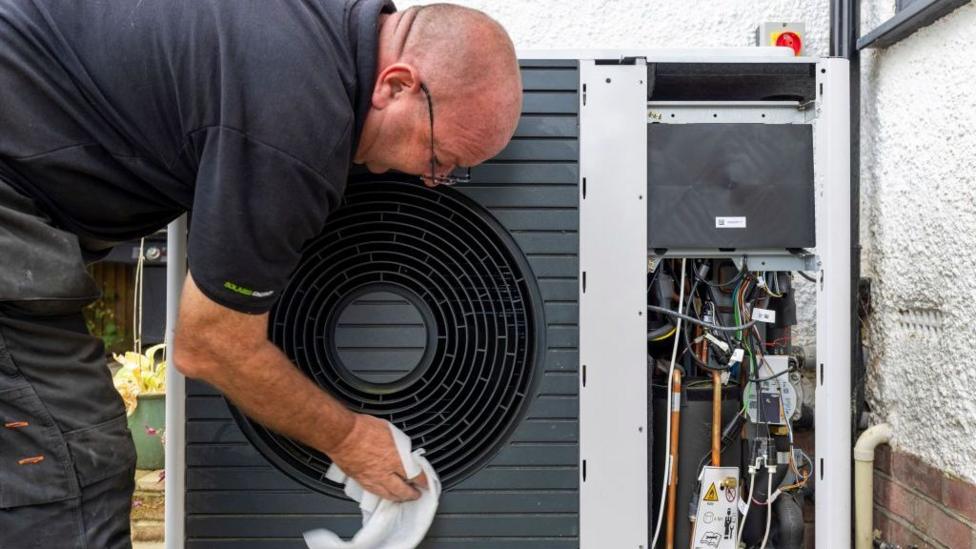
Heat pumps operate on electricity rather than gas, offering higher efficiency than traditional boilers. These systems warm buildings by capturing and amplifying heat from the air, ground, or water. Air source heat pumps, the most prevalent variety, draw in outdoor air and pass it over tubes filled with refrigerant fluids. The resulting heat causes the refrigerant to evaporate into a gas, which is then compressed to increase its temperature and circulated throughout the home.
A typical installation includes an outdoor unit measuring roughly 1m x 1m x 0.4m, alongside an indoor heat pump unit and a hot water cylinder. While ground source heat pumps are more efficient, they are less common due to higher costs and the requirement for deep boreholes or extensive horizontal ground systems.
Costs and Financial Support
The UK government offers the Boiler Upgrade Scheme, which provides a £7,500 grant toward the installation of heat pumps in England and Wales. Despite this, households often pay an additional £5,000, a figure the UK’s spending watchdog has described as prohibitively high for many. To qualify, properties must have an Energy Performance Certificate (EPC) issued within the last decade, though requirements for loft or cavity wall insulation have been removed to lower upfront costs by about £2,500.
Additional support is available through the £5bn Warm Homes Local Grant and Social Housing Fund for low-income households. Furthermore, the Warm Homes Loan Scheme offers low or no-interest loans ranging from £7,500 to £35,000. Scotland and Northern Ireland maintain their own separate efficiency programs.
Funding and Policy Shifts
Although the government has committed to maintaining the Boiler Upgrade Scheme at £400m for 2027-28, this represents a reduction from previously announced levels. Some funds originally intended for green technology investments are being redirected to the £4.7bn “Your First Home” scheme. Additionally, while heat pump installations currently benefit from 0% VAT, this rate is scheduled to increase to 5% in April 2027.
Energy Savings and Efficiency
According to the Climate Change Committee (CCC), heat pumps could eventually become more cost-effective to run than gas boilers, depending on energy prices and system efficiency. Although electricity is currently more expensive than gas, the government expects prices to stabilize as renewable energy capacity expands. The innovation charity Nesta estimates that the average household using both a heat pump and solar panels could reduce annual energy bills by nearly £1,000.
Installation and Noise Regulations
Recent policy changes have simplified the installation process. Planning permission is no longer required for heat pumps located within 1m of a neighbor’s property, and noise standards have been updated to ensure devices operate at or below 42db—a level comparable to a refrigerator. Rules regarding the size and quantity of units allowed per property have also been relaxed.
Industry Progress and Targets
Currently, heat pumps are installed in fewer than 2% of UK homes, with gas boilers remaining the dominant choice. While sales have grown, with twice as many units installed in the first half of 2026 compared to the same period in 2021, recent data shows a 22% decline compared to the first half of 2025. The CCC emphasizes that to meet net zero targets, annual sales must reach 450,000 by 2030 and 1.5 million by 2035, with a goal for half of all UK homes to utilize heat pumps by 2040.