Table of Contents
Following Russia’s 2022 invasion, Ukrainian tech entrepreneurs like Yaroslav Azhnyuk shifted their focus toward developing drone warfare technology. Azhnyuk explained to NPR that artificial intelligence is making drones faster and significantly more capable on the battlefield.
The Shift from Pet Cameras to Defense Technology
Azhnyuk, a 37-year-old computer scientist, previously worked in Silicon Valley and founded companies including Petcube, which produces smartphone-connected cameras that use artificial intelligence to watch and entertain pets. After the full-scale war began, he left Petcube to protect his country, stating that his companies now build cameras that fling explosives instead of treats at occupying forces.
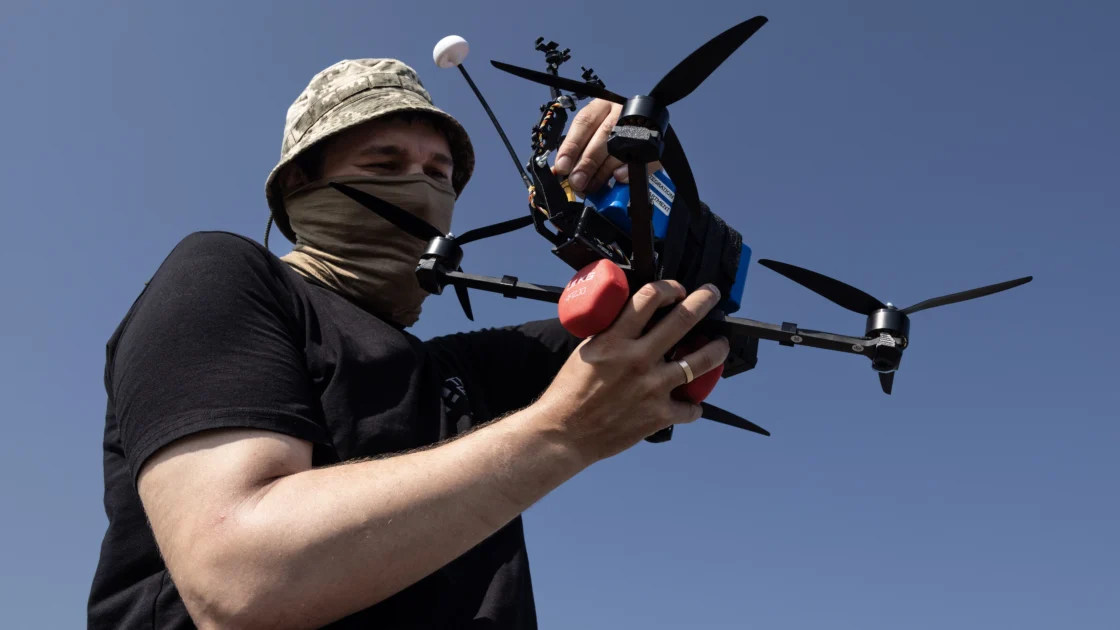
His defense firms, The Fourth Law and Odd Systems, produce top autonomous drones in Ukraine, including the Lupynis-10-TFL-1. Dozens of Ukrainian military units already deploy this autonomous drone system, which combines an affordable first-person-view drone with an autonomous terminal guidance unit. The onboard computer and AI take control during the final 500 meters of flight, utilizing simple tools for image recognition and smart software to navigate or target autonomously.
The Fourth Law names its weapons after Ukrainian intellectuals and artists who were killed or persecuted by Russians over the last century, with the Lupynis TFL-1 named after 20th-century poet and political activist Anatoliy Lupynis. Azhnyuk noted that this honors these figures, ensuring their ideas continue fighting back.
Testing Autonomous Drones in the Field
During a test at an overgrown field outside Kyiv, a test and integration team member using the call sign Stab demonstrated the internal microcomputer running on a deep-learning neural network. The network analyzes combat footage to recognize targets such as light-armored vehicles, tanks, and flying objects. A pilot using the call sign Professor navigated the drone via a control stick, locked onto a target vehicle on a video monitor, and released the controls while the drone flew itself toward the car.
Stab explained that AI drones offer distinct advantages because they remain difficult to jam, while noting that human operators still select targets to prevent the systems from going rogue.
Balancing Survival and Ethical Concerns
Russia is similarly deploying AI-enabled drones, creating a high-tech arms race that has sparked concern from figures including Ukrainian President Volodymyr Zelenskyy, who warned that AI might dictate battlefield decisions as soon as next year. Azhnyuk acknowledged these concerns regarding destructive weapons but compared the technology to fire or steel, arguing that human decision-making ultimately dictates how any tool is used.
While dismissing the likelihood of a Terminator-style scenario and describing the current tech as basic calculators, Azhnyuk conceded that future drones might eventually designate targets independently. However, he emphasized that Ukraine’s immediate survival takes precedence, noting that adversarial systems operate in microseconds while human control takes much longer. If Ukraine loses, he added, discussing the ethics of AI becomes impossible.
Polina Lytvynova contributed reporting from Kyiv for NPR.