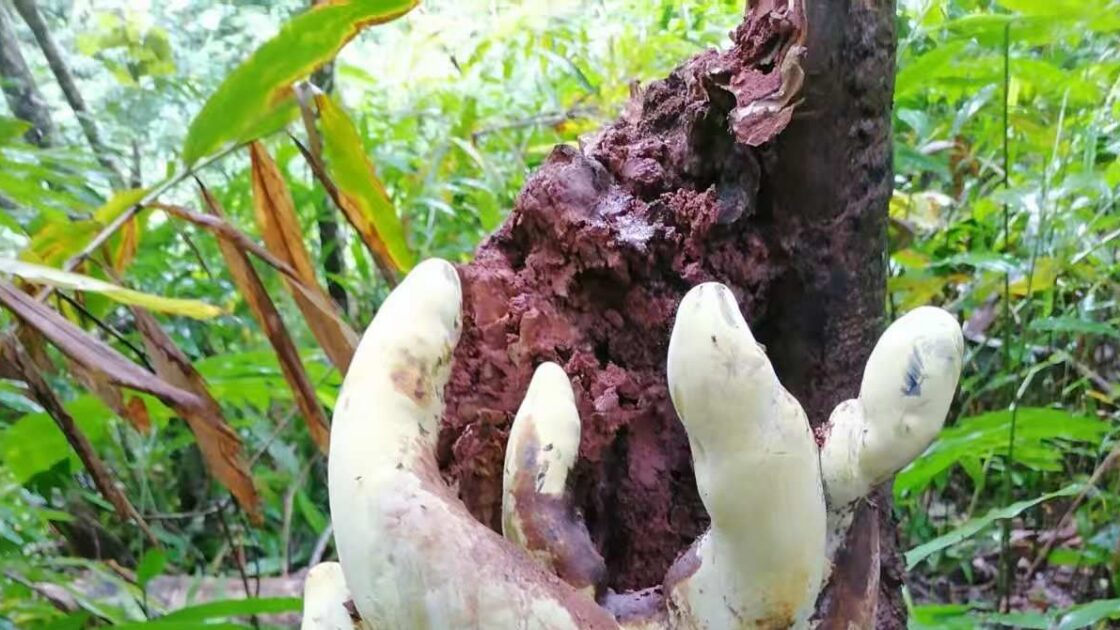
Researchers in China have discovered a massive new species of fungus named Dianmushania rexi (D. rex), which can grow up to 20 inches tall and weigh nearly 5 pounds. Found in the Yunnan province, the fungus belongs to the Ascomycete phylum and produces some of the largest mushroom masses ever recorded.
Discovery in the Yunnan Rainforest
The name of the new species combines the ancient Dian Kingdom of the region with the Chinese pronunciation of the word fungus. Within Ascomycetes, the giant organism forms an entirely new biological family with no known close relatives. Yunnan is already known for high biodiversity with 6,000 documented fungal species, but mycologists estimate the province could harbor up to 100,000 species.
Indunil C. Senanayake, an associate professor at the Kunming Institute of Botany and the lead author of the research paper, noted in a press release that the find highlights how much fungal biodiversity remains hidden in East Asian forests.
Senanayake and his research team encountered the large, whitish fruiting bodies growing in soil near dying tree roots during surveys in the Nanban tropical rainforest. The collected specimens displayed various shapes, including cylinders, spindles, and cupped palms, developing finger-like branches as they matured. Above-ground parts feature white, powdery fibers turning dark yellow over time, while underground portions are black and smooth.
Laboratory analysis showed the fruiting bodies dried quickly, revealing dense, sponge-like interiors that appeared white or yellow without any strong odor or taste.
Evolutionary Timeline and Survival Strategy
By analyzing the DNA of the fungi, the researchers built a molecular clock indicating that D. rex diverged from other species around 65 million years ago. This timeline coincides with the end of the Cretaceous period right after the mass extinction event that wiped out the dinosaurs. The massive die-off created abundant dead plant material, likely providing new ecological opportunities for decomposing organisms.
Genomic analysis surprised the scientists by revealing that D. rex possesses only about half the decomposition-related genes found in close relatives that feed on plant matter.
To explain this, Senanayake theorizes that the fungus might lead a double life, residing inside healthy trees before feeding on dead plant material after the host dies, which could supply the massive energy needed to build such large fruiting bodies. Senanayake hypothesizes that growing tall allows the fruiting bodies to tower above surrounding plants and fallen leaves, improving wind-mediated spore dispersal in dense forests. Constructing such large structures demands substantial energy, meaning the strategy likely evolved only where ecological benefits outweighed the costs.