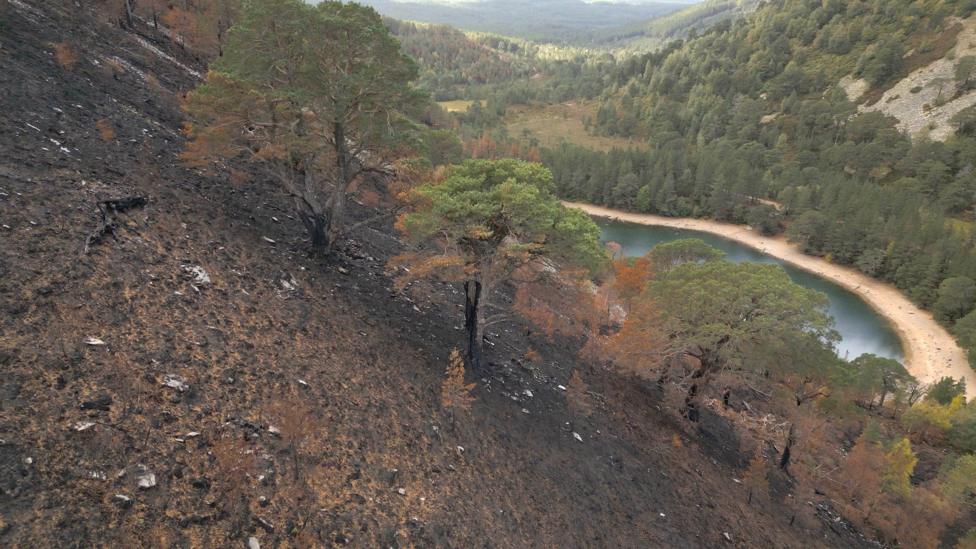
Experts fear that mature Scots Pine trees could be permanently lost from a Highland landscape following a massive summer wildfire. Forestry and Land Scotland stated that the blaze near Glenmore in the Cairngorms may have destroyed numerous centuries-old “granny pines.”
Wildfire Damage and Recovery Signs
The fire destroyed roughly 10 square miles of forest and moorland close to Aviemore across July and August. Forestry and Land Scotland staff monitoring the location observed birch, rowan, and willow sprouting back from surviving roots and stems, while hillside sections turned green again as grasses, bracken, and blaeberry recovered. The agency noted that this resurgence was especially visible where the soil retained moisture or where the fire burned with lower intensity. Additionally, deer and capercaillie are frequently returning to the fire-affected zones, drawn by the fresh grass growth.
Challenges for Ancient Pine Trees
Eelco de Jong, an FLS forestry management and stewardship forester, described the broadleaf recovery as promising with rapid regrowth anticipated for birch, rowan, and willow. Nevertheless, he cautioned of major difficulties ahead stemming from severe damage to organic soil layers and the region’s famous Scots pine. He stated, “The concern is many of the oldest ‘granny pines’ could be lost, removing important seed sources and habitat for species such as capercaillie.”
He added, “Some of these veteran trees were more than 100 or 200 years old and, where losses occur, it could take centuries for trees of a similar stature to return to the landscape.”