Table of Contents
Prime Minister Mark Carney is looking toward Asian and European carmakers, including China, as potential solutions for Canada’s embattled automotive manufacturing sector as Ottawa grapples with stringent US tariffs.
Exploring New Partnerships at Apec
While visiting Cambodia earlier this week, Carney told reporters that Canada could turn to European and Asian manufacturers to save its auto industry if a trade agreement with the United States cannot be reached. He stated that if Canadian auto workers are not fully utilized within a North American context, alternative opportunities exist and Canada will move forward either way.
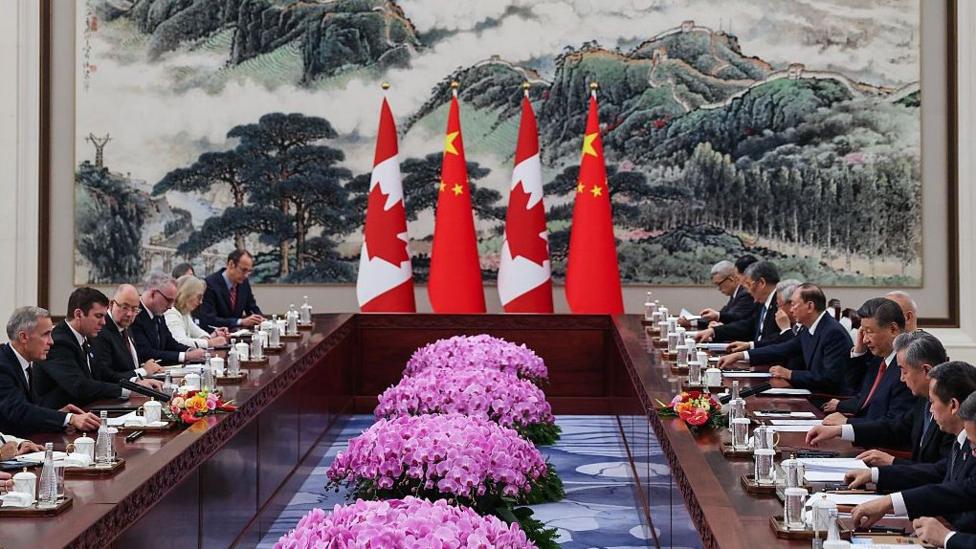
Carney subsequently met with Chinese President Xi Jinping in China on Tuesday for their second head-to-head discussion in less than a year. The leaders talked about developing bilateral relations, and Carney announced they had agreed to further tariff cuts. While neither side explicitly mentioned vehicles, analysts suggest the topic was prominent during the talks.
Earlier in January, Carney noted that opening the door to Chinese electric vehicles (EVs) could generate investment in Canadian-owned companies and create manufacturing jobs. American tariffs on Canadian-made vehicles have caused thousands of job losses and widespread anxiety, given that 90% of cars produced in Canada are typically shipped to the US market.
Friction with Washington and Domestic Opposition
China has viewed Canada as a potential gateway to the North American EV market. Canada previously announced plans to allow 49,000 electric vehicles from China at a low tariff rate, with quotas gradually increasing to 70,000 by 2030—marking a distinct departure from heavy US tariffs designed to protect domestic manufacturing.
Peter Navarro, trade and manufacturing senior counsel to Donald Trump, criticized the approach in a post on X, asking if Carney was threatening to play China off the US and warning that China would consume Canada alive. The comments were reposted by Pete Hoekstra, the US ambassador to Canada.
Chinese EV manufacturers such as BYD and Chery have actively lobbied the Canadian government for market access. Following a tour of a Chery plant in China last week by Canada’s Minister of International Trade Maninder Sidhu, officials indicated that affordable Chinese EVs could arrive in Canada by early 2027.
The toll of US tariffs has already impacted major operations, such as Stellantis announcing the sale of its assembly plant in Brampton, Ontario. The facility had been idle since 2023 for retooling, but the shutdown became permanent due to Trump’s tariffs. Reports from CTV News citing anonymous sources suggested Stellantis might lease back a portion of the plant to assemble affordable EVs, sparking speculation of a Chinese manufacturer moving in.
This possibility faced strong opposition from Ontario Premier Doug Ford, who wrote a letter to Carney warning against allowing Chinese EV kits to be assembled at the Brampton facility.
Navigating Guardrails and Future Trade Talks
Lynette Ong, director of the China Governance Lab at the University of Toronto, explained that introducing Chinese auto manufacturing to Canada remains controversial due to concerns over potential job losses and the erosion of the North American industry. Ong emphasized the need to ensure Chinese firms hire and train Canadian workers and facilitate technology transfer.
Carney noted that strict guardrails govern Canada’s engagement with China, including prohibitions on sensitive areas like artificial intelligence and critical minerals. Alongside these discussions, Canada is pursuing associate member status with the European Union and recently signed a free trade agreement with the Philippines.
The depth of Canada’s pivot toward Chinese manufacturing ultimately depends on the results of ongoing trade negotiations with the United States. Carney reported that progress has been made, though significant differences remain as leaders gather for the Apec summit.