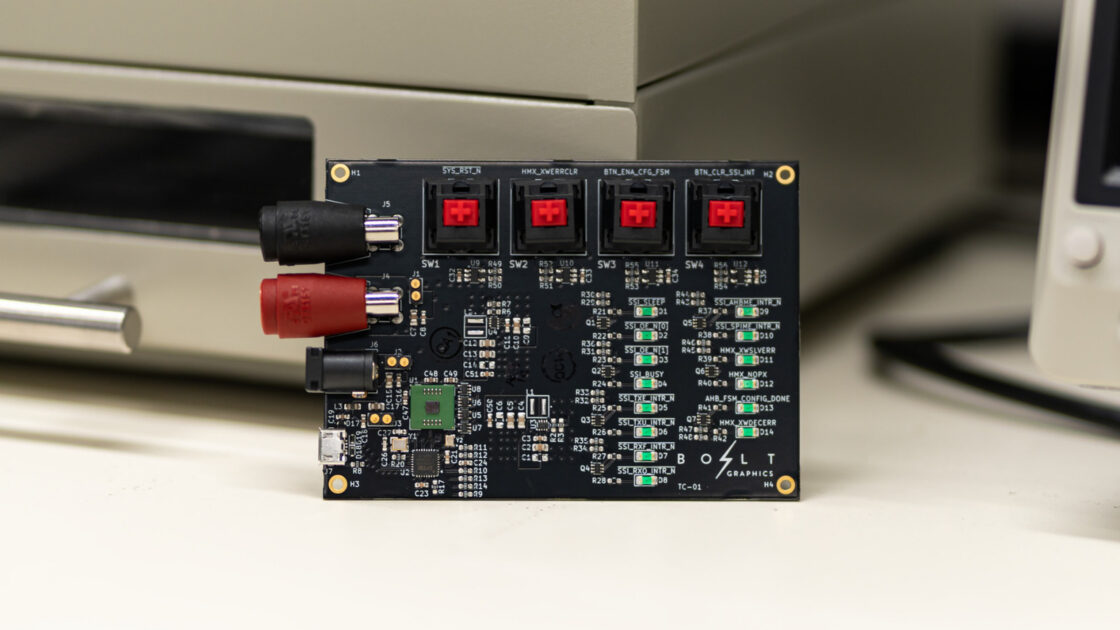
Bolt Graphics has powered on the first silicon for its Zeus GPU project, although the final graphics card is not anticipated to reach volume production until 2028. The California-based startup announced in mid-October that its 12nm test chip, manufactured by TSMC, operated without issues upon activation.
Test Chip Details and Performance
The company also opened a new office in Taipei to remain close to manufacturing partners ahead of production. Shortly after, Reuters reported that Bolt was seeking to raise approximately $100 million at a valuation of about $700 million, according to three individuals familiar with the situation.
The small test chip measures 6mm^2 and consumes 1.4 watts of power, a significant drop from the 35 watts used by the FPGA prototyping chip Bolt previously relied on. Its primary capability is dedicated hardware designed for electromagnetic simulation, aiding in the development of tools ranging from radar sensors to camera lenses.
Bolt CEO and founder Darwesh Singh stated to HPCwire that the chip demonstrates the company’s ability to run a highly complex physics algorithm accelerated in hardware, which has not been done before. The firm did not release performance metrics for the test chip, noting only that it exceeded internal expectations. The intended Zeus GPU is a distinct processor that will utilize TSMC’s N5P process node, a 2020-era technology chosen to prevent competition with other manufacturers for scarce wafer supplies.
Architecture and Market Plans
The Zeus GPU architecture centers on RISC-V processor cores combined with Bolt’s proprietary path-tracing hardware. Its PCIe cards will feature soldered LPDDR5X memory alongside traditional DDR5 SO-DIMM slots typically found in laptops, allowing users to expand total memory up to 384GB. When the company first announced Zeus in March 2025, it reported ambitious performance claims, including 10 times the rendering performance of existing GPUs, 300 times faster electromagnetic simulation, and up to 10 times the path tracing throughput of Nvidia’s RTX 5090.
These performance figures have not undergone independent testing. Bolt is initially targeting studios, engineers, and scientists with Zeus before eventually branching into gaming and AI markets. Entering the consumer GPU space would pit Bolt against established competitors like Nvidia and AMD, presenting challenges regarding the extensive software support required for modern video games, as noted by Reuters.
Earlier in April, Bolt reported that over 14,000 businesses, developers, and individual users registered for its early access program, alongside a product pipeline valued above $500 million, though no specific customers were named. The company also stated that Zeus would reduce compute costs by up to 17 times compared to existing hardware.