Table of Contents
Inside the Republican Party, initial shock at stunning election results quickly gave way to anger toward US President Donald Trump after Democrats won upset victories in deep-red states like Texas, Kansas, and South Carolina.
Party Fallout and Voter Backlash
After Democrats secured victories in states considered safe for Republicans, some party members focused their ire on Trump, arguing that his focus on his legacy and indifference to voter concerns cost the party control of Congress. Bill Miller, a top Republican lobbyist in Texas, told BBC News that the outcome was a total, complete rejection of the president and a disaster of the first magnitude.
Most Republicans expected to lose the House and faced a tough challenge in the Senate during an election cycle that typically favored the party out of power. However, some strategists said in interviews that Trump dragged them down with unpopular policies, a low job approval rating, and an obsession over Washington construction projects. Gregg Peppin, a Republican strategist in Minnesota, stated that voters clearly disliked the president’s policies.
A White House ally told BBC News that public disapproval over the Iran war, tariffs, and an immigration crackdown created a November perfect storm, noting that frustration within the party directed at Trump was extremely high.
Trump’s Response and Campaign Strategy
Trump was silent for much of election night before posting a message on Truth Social after both chambers were called for Democrats, writing that he was not on the ballot and would have won in a landslide if he had been. In later interviews with the New York Times and Fox News, Trump said he accepted the results and was a little bit surprised, while noting that a president’s party typically fares poorly in midterms.
Ahead of the election, Trump and Vice-President JD Vance held dozens of rallies, while the Trump-aligned Super PAC MAGA Inc. spent hundreds of millions backing candidates. Trump allies argued it was unfair to hold him responsible, pointing to historical midterm trends and weak local candidates. Another Texas Republican operative told BBC News that Ken Paxton, the Republican Senate nominee in Texas, ran the worst Senate campaign in the country, while praising victorious Democrat James Talarico for running a smart campaign.
Other defenders praised Trump’s campaign schedule. Krish Mathrani, the Michigan Republican Party’s youth chair, told BBC News that Trump helped drive up voter enthusiasm and described him as a turnout machine. Nevertheless, Trump’s turnout operation failed to deliver in an election where he was not on the ballot.
Distractions and Controversies
Voters rejected Trump’s arguments regarding the economy and the war with Iran, while attempts to portray Democrats as extreme socialists fell flat. Over the summer, Trump often seemed disinterested in the midterms, remaining consumed by foreign conflict and domestic construction overhaul projects including a White House ballroom, a helipad, golf course renovations, and the Kennedy Center. Sources told BBC News that events like a UFC match at the White House on Trump’s 80th birthday created the impression he was more interested in celebrating himself than winning the election.
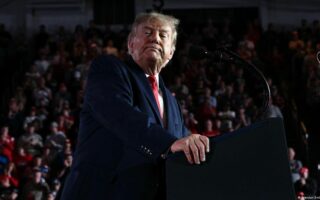
Trump turned his full attention to the race in September at a midterm convention in Dallas, an event that failed to attract a large television audience. During a rambling keynote speech, Trump pledged a $5,000 payment to Americans if Republicans kept Congress and raised eyebrows by criticizing Paxton’s charisma and physical appearance. Robin Armstrong, Texas’ Republican National Committeeman, told BBC News that the critique was never helpful, noting that the party simply had to live with what the president says.
In the final weeks before Election Day, Trump made headlines for praising Ohio Senator John Husted’s physique and calling Abdul El-Sayed a jihadist in the Michigan Senate race. Concurrently, the White House contended with controversies, including the ousting of press secretary Katie Zacharia after five days, the resignation of US Ambassador to Greece Kimberly Guilfoyle over credit card debt inquiries, and a backlash in October over a deal to buy Russian diesel.
As Republicans take stock of their defeat and look ahead to the 2028 election, Peppin stated that the midterm results demonstrated the party needed a new direction and expressed hope that the party had turned the page from the Trump era.