Table of Contents
Acer has entered the high-performance handheld PC market with the Predator Atlas 8, a device designed to challenge premium competitors by offering top-tier graphics power at a more accessible price point. By utilizing the same Intel Arc G3 Extreme processor found in more expensive machines, the Atlas 8 provides a compelling alternative for gamers looking to save money without sacrificing significant framerate performance.
Design and Display
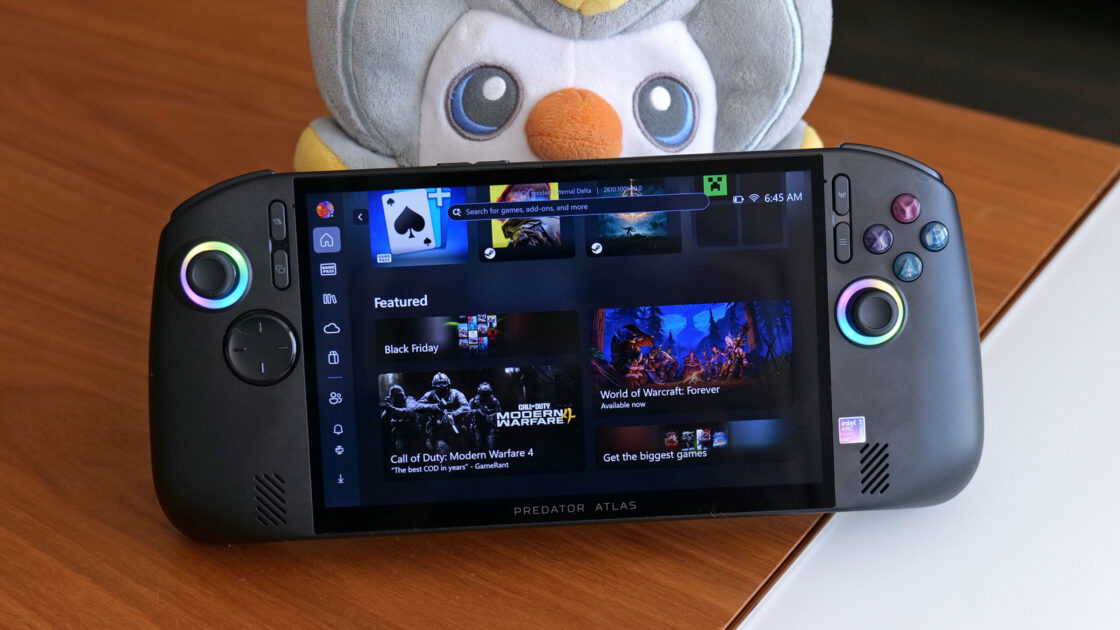
The Predator Atlas 8 follows a familiar design language for portable PCs, featuring an 8-inch LCD TFT display with a 120Hz refresh rate and 500 nits of brightness. While the screen is highly functional, the colors are slightly less vibrant than those on the MSI Claw 8 EX AI+, a difference that is only noticeable when the two devices are placed side-by-side. The controls include TMR analog sticks and an Xbox-style layout, though the circular D-Pad feels somewhat mushy and lacks precision, making it better suited for menu navigation than fighting games.
The device is equipped with rear paddles, shoulder buttons, and analog Hall-effect triggers that offer substantial travel, which is particularly beneficial for racing titles. Connectivity options located on the top edge include dual USB-C ports with Thunderbolt 4 support, a 3.5mm audio jack, and a microSD card slot for storage expansion. A fingerprint reader is integrated into the power button for security. Notably, the system lacks a USB-A port. While the dual two-watt speakers can reach high volumes, audio quality tends to distort above 50 percent, resulting in a crunchy or crackly sound.
Performance and Software
The core of the Atlas 8 is the Intel Arc G3 Extreme processor. To achieve its $1,450 price point—$350 cheaper than the MSI Claw 8 EX AI+—Acer reduced the shared memory to 24GB and the storage to 512GB. Despite these hardware differences, the performance gap remains narrow. In testing with Cyberpunk 2077 at 35 watts on FHD medium settings, the Atlas 8 reached 88 fps, roughly five percent lower than the 95 fps achieved by the MSI model. When set to a 15-watt power profile, the two devices performed almost identically in Returnal, both hitting approximately 60 fps.
The handheld runs on Windows and includes Microsoft’s Xbox experience, providing a dedicated interface for gaming that simplifies access to storefronts like Steam, Epic, and Battle.net. Because the underlying operating system is Windows, it offers broader compatibility than SteamOS-based portables. Users can also switch to the traditional desktop interface to perform productivity tasks if they connect a keyboard, mouse, and portable monitor.
Battery Life
Equipped with an 80WHr battery, the Atlas 8 offers flexible longevity depending on the intensity of the game being played. During testing, the device lasted one hour and 45 minutes while running World of Warcraft: Forever at FHD medium settings with frame rates consistently above 90. For less demanding titles like Warhammer Survivors, the battery lasted over three hours. Both tests were conducted using the 30-watt Balanced performance mode, leaving users with significant room to adjust settings for longer gaming sessions.
While the Predator Atlas 8 requires some trade-offs—such as less RAM, lower storage capacity, and minor hardware omissions like the USB-A port—it remains a strong contender for mobile gaming enthusiasts. By delivering nearly identical performance to more expensive handhelds, Acer has positioned the device as a practical choice for those seeking high-end gaming power without exceeding their budget.