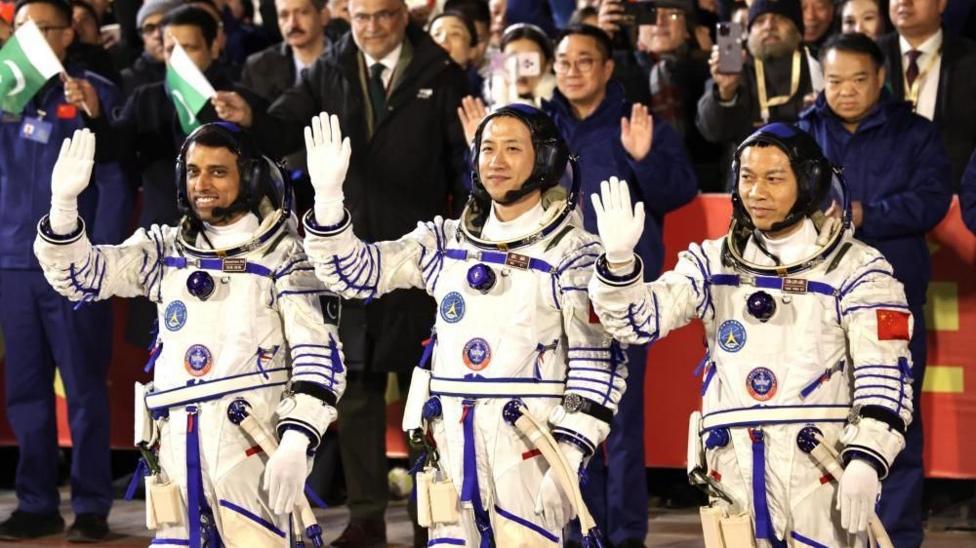
China successfully launched its Shenzhou-24 space mission on Wednesday, sending a three-person crew to the Tiangong space station that includes Pakistan’s Muhammad Zeeshan Ali, the first foreigner to join a Chinese crewed space flight. Beijing expressed hope that the mission would strengthen bilateral relations with Islamabad as both nations celebrate 75 years of space cooperation.
Mission Details and Crew Objectives
The spacecraft lifted off at 08:18 local time (00:18 GMT) from the Jiuquan Satellite Launch Center in the Gobi desert, and officials declared the launch a complete success shortly afterward. The crew includes mission commander Tang Hongbo, flight engineer Wu Yi, and payload specialist Ali. Addressing reporters at the launch center before departure, Ali stated that he carried the name of Pakistan on his shoulder alongside the hopes of 250 million Pakistanis.
During their time aboard the Tiangong station, the crew will conduct scientific experiments and test new technologies across several fields, including aerospace medicine and combustion, while observing how space conditions impact living organisms. Researchers aim to examine the effects of the space environment on aging to help discover new methods for preventing and treating age-related vascular diseases. Ali’s specific research tasks will involve studying bacterial photosynthesis as well as examining how microgravity and space radiation affect seeds.
International Diplomacy and Future Goals
Ali, a former fighter pilot, will return to Earth after completing a short stay in orbit alongside two members of the previous Shenzhou-23 crew who arrived at the station in May. Meanwhile, Tang and Wu will remain at Tiangong for a six-month tour of duty alongside Zhu Yangzhu, who has spent his time studying how human physiology adapts to extended periods in orbit.
The mission serves as a significant diplomatic milestone for Beijing as it invests billions of dollars into its space program. By opening its rotating, three-person Tiangong facility to international participants, China aims to demonstrate that the station can function as a global research platform rather than an exclusive national facility. This outreach coincides with Beijing’s broader ambition to establish its space program as a primary alternative to US-led efforts, with a stated objective of landing Chinese astronauts on the moon by 2030.
For Pakistan, participation in the flight represents a major milestone since the country lacks its own spacecraft to launch astronauts independently. Ali and fellow finalist candidate Khurram Dawood completed rigorous training regimens in China under the supervision of local experts, with Ali noting that learning the Chinese language presented one of his greatest obstacles, according to Pakistani media reports.